A Black Agenda Radio commentary by Glen Ford
"Prof. Van Sertima almost single-handedly introduced and defended the proposition that Africans made significant contact with the people of the Americas, not just before Columbus, but before the birth of Christ." By bringing multi-disciplinary evidence to back up his claims, Van Sertima "debunked" European contentions "that only white people were capable of moving around the world in a methodical manner." Van Sertima labored heroically to break the white choke-hold on the human narrative.
Ivan Van Sertima: Fighting Racism Through Science
A Black Agenda Radio commentary by Glen Ford
“His body of work was a powerful challenge to the insane idea that Europeans were the main actors in world history.”
There are men and women who change the paradigms of history. Ivan Van Sertima will be remembered as one of those men. Prof. Van Sertima almost single-handedly introduced and defended the proposition that Africans made significant contact with the people of the Americas, not just before Columbus, but before the birth of Christ. In a larger sense, Van Sertima’sbody of work was a powerful challenge to the insane idea that Europeans were the main actors in world history.
Prof. Van Sertima is most famous for his book, They Came Before Columbus, published in 1976. At the heart of this magnificent volume is a group of huge stone heads, weighing ten to forty tons, dating to the Olmec culture of Mexico at least 800 years before Christ. The Africanness or Negroidness of the heads is visually undeniable – unless one is a racist, intent on reading Africans out of history. As Van Sertima explained, the evidence goes far beyond fullness of lips and broadness of nose. The heads wore helmets that match Egyptian military helmets of the era. The hair is depicted in stone braided in the Ethiopian style. And most importantly, it is following the period of African contact that the people of that region of America begin building pyramids.
Van Sertima also makes the case for a much later African trade and exploration expedition to the Americas, this one from Mali in West Africa in the 14th Century, A.D.
Even more than the striking visual evidence of the stone heads, Van Sertima compiles convincing data from a range of sciences and disciplines: mechanical evidence, metallurgical evidence, documents as evidence, African oral histories, and navigational evidence – all pointing to intercontinental contact that impacted on the culture and technologies of Americans and Africans.
“Van Sertima understood that his scientific mission was ultimately a political struggle, as well.”
Most compelling, is the fact that ocean currents made contact between Africa and the Caribbean and Gulf Coast region of the western hemisphere absolutely inevitable. At least three currents off the African coast will deposit any boat that ventures into them into American waters. It is a conveyer belt between continents. That is how Chistopher Columbus got to the Caribbean, in 1492, and on succeeding voyages – by sailing south to the Canary Islands off the African coast, and then turning into the America-bound currents. And that, said Van Sertima, is how Africans traveled across the ocean, many centuries before.
Van Sertima, a native of Guyana, began his 30-year teaching career at New Jersey’s Rutgers University in 1972. By title, he was a professor of African Studies, but his work required a thorough knowledge of literature, linguistics, anthropology, history – all of the disciplines necessary to trace the human footprint on the planet. Van Sertima also worked as a journalist. He understood that his scientific mission was ultimately a political struggle, as well. As he has remarked, Europeans assumed that only white people were capable of moving around the world in a methodical manner. By their logic, if evidence was found of Africans outside of Africa, then someone else must have brought them there. Van Sertima spent much of his adult life debunking such white supremacist assumptions, through sound application of science. For Black Agenda Radio, I’m Glen Ford. On the web, go to www.BlackAgendaReport.com.

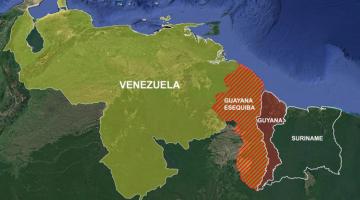 The Essequibo dispute benefits Exxon Mobil and the Pentagon while crushing anti-imperialist solidarity.
 The same week Cuba mobilized millions to defend its revolution, the White House imposed even more illegal measures in an effort to strangle the country into submission.
 Organizers, activists, intellectuals, and international delegates were arrested in Nairobi during an anti-imperialist protest against the France–Africa Summit, which critics have described as an…
 The same legal machinery that once protected Jim Crow segregation has found a new way to strip Black voters of political power without touching the right to cast a ballot.
 Delcy Rodríguez insists that every decision made since January 3 serves to benefit Venezuela. The deportation of Alex Saab to the U.S. discredits that claim.


