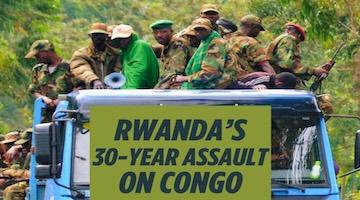
An M23 soldier stands at the Coltan mining pits in Rubaya on March 5, 2025.
The Congo remains ground zero for Africa’s resource wars, where Rwanda and Uganda act as looters for the West. While international scrutiny has largely focused on Rwanda’s aggression, Uganda’s role in the systematic looting of Congolese resources has evaded comparable condemnation.
Originally published in Black Alliance for Peace.
The ongoing exploitation of the Democratic Republic of the Congo (DRC) by Rwanda and Uganda is a manifestation of neocolonial plunder, facilitated by Western corporate interests and enforced by regional comprador regimes. While international scrutiny has largely focused on Rwanda’s aggression, from its backing of the M23 militia and its interests in annexing eastern Congo, Uganda’s role in the systematic looting of Congolese resources have evaded comparable condemnation. Both states serve as intermediaries in a broader imperialist project, funneling stolen minerals to the global market. The recent US-brokered schemes further illustrate how imperial powers manipulate regional conflicts to secure resource dominance.
The following interview examines these dynamics, exposing the root causes of the crisis in Congo, and the urgent need for a militant, anti-imperialist, Pan-Africanist alternative.
U.S. Out of Africa: Voices from the Struggle
AFRICOM Watch Bulletin spoke with Milton Allimadi, a Uganda-born publisher of Black Star News and host of a weekly radio show on WBAI Radio in New York City. He's a PhD student in History at Howard University. Reach him via mallimadi@gmail.com and follow him @allimadi via X or miltonallimadi on IG.
1) There has been a great deal of focus on Rwanda's interference in its neighboring Congo. Despite UN experts claiming Ugandan intelligence provided active support for M23 in 2024, there does not seem to be as much focus on Uganda. Can you speak to how Uganda has avoided more scrutiny?
I believe Congo’s president, Felix Tshisekedi, concluded that he could not confront both Rwanda’s Gen. Paul Kagame and Uganda’s Gen. Yoweri Museveni militarily so he decided to drive a wedge between them. He knows Rwanda wants to annex Eastern Congo as the best way to ensure that it will always be able to steal the minerals that bring in about $1 billion in annual revenue for Paul Kagame’s government. Whereas Uganda was content to strike a deal to continue stealing resources, especially gold, without seeking to annex parts of Congo or escalating a campaign to overthrow Tshisekedi.
Uganda steals, on average, more than $500 million worth of Congolese gold annually. Last year it was more than $1 billion. Congo and Uganda actually signed a deal to build roads to increase trade between the two countries; in other words, to make the plunder more efficient.
So essentially, Tshisekedi capitulated to Yoweri Museveni’s economic imperialism as a lesser evil than Paul Kagame’s annexation and even regime-change agenda.
Rwanda saw this as a scheme to isolate it and escalated its support for M23, which was supported by both Uganda and Rwanda historically. At the same time, Kagame and Museveni are bitter enemies and each waiting to see who goes down first.
Currently, M23 is essentially a cover for Rwanda’s regular armed forces.
2) Given that the Congo consented to the deployment of Ugandan troops in 2021 and considering the overall weakness of the Congo state, how would these factors compare to Ugandan and Rwandan interference when evaluating the root causes of the conflict?
The root causes are Western and local comprador economic imperialism. Uganda does not consume the gold it steals domestically. Rwanda does not consume the coltan, cobalt, or gold it steals domestically. Both countries are not industrialized. All the plundered resources are exported primarily to Western corporations. The domestic political and military elite steal some of the minerals and make their respective side-deals and enrich themselves, becoming multi-millionaires off the blood of the Congolese.
3) Islamist Militias in the region: Would you say that they are a legitimate concern for a relatively weak state structure in the Congo, or that their threat is exaggerated to serve as a pretext for neighboring intervention from Uganda, among other countries?
The Islamist “threat” is definitely exaggerated to legitimize Ugandan deployment. The “Muslims are coming” card was used more frequently before the deal between Museveni and Tshisekedi. What time would the Ugandan soldiers have to steal almost $100 million worth of gold per month if they were fighting a legitimate force there? If you study carefully, you’ll find that there’s a pattern. Following some major political setback to the Museveni regime, a few days later, Allied Democratic Forces (ADF) , the alleged Islamist insurgents, would, conveniently for Museveni, launch a bloody operation targeting civilians in Uganda.
4) Some believe the direction of the Alliance of Sahel states can serve as a model for the Congo, Uganda, and the entire Great Lakes region. How do you feel about that possibility, and what would be the first steps to create a political environment to make such a shift possible?
The Alliance of Sahel States is a model for all African countries since each is fighting off the yoke of neocolonial economic and political domination.
However, in West Africa, it has been easier to articulate the challenges.
French imperialism was much more intense, blatant, visible, and highly resented than British imperialism, and later American, in East Africa. The French are linked to more cases of engineering reactionary coups to install puppets.
The French garrisoned thousands of troops in their former colonies; they had absolute dominance over the economies of their former colonies by controlling the value of their currencies–CFA Franc; and they determined their former colonies’ level of economic production by requiring that they maintain at times 50% of their foreign reserves in the Central Bank in France So the West Africans had a unique matrix of resentments towards the outside neocolonial power, France, and toward the domestic comprador.
East Africa is similarly subjugated to international imperialism and compradors; but there are no obvious symbols of imperialism such as the French troops deployed in West Africa. But the actual structures and mechanisms of neocolonial exploitation exist–The World Bank and IMF, for example. I was very encouraged to see posters directly attacking these institutions during the GEN-Z protests in Kenya against the tax hikes on foods and fuel in June 2024. As you know, the government was forced to abandon the tax increases.
So, East Africa lacks anything comparable to the “Ugly Frenchman”display of imperialism which helped spark Thomas Sankara’s and the Burkinabe Revolution of 1983, and is now inspiring the Revolution by Traore in Burkina Faso, Tchiane in Niger, and Goita in Mali.
However, the immiserizing conditions resident in the marginalized and dependent economies of East African countries, including Uganda, Kenya, and Tanzania, are so real that they can spark military intervention. In Uganda, it would have to be enlightened young officers since it is already governed by Gen. Museveni and his son, Gen. Muhoozi Kainerugana, both reactionary kleptocrats. Museveni might even pre-empt a revolution by having his son “overthrow” him.
But yes, I can see young people in East Africa welcoming young military officers who, upon seizing power, immediately announced well-articulated plans for taking control of their nations' resources and instituting economic structures for production that fulfill the domestic demand and consumption, not that of multinationals and imperialism.
5) Comparably, how viable would the ICD agreement, which ended the Second Congo War, be as a model today?
What seems to be on the table at the moment is the Trump Administration’s plan with eyes toward Congo’s minerals. In return for Congo allowing access, the U.S. will order Rwanda to call off the pitbulls. In return U.S. corporations will invest in factories in Rwanda to process Congo’s minerals and presumably in Uganda too.
Critics contend this plan rewards aggression against Congo by Rwanda and Uganda.
Once again, Africa has abandoned Congo, just as it did in 1960.
The Congolese State is so weak and militarily ineffective that President Tshisekedi has had to run to the United States, the country involved in the overthrow and murder of Patrice Lumumba, to rescue him from Rwanda’s war of aggression.


 The Anti-Imperialist Scholars Collective (AISC) wrote this response to the open letter To Iran's political prisoners, 'trapped between two blades of a scissors' which appeared in The…
 The Anti-Imperialist Scholars Collective (AISC) offers an analysis of the Ramadan War and the multiple fronts of Iranian anti- imperialism. It uses anti-imperialist methodology, grounded in…
 From the blockade of Cuba to the kidnapping of Venezuela's president, U.S. imperialism is recolonizing the Americas, and the only answer is a Zone of Peace built through popular struggle and anti-…
 Early last year, Governor Ron DeSantis began signing death warrants at a faster rate than ever before. What followed was the most intense period of executions the state has carried out in more than…
 Eight student activists in Michigan face decades in prison for advocating that their university divest from genocide. It is clear the goal of the indictment is to terrorize the Palestine solidarity…


