Dropping Out of Electoral College
by Martha Biondi
This article originally appeared
in In These Times.
"Under NPV, all votes in the country would count the same."
A Stanford University computer
scientist named John Koza has formulated a compelling and pragmatic alternative
to the Electoral College. It's called National Popular Vote (NPV), and has been
hailed as "ingenious" by two New York Times editorials. In April,
Maryland became the first state to pass it into law. And several other states,
including Illinois and New Jersey, are likely to follow suit.
How NPV works is this: Instead
of a state awarding its electors to the top vote-getter in that state's
winner-take-all presidential election, the state would give its electoral votes
to the winner of the national popular vote. This would be perfectly legal
because the U.S. Constitution grants states the right to determine how to cast
their electoral votes, so no congressional or federal approval would be
required. NPV could go into effect nationwide as soon as enough states pass it
(enough states to tally 270 electoral votes - the magic number needed to elect
a president). In 2008, NPV bills are expected to be introduced in all 50
states.
"We'll have it by 2012," says
Robert Richie, executive director of the reform group Fair Vote.
NPV is an agreement between the states to
honor the wishes of a plurality of American voters. (Koza came up with the idea
from his experience working on lotteries, where state compacts are common.)
"The state would give its electoral votes
to the winner of the national popular vote."
In the last 20 years, partisan
trends have made presidential elections a series of separate contests in a
shrinking number of competitive states. Republican and Democratic candidates
alike consider two-thirds of the states to be "spectator states." They often
ignore voter registration efforts and spend considerably less money in those
states - if they visit them at all.
In 2004, candidates spent 99
percent of campaign funding in only 16 states, leaving the rest of the country
without a political voice. Highly populated states like New York and
California, and states in much of the South, are considered "safe" and
therefore offer little incentive for candidates to pay attention to their
residents.
Currently, 70 percent of white
voters and 80 percent of non-white voters live in spectator states. In the
'70s, three in four black voters lived in swing states where their population
total was larger than the margin of difference in elections. But today, only 17
percent of black voters are in that position. Not surprisingly, presidential
candidates pay less attention to issues that concern many African Americans.
According to its advocates, NPV promises
basic fairness. For example, as electoral rules stand now, the loser of the
national popular vote can still be elected president, as happened in 2000.
Under NPV, all votes in the country would count the same. NPV would, in
Richie's view, "awaken people's belief in the possibility of change" and prove
that fundamentally unfair structures can be reformed.
"70 percent of white voters and 80 percent
of non-white voters live in spectator states."
Over the years, according to
Koza and Richie, 65 to 70 percent of U.S. voters have supported direct election
of the president. The declining number of battleground states now gives many
states an incentive to sign on.
Illinois is the quintessential
example of the flaws in the current system. As a safe state for Democrats, both
major party candidates ignore it. There is little motivation to campaign there
since the winner in Illinois gets only 21 electoral votes and the loser gets
nothing. As a result, Illinois voters play virtually no role in shaping the issues
of the election.
Illinois stands to become the
second state to pass an NPV law. Last spring, the state house and senate passed
bills that are currently being resolved and will head to the desk of Gov. Rod
Blagojevich, who as a member of Congress supported efforts to reform the
Electoral College.
According to advocates, New
Jersey also appears likely to pass the law this year.
Koza, who originated the plan
for NPV, also chairs National
Popular Vote Inc., the coalition leading the national campaign. He predicts
the 2008 presidential election will be a turning point in the rise of NPV.
Currently, it's hard to
imagine a party's presidential nominee visiting Harlem, N.Y., Compton, Calif.,
or Detroit, Mich., never mind investing in voter registration efforts in these
poor, predominantly black and Latino areas. But a fairer, more democratic
voting system could hold the potential to transform the electoral process and
revive grassroots participation in politics.

 Kwesi Pratt Jr. is General Secretary of the Socialist Movement of Ghana.
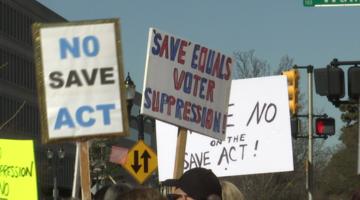 The SAVE Act would require proof of U.S. citizenship to be presented in person in order to register to vote in this country and would disenfranchise millions of people who are currently able to vote…
 Russia finally makes good on promises to help Cuba, but its level of commitment is unclear. The left are clearly immobilized, even as Iran demonstrates how to fight back.
 “We are not freeing ourselves from centuries of imperialism and colonialism only to be maimed and destroyed by nuclear weapons.”
 Rwanda’s 30-year Assault on the Democratic Republic of Congo, a new 80-page title from Baraka Books, gets straight to the essentials.


