Migrants detained in Panama call for help. Photo: NY Times
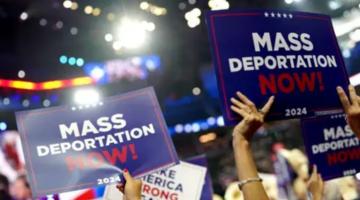
Trump administration interference in Panama has brought about a reckoning on migration and human rights throughout the region. These issues can no longer be ignored.
Panama—and by extension, much of Latin America—is in an uproar. The news of deported migrants, stranded and detained in Panama, has stirred outrage and condemnation. Yet, this is not a new story. It is merely a chapter in a book that has been written, rewritten, and ignored for decades in the United States, even as families, migrants, and human rights advocates warned that such policies would not stay contained within U.S. borders forever.
The real question now is: Why is migration only becoming a pressing issue for Latin American nations when they are the ones forced to deal with the aftermath?
For years, the violations committed against migrants in the U.S. were dismissed as an "American problem." Family separations, detentions under inhumane conditions, legal limbos with no path to regularization—these have been the cornerstones of U.S. immigration enforcement for generations. The systemic mistreatment of migrants, many of whom were from Latin America, was well-documented, well-known, and well-ignored by many governments in the region.
Panama’s current predicament—the hosting of deported individuals under questionable conditions—now forces the country to confront the reality that it, too, is part of a global migration crisis. The same dehumanization that shaped U.S. immigration policy is now taking root in Latin America, under different justifications but with similar consequences.
Migration in Latin America: From Individual Hardship to a Political Crisis
One of the key distinctions that must be made is that the families left behind in migrants' home countries have always known about these violations. They have witnessed the struggles of their loved ones abroad—detentions, deportations, exploitation, and legal limbo—long before international organizations or governments acknowledged these issues. For decades, these families have carried the weight of migration’s consequences: financial instability, separation, and the emotional toll of not knowing if their relatives will return or if they will ever see them again. Yet, in most of Latin America, migration has been framed as a private burden rather than a national or regional economic, social and political issue, nor a policy issue. Governments treated it as the responsibility of individual families, ignoring the structural factors that push people to leave in the first place and failing to establish protections for migrants abroad or reintegration plans for those forced to return.
Unlike in the U.S., where immigration is a central political issue (albeit used mostly as a weapon rather than a human rights concern), Latin American nations—especially those that were once primarily "sending" countries—failed to establish the necessary frameworks to advocate for their migrants abroad or to support them upon their return. Until recently, there were limited organizations in Latin America dedicated to migration beyond basic consular services. Migration was framed as an economic necessity or a personal choice rather than a consequence of systemic failures—whether economic instability, violence, or U.S. interventionist policies that destabilized the region in the first place.
Panama’s Reckoning: A Case Study in Hypocrisy
Now, the very countries that once dismissed migration as an individual burden are being forced to confront it as a national crisis. Panama, long considered a transit hub for migrants heading north, is suddenly responsible for receiving, detaining, and managing deportees sent back by the United States. The outrage from Panamanian officials reflects a sharp irony: the same indignation being expressed over migrant detentions in Panama is identical to the criticisms long leveled at the U.S. for its treatment of Latin American migrants.
This is the end result of an international system that treats migrants not as human beings but as logistical burdens to be passed from one country to another. Governments, including Panama, are replicating the same abdication of responsibility that they once criticized the United States for. The problem was never just the U.S.; it was the entire framework that treats migration as a liability rather than a fundamental part of modern global mobility.
The American Dream Was Always a Myth—Now What?
For many migrants, the so-called "American Dream" was always a mirage—one that came with the risk of family separation, wage exploitation, racist immigration policies, and an unforgiving legal system designed to keep immigrants in a state of permanent precarity. What is new is not the exposure of U.S. abuses, but rather the realization that no country is immune from having to reckon with migration as a collective responsibility.
Now, Panama and other Latin American nations must decide: Will they replicate the same patterns of criminalization and neglect that they once denounced in the U.S., or will they take a different path? The outrage must be followed by action—not just in response to the U.S.'s treatment of migrants, but in the construction of policies that recognize migration as a regional reality rather than a foreign imposition.
If Latin American nations continue to view migration as merely an individual or family hardship rather than a domestic and regional issue requiring collective action, they will find themselves facing the same crises that the U.S. has failed to address for decades. It is not enough to be outraged when deportations land at your own doorstep—it is time to acknowledge that migration has always been a transnational, human rights issue, not just an American scandal.
Janvieve Williams Comrie is a human rights strategist, trainer and organizer from Latin America with a deep commitment to assist in the building of powerful social movements for racial justice and human rights. She has worked in a variety of fields and for several human rights institutions, including the Office of the High Commissioner on Human Rights Regional Office Central America. She is the founder and current Executive Director of www.afroresistance.org, she is the mother to two amazing children and lives in the Bronx New York









 "Operation Piracy or Pedophile Protection, mates?" is the latest from BAR's Poet-in-Residence.
 Jake Paul’s ascent in boxing is a cultural symptom of an empire in decline. It reflects a country that now prefers empty spectacle over real strength, both in sports and on the world stage.
 To dismiss revolutionary theory is to choose permanent defeat, reducing the movement to a hamster wheel of reaction and co-opted rage.
 Preserving the Black Radical Tradition demands struggle not only against white supremacists, but also against the co-opted Black political class who actively support the very evils Dr. King named.
 Africans in the U.S. must weaponize their position and sabotage imperial projects from the inside. Black revolutionaries must modify traditional strategy.


