"I spoke to Commander Asad Duulane who is tasked with defending the border between Northeast State and Somaliland."
"During the last week of July, I traveled to the front lines of Somalia’s unresolved border conflict with Somaliland, the Somali secessionist state now recognized by Israel but not by any of the UN's other 192 sovereign members. The Northeast State forces were holding the line."
Several weeks ago, in early July 2026, I told friends and family that I’d be traveling to the first annual Las Anod Forum 2026. My family said, “Oh My God. Somalia? What the hell are you gonna do next??? Terrorists! Al Shabaab! Warlords! Drone bombing! Kidnapping! Oil!”
US State Department advisories say more or less the same, although they don’t mention the US drone bombing operation, which, according to Brown University’s Costs of War project, has a far larger budget than Somalia’s federal government. It’s fired off some staggering amount of ordnance since 2007, often hitting civilians, mostly desert nomads, in the name of fighting Al Shabaab and ISIS. Trump is now escalating the bombing to unprecedented extremes, while looking to withdraw troops and set it all on auto-pilot, much as he did in his first term.
I was not, however, headed for any of Trump’s desert targets, which are well south of Las Anod, and Somalia’s a big place, roughly the size of Texas, with just over 20 million people and seven million camels.
I said, “People I trust assure me that Las Anod is peaceful and safe and they’ll be with me. I’m going.”
As I did, and I’ve rarely felt safer. Tales of kidnapping for ransom had actually caused me more pre-trip anxieties than anything else, but those were quickly dispelled.
One of the forum organizers, whom I’ll call Mohammed, met me at the gate in Mogadishu, then flew with me to Las Anod, which took about an hour and a half.
Somali and Northeast State flags at the gates
Flags of both Somalia and Northeast State were raised high, blowing in the desert wind at the gates to the city. A lovely woman waving a Northeast State flag and wearing a dress all stitched together of state flags, greeted us at the city gates.
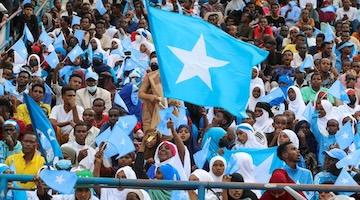
The flag combines a blue band with the Somali flag’s five-pointed star at its center and a green band representing the local land, agriculture, and prosperity. At the center, black on a white background, is an image of Imam Sayid Mohamed Abdulle Hassan, the father of Somali nationalism, on horseback. Hassan led the Dervish forces who fought British colonial rule in the area for nearly twenty years.
Mohammed and I soon met up with Markus Virgil Hoehne, a tall, redheaded German anthropologist who did his field work in Las Anod, where he learned to speak fluent Somali, a challenging language for most Westerners because it includes many Arabic sounds. However, it was first written down in the Latin alphabet, in 1972, when President Mohammed Siad Barre decreed that it be written in the Latin rather than Arabic letters, not only because of suitable phonetics but also because typewriters with Latin letters were available.
Markus told me that high-ranking sheikhs objected at the time, calling this “language without religion” because the Koran was first written in Arabic.
He is very popular in Las Anod, almost comically, but no doubt because he’s so mastered the language and gotten to know the people so well. He stands out, to say the least, with his height, broad shoulders, and red hair. People would call out to him in the streets —“Markus!”— then come up to grasp his arm and talk.
Others looked at me when the two of us weren’t together and asked, “With Markus?”
I’d say, “Yes, with Markus,” or nod, feeling confident in the introduction.
Markus has spent considerable time explaining Somali clan networks, Somali’s fundamental precolonial social formation, to me, as in the interview I recorded for “Capitalism, Race, and Democracy,” a weekly hour that airs on the Pacifica Radio Network in the U.S.
At one of the forum events, he presented the Somali translation of his 2015 book, “Between Somaliland and Puntland: Marginalization, militarization and conflicting political visions (Contested Borderlands).”
Traveling outside Las Anod
I traveled with others to a lovely garden at a farm on the edge of town, where we drank coffee, camel milk, and water in a carpeted orange tent. It’s best to drink water whenever you can in this desert clime.
Somaliland forces held the ground during the war, we were told. A long line of snipers had fired on the town from the surrounding hills, but it was perfectly peaceful now.
Yes, we traveled with guards armed with AK-47s, and yes, there were police and military armed with AK-47s in town and at regular outposts along the roads, but nothing went off. The armed guards only made me feel confident that Northeast State authorities and security services are well in control of their territory three years after reclaiming it from Somaliland, the state that has tried to secede from Somalia since its federal government collapsed in 1991.
Somaliland’s proponents say that Las Anod controls only Las Anod, but how could that be? If that were true, then Somaliland soldiers should be well able to retake it from the flat desert landscape on one side or the hills on the other. Are we supposed to believe that this city has been somehow holding out all on its own for three years, without control of the airport or the roads in and out, one of which goes all the way to Addis Ababa, the capital of Ethiopia?
I asked to travel well outside the city, to the front lines of the fortified border, so I could see for myself. One of the forum organizers then arranged a 100-kilometer trip for Markus and me. We all climbed into an SUV with a driver and a guard with an AK-47, and drove 100 kilometers into the desert to a military outpost, where we spoke to Commander Asad Duulane about the war and their vigilance at the border, which Somaliland has not formally ceded. There were four or five quiet military checkpoints along the way.
Commander Asad said that there had been only a few minor clashes since their victory in August 2023. He also said that the Somalis on the other side of the border were their brothers and sisters and that he hoped they would ultimately reconcile and rejoin the Somali nation.
Upon our return to Las Anod, we stopped while a majestic camel herd crossed the road, then got out to mingle amongst them, enchanted by their wise, bemused grins.
Camels are Somalia’s national icons, their source of survival. For one generation after another, as far back as anyone can remember, camels have been the source of milk, meat, and transportation from one water source to another. There are paintings and other imagery of camels everywhere.
A new state, a new state constitution, and a new leader
Las Anod is the capital of the new Northeast State, which approved its state constitution and elected its state president just last year, two years after winning its war with secessionist Somaliland. The term “president” is in this case what we would call “governor,” the head of a state within a nation. Abdikhadir Ahmed Aw-Ali, aka Firdhiye, was elected to lead the new Northeast State last year. I had the honor of meeting him at the Las Anod Forum and at his residence, along with his ministers, the night before the Forum began.
Somalis are one people, with one language, religion, and culture
When Europeans drew maps all over the African continent, they trapped people with different languages, cultures, and religions inside unnatural boundaries and the unfamiliar, unitary nation state form. This led to ethnic-based competition for power and resources that has plagued the continent since, fueling dozens of currently active secessionist movements. As Kwame Nkrumah predicted, ethnic competition has made Africa vulnerable to foreign manipulation, susceptible to the "divide and rule" tactics used by colonial powers to exploit ethnic differences and prevent national and continental unity. The African Union advocates accepting colonial borders in order to minimize the possibility of conflicts.
Somalia’s case has been different, however, in that Somalis speak the same language and share the same religion and culture, but were divided into French, English, and Italian Somalilands. More Somalis were trapped within the European-drawn boundaries of neighboring Ethiopia and Kenya, and multiple wars have been fought, without success, to reunite them within a continuous, language-based border.
Upon independence, French Somaliland became Djibouti, while British and Italian Somaliland reunited to become the Somali Republic now known as Somalia.
Trump’s racist redneck rambling about how Somalia’s not even a country and its people are barely human is so moronic that it makes Somalis laugh. Renowned Somali referee Omar Artan returned home a hero after he was refused entry to the US to officiate at World Cup matches.
Trump’s delirium about Minnesota Congresswoman Ilhan Omar and “her little turban” has made her a heroine here in Somalia as well as Minnesota, where she has easily won reelection.
Clans create a deep sense of human connection that crosses borders, continents, and oceans. As I said in conversation at one of the Las Anod Forum events, I’m realizing that Somalis, unlike most Americans, are rarely lonely. They’re connected not only to immediate family but also to widespread clan networks.
I myself have little or no connection to cousins or other blood relatives in another state, several generations or marriages removed, but Somali clans maintain deep connections all over the world. In Las Anod, the owner of the popular downtown Luna Café grew up in the Somali Region of Ethiopia, went to school in Addis Ababa, Ethiopia, then Minneapolis, where she worked for some years, then returned to open the café in downtown Las Anod after her clan, the Dhulbahante, triumphed in the Las Anod Conflict.
When I asked why she returned she first said, “I’m Dhulbahante.”
Diaspora groups fundraise to provide aid and build infrastructure for their clans and individual members of their clans back home. A Somali American friend of mine helped raise millions of dollars for a flood control system in Somalia, and then, in a smaller effort, helped identify and tap into a water source for a village inhabited by members of his clan in Ethiopia’s Somali Region.
Everyone in Las Anod seemed to have a late model cell phone; many had the latest iPhone purchased for them by family members somewhere in the diaspora.
And, by the way, I was awed by their skill at using their phones, which was way beyond mine, because most seem to use their phones as their sole computers. The kids’ skills are of course the most dazzling, but most everyone seemed to be a whiz with their phones, again far more than I.
On the other hand, clan competition plagues Somalia as much as ethnic competition plagues other African nations, and the six or seven states of Somalia are largely clan-based. Preserving clan networks with all their advantages while also building a strong sense of national citizenship seems to be Somalia’s greatest challenge.
A people, of course, who cannot build and strengthen a national government that represents their interests will be eaten alive by the powerful nations like the United States, which have their own designs on the country.
Somaliland’s 30-year plea for international statehood
The Isaaq clan elite who formerly dominated the territory within the borders of Somaliland from their capital, Hargeisa, have been pleading for international recognition as an independent nation since Somalia’s state collapse in 1991. The nation descended into clan warfare when the US abruptly yanked their support out from under President Mohammed Siad Barre at the end of the Cold War.
The people of Las Anod and what is now the Northeast State are primarily of the Dhulbahante and Warsangali clans. They have long felt that their lands are occupied by the Isaaq and that the Isaaq have oppressed them.
The Dhulbahante rose up after a prominent leader of their clan was mysteriously assassinated in November 2022. He was one of more than a hundred who had earlier met the same fate.
By February of 2023, the uprising became a full-blown armed conflict between the Somaliland army and local forces until local forces triumphed and raised the blue flag of the Somali nation in August. I wrote down what I was able to understand from a distance at the time, here in Black Agenda Report, in a piece headlined Blue Flag Over Las Anod: A Victory for Somali Nationalists.
That and subsequent interviews and accounts of the new Northeast State’s emergence occasioned my invitation to this year’s first Las Anod Forum. Its organizers intend to make it an annual event bringing people together to discuss the state and the nation, and I hope to attend again next year.
I asked an administrator at Nugaal University in Las Anod whether the hole in a window at one top corner of a building was an unrepaired bullet hole. He confirmed that it was but pointed out that one corner of the room had also been hit by a shell and that it had been reconstructed and plastered. Work has been done but there’s much more to do.
On my flight back from Las Anod to Mogadishu, I sat next to a Somali gentleman who worked for a Norwegian NGO, one of the worthwhile NGOs which actually builds infrastructure that the local population is then able to maintain. He said that he had been there to discuss the plan to rebuild the hospital damaged during the war, including the ICU unit.
Is Northeast State the glue binding Somalia together?
This question was asked of a panel that I had the honor to be a member of. I answered that I really couldn’t say, given that I was making my first visit. However, I came to understand why a “yes” answer was convincing when other panelists noted that young men from distant southern Somalia had come north to fight alongside the Dhulbahante forces because they believe in the idea of “One Somalia” and felt the Dhulbahante were fighting for it.
That made perfect sense. Two large Somali-speaking territories, aside from Somaliland, were lopped off into neighboring nations upon independence. The Somali-speaking people of Northern Kenya, bordering Somalia, in what was called the “Northern Frontier District,” voted in a referendum that they wanted to become part of the new Somali Republic, not the Republic of Kenya, upon independence. Their wishes were not respected, and they then fought the 1963–1967 Shifta War to try to join Somalia nevertheless.
The Somali Region of Ethiopia was taken by Ethiopian Emperor Menelik II in his expansionist wars to build the Ethiopian Empire. As I mentioned earlier, a Somali American friend of mine helped raise money and traveled back there to establish a water source for a village.
I don’t know for sure, being an outsider, but it seems unlikely that the Somali-speaking territories of Ethiopia and Kenya will rejoin the Somali nation going forward, but in Northeast State, I sensed a strong commitment to preserving not only the new state but also the nation of Somalia, one people with one language, one culture, and one religion, as it is now.
Israel, Palestine, Somalia and the Northeast State
“Somaliland” is a difficult idea right now. What is it? Somali state, secessionist state, disputed territory?
US military partner? Without doubt. In 2022, the US National Defense Authorization Act mentioned “Somaliland” more times than any actual African country recognized by the UN, as we reported here in Black Agenda Report.
All three seem fair enough except that the entire area within the old map is not disputed by the Northeast State. They claim the territory they won militarily and control administratively, which the federal government recognizes as a federal member state (FMS). It is the land inhabited by the Dhulbahante and by the Warsangali clan.
AI Overview says:
Yes, the Warsangali clan fought and collaborated alongside the Dhulbahante clan to secure the liberation of their territories, which directly led to the establishment of the North Eastern State of Somalia (formerly known as the SSC-Khatumo administration). Both groups are sub-clans of the larger Harti-Darod clan family and have historically shared overlapping territorial, political, and cultural bonds in the Sool, Sanaag, and Cayn (SSC) regions.
(Which should be enough to say that this is a complicated subject. The best summary for now may be that the Dhulbahante and Warsangali fought successfully together to free themselves from Isaaq rule. However, they do not claim the rest of the territory on the old map of Somaliland.)
(There is another territory on the old Somaliland map called Awdal, where the people are in revolt against rule by the Isaaq in Hargeisa, but they have not yet won their struggle.)
Maps are confusing. The Wikipedia entry on “Somaliland” includes the old map, at least on the last day I checked it. This is the map that corporate media typically reproduce if they address the breakaway state or the region.
However, a Wikipedia entry on Somalia’s Northeast State contains a map indicating that it is about half of the territory that Somaliland still claims.
The shifting maps and accounts in Wikipedia, Grok, AI Overview and whoever is publishing about this reflect the people’s struggles over identity, power, resources, and visions for the future. I find them changing now in as little as a week’s or less time. The maps and text entries are likely to keep shifting for a while now, no telling how long.
I find it interesting to watch them shift, indicating the struggle over information and ideology reflecting that on the ground.
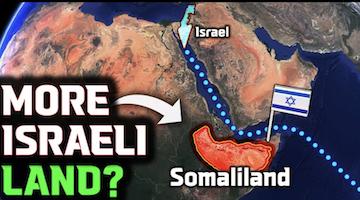
In December, Israel entered into Somalia’s struggles with startling aggression, bringing the eyes of the world with it, by formally recognizing Somaliland as a sovereign nation.
It’s worth noting that Somalia is among the 29 states that do not recognize Israel as a sovereign nation, primarily due to their solidarity with Palestine. According to Wikipedia, twenty-six of them are Muslim; the other three are Cuba, North Korea, and Venezuela.
Now that the US has its boot firmly planted in Venezuela’s neck, that may well change soon.
Commitment to Palestine, however, seems to be far deeper in Somali hearts. Enraged demonstrators burned Israeli flags in the streets of Mogadishu when Israel recognized Somaliland and protest was also filmed within Somaliland itself.
It’s been noted that Israel’s recognition of Somaliland could make way for a “bilateral agreement between states” to offload Palestinian refugees in Somaliland, but Kenyan and Pan-African writer and social media influencer DJ Bwakali warned the Isaaq that that would mean war in the streets of their capital, Hargeisa.
Stay tuned. These are my thoughts after only my first trip to Somalia. I can’t say more for now except that I loved the people, the landscape, the climate, and the camels, and I want to take this opportunity to share my heartfelt thanks to those who invited me, included me in the forum, and took the utmost care for my safety.
Salaam salaam.
Ann Garrison is a Black Agenda Report Contributing Editor based in the San Francisco Bay Area. In 2014, she received the Victoire Ingabire Umuhoza Democracy and Peace Prize for her reporting on conflict in the African Great Lakes region. She can be reached at ann@anngarrison.com. You can help support her work on Patreon.




 The Bush administration had long planned a global war for U.S. hegemony, and the attacks of September 11 provided the perfect pretext to put those plans into motion.
 Oklahoma prison inmates were making political calls for a conservative Super PAC during the primary.
 Longtime attorney Flint Taylor’s new book tells the story of the People’s Law Collective, which grew out of the radical movements of the late 1960s.
 The Trump administration has already cut off Cuba’s access to oil. Now it’s attempting to starve the Cuban people, targeting the country’s capacity to grow, process, and import food — unless it buys…
 Fergie Chambers is an American philanthropist who was arrested on July 10 in Ibiza, Spain, by order of the Trump Administration.


