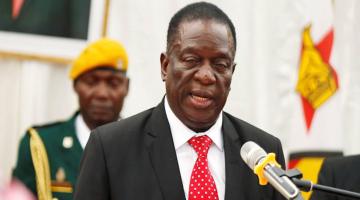
Zimbabwean Communists Say Handing Over Mineral Resources to Foreign Firms is Treason - Photo: Zimbabwe Finance Minister Mthuli Ncube
Zimbabwe’s new “open for business” posture apparently means, “Come and take all of our resources.”
“Ownership of mineral resources is the birthright of Zimbabweans.”
The ZANU(PF)-led government of Zimbabwe recently announced that the indigenization rule, which prohibits foreign mining companies from owning 50% or more of the shares, would be scrapped to allow 100% private ownership of platinum mines. The decision was soon extended to diamond mines, too.
The decision of the ZANU(PF)-led government of Zimbabwe to change the rules in order to allow 100% private ownership of platinum mines has been harshly criticized by the Zimbabwe Communist Party (ZCP), which has termed the decision as “treason.”
The Economic Structural Adjustment Program (ESAP), prescribed by the IMF, was adopted by Zimbabwe in 1991 under the leadership of the then finance minister, Bernard Chidzero. The program subjected the population to severe austerity for decades, while simultaneously providing an opening for private entities to gradually expand their ownership of the country’s natural resources.
“Ncube has offered to give our most precious resource, platinum, to foreign investors.”
“Now his clone, MthuliNcube [the current finance minister] has presented us with ESAP 2, and in the ultimate act of betrayal, has offered to give our most precious resource, platinum, to foreign investors ― with our diamonds (already in large part under the control of apartheid Israel) to follow,” the ZCP said in a statement.
While a formal announcement is yet to be made, the finance minister reportedly told Bloomberg, “We are removing that indigenization rule which is discouraging foreign direct investment. We say Zimbabwe is open for business; you can only be open if you allow ownership of 100%.”
The South Africa-based Impala Platinum was one of the mining giants whose share prices had dropped after the indigenization rule was introduced in 2011. The rule mandated foreign companies operating in sectors, including mining and banking, to transfer at least 51% of the shares to black Zimbabweans.
The company’s spokesperson said that they are waiting for a formal confirmation, and “remain encouraged by ongoing efforts by the government to open the economy to investment and growth.” Soon after, the minister of mines released a statement saying that this change in rule will also be extended to diamonds.
“We say Zimbabwe is open for business; you can only be open if you allow ownership of 100%.”
The difference between the development levels of the two countries in the neighborhood, the Democratic Republic of Congo (DRC) and Botswana, ZCP said, is instructive of the consequences of having no restraints on foreign investment in mining.
“Botswana, on our western border, despite having a pro-Western foreign policy and a US base within its borders, has a 51% government share in its mines. Debswana, the main diamond mining company is 51% owned by the Botswana government and 49% owned by De Beers. In addition, the Botswana government bought a 20% interest in De Beers on the open market from its profits. At independence in 1964, there were only 3 kilometers of tarred road in Botswana; now due to investment in infrastructure, tarred roads cover most of the country.. [There is also improvement in] education and housing,” ZCP’s statement read.
On the other hand, the DRC “has a population living in abject poverty with little infrastructural development since the Belgians left in 1960. Only China, in the last few years, has started to build roads and schools in return for minerals. DRC, with its wars and its poverty is a living example of “Foreign Direct Investment” at work.”
“Botswana has a 51% government share in its mines.”
The ZCP clarified that what the party is calling for at this stage is not a full nationalization of the mining sector, but an arrangement where at least 50% of the shares are held by the state. However, it added that progress has to be made towards eventual nationalization.
“Ownership of mineral resources is the birthright of Zimbabweans. Management should be professional, and based on skill and experience. It may or may not be local in composition,” the ZCP noted.
The ZPC called on all progressive organizations and individuals, especially organized labor, to fight the “monstrous theft of national resources through the comprador bourgeoisie,” led by president Mnangagwa and finance minister Ncube.
This article previously appeared in Peoples Dispatch.
COMMENTS?
Please join the conversation on Black Agenda Report's Facebook page at http://facebook.com/blackagendareport
Or, you can comment by emailing us at comments@blackagendareport.com


 The murder of Sonya Massey by the Illinois police is a symptom of a larger, deeply rooted, systemic assault on Black and Brown working-class communities. The only way to protect the people and resist…
 The Instituto Simón Bolívar president places Venezuela’s July 28 presidential election in the global context.
 The city’s abstainers could determine who wins Wisconsin, a critical swing state, this November.
 Despite the well-known political instability of the Fifth Republic, caused by the results of the recent legislative elections, the continuity of Paris' military-political path in Africa seems…
 Four consecutive US governments have incrementally expanded their reliance on using the US dollar as a weapon of war, forcing nations across the world to create alternative financial systems and…


