
by Mark P. Fancher
All African nations except Liberia have so far refused U.S. requests to establish a U.S. Africa Command headquarters on African soil. But “AFRICOM is likely to continue nibbling away at Africa’s resistance through projects like the National Guard partnership program” with African militaries. “Mass resistance must take place in the U.S. as well,” if Africa is to be spared further U.S. penetration and militarization.
Africom Unmasked, Unwanted and Vulnerable
by Mark P. Fancher
“Africa’s continuing commitment to stand firm against an AFRICOM headquarters on the continent is an under-appreciated victory.”
When the Bush Administration created U.S. Africa Command (AFRICOM) to protect America’s oil and strategic interests, the door was slammed in its face by every African country except Liberia. Fortunately, AFRICOM never accepted Liberia’s offer to establish headquarters there, and the military command has by default made its home in Stuttgart, Germany.
Although AFRICOM has hinted that it may renew its efforts to establish its base in Africa, the Washington Post quoted a member of AFRICOM’s advisory board as saying the chances that this will actually happen are very low. He said: “I would personally put it at between slim and none.” There is no mystery about why. The Post article quoted Morocco’s director of intelligence as saying: “The African countries looked at [AFRICOM] as a threat. It was made very clear that no one wanted the presence of any foreign military, especially the U.S., anywhere in Africa.”
Africa’s continuing commitment to stand firm against an AFRICOM headquarters on the continent is an under-appreciated victory. If Africa has not learned from this experience that imperialism can be defeated to some degree simply through non-cooperation, it should. That lesson has certainly not been missed by others.
In her book The Shock Doctrine, Naomi Klein wrote:
“The governments of Venezuela, Costa Rica, Argentina and Uruguay have all announced that they will no longer send students to the School of the Americas – the infamous police and military training center in Fort Benning, Georgia, where so many of the continent’s notorious killers learned the latest in ‘counterterrorism’ techniques, then promptly directed them against farmers in El Salvador and auto workers in Argentina. Bolivia looks to cut its ties with the school, as does Ecuador.”
“African governments must simply refuse to allow their soldiers to participate in AFRICOM training programs.”
Programs like Africa Contingency Operations Training and Assistance (ACOTA), Africa Partnership Station and the International Military Education and Training Program are all AFRICOM projects that provide African soldiers with military and ideological training, and it is not unreasonable to fear that they will evolve into a “School of the Americas” of sorts for Africa. If Africa’s government leaders are to prevent the militarization of their continent they must build on their non-cooperation with AFRICOM’s search for an African home by following the example of their progressive Central and South American counterparts. African governments must simply refuse to allow their soldiers to participate in AFRICOM training programs. Unfortunately, more than a few African countries have not hesitated to offer up their troops, and in the process they have illustrated yet another lesson that Africa should learn from progressive forces in Central and South America. That is that resistance to imperialist initiatives should not be left to governments.
In her book, Naomi Klein wrote:
“[Latin America’s mass movements are] less centralized than in the sixties, making it harder to demobilize whole movements by eliminating a few leaders. Despite the overwhelming cult of personality surrounding [Hugo] Chavez, and his moves to centralize power at the state level, the progressive networks in Venezuela are at the same time highly decentralized, with power dispersed at the grass roots and community level, through thousands of neighborhood councils and co-ops. In Bolivia, the indigenous people’s movements that put [Evo] Morales in office function similarly and have made it clear that Morales does not have their unconditional support….”
“If Africa’s government leaders are to prevent the militarization of their continent they must follow the example of their progressive Central and South American counterparts.”
There is never a guarantee that a mass movement will succeed in pressuring an African government to make the risky decision to tell the U.S. “no thanks” in response to an invitation to participate in an AFRICOM project. However, a mass movement does have the potential to establish a climate and consensus among the grassroots that the country’s young men and women should individually resist military service if it means their direct or indirect participation in AFRICOM’s projects.
Mass resistance must take place in the U.S. as well because only a few months ago, high ranking representatives of AFRICOM and others traveled to Liberia to establish a “partnership” between that West African country’s military and the Michigan National Guard. African-descended and other people of Michigan (and the seven other states that have joined AFRICOM “partnerships”) not only have a right, but an obligation to resist the use of their National Guard troops as AFRICOM pawns. In Michigan’s case such resistance should not only be for the sake of Africa’s independence, but also because of the large numbers of jobless and poverty-stricken African-descended persons in Detroit, Flint, Benton Harbor and elsewhere in the state who need a financial bail-out, but who will never get one because so much money is used to feed a ravenous military budget.
AFRICOM is unlikely to fold up its tent soon. It is more likely to continue nibbling away at Africa’s resistance through projects like the National Guard partnership program and strategies designed to put a friendly human face on what many Africans now see as a big, terrifying U.S. military monster. This makes holding the line against AFRICOM all the more important. AFRICOM’s inability to establish its headquarters in Africa has exposed its vulnerability, and it serves up on a silver platter the strategies that must be pursued to defeat it.
Mark P. Fancher coordinates the National Conference of Black Lawyers’ AFRICOM Task Force. He is also the author of the book: “I Ain’t Got Tired Yet.” He can be contacted at mfancher@comcast.net.

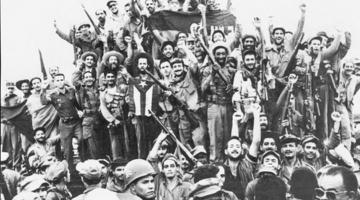 The survival of Cuba's socialist project remains one of the most critical holdouts against hemispheric domination, making its defense a global litmus test for sovereignty.
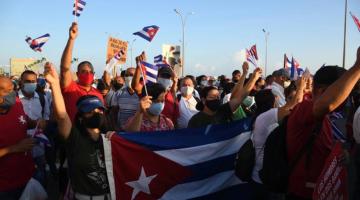 Branding Cuba an "extraordinary threat" on the anniversary of a regional peace declaration, the U.S. has escalated an assault designed to destroy hemispheric solidarity and justify hybrid war.
 After 41 years in French captivity, revolutionary militant Georges Ibrahim Abdallah speaks, offering an analysis of October 7th, global fascism, and the Palestinian resistance.
 Reuters sells custodial plunder as a pricing issue, turning blockade into “market caution.” We restore the missing record: seizures, supervision, and the re-routing of Venezuelan oil revenue through…
 The push by white farmers to enlist Donald Trump in a compensation battle over Zimbabwean land is a brazen, neo-colonial plot to undo African liberation history.


