If everything the United States does appears to be related to its imperial mission, that's because it's true. The “U.S. policy of putting the military in charge of, not only disaster relief, but foreign assistance in general, is an outgrowth of the collapse of the Soviet Union.” The attitude is, “If they want American aid, they'll have to accept the U.S. military presence.”
US Humanitarian Aid Looks More Like US Invasion
A Black Agenda Radio commentary by Glen Ford
“U.S. governments regard masses of Black people, first, as potential threats to security, and only second as fellow human beings deserving of assistance.”
It is understandable that many African Americans are making comparisons between the militarized character of the U.S. intervention in Haiti’s earthquake disaster and the federal government’s largely military response to the Katrina catastrophe in New Orleans, four and a half years ago. It is quite reasonable to conclude that the U.S. government is more concerned about law and order issues than in attending to the immediate needs of desperate disaster victims – especially when the victims are Black. History tells us that U.S. governments regard masses of Black people, first, as potential threats to security, and only second as fellow human beings deserving of assistance. Nevertheless, the heavy-handed militarization of U.S. disaster aid to Haiti should be seen in a larger context. As a matter of established American policy, the military has been assigned prime responsibility for U.S. foreign disaster relief, worldwide.
It’s not just Haiti and New Orleans, or Black people in. When the biggest tidal wave in recorded history killed nearly 230,000 people in 14 countries in 2004 – a death toll that some fear may be reached in Haiti – the face of U.S. disaster aid was overwhelmingly military, so much so that the government of Indonesia, the epicenter of the undersea earthquake, was initially hesitant to allow the Americans in. The Pakistani government’s response was much the same the next year, when 80,000 people died in an earthquake. The American “aid” mission to Pakistan looked more like an invasion – which was not an irrational fear, as subsequent events have shown.
“More often than not, the uniformed military is the dispenser of a wide range of U.S. foreign aid in Africa.”
It’s not just disaster relief that has been militarized. The U.S. military command in Africa, AFRICOM, has assumed responsibility for much of the day-to-day duties once performed by the State Department and other civilian agencies. More often than not, the uniformed military is the dispenser of a wide range of U.S. foreign aid in Africa, as part of a general militarization of U.S. relations with the rest of the planet.
This U.S. policy of putting the military in charge of, not only disaster relief, but foreign assistance in general, is an outgrowth of the collapse of the Soviet Union, nearly two decades ago. As the world's only superpower, the Americans began comparing themselves to ancient Rome. If weaker nations recoil at the prospect of American legions stomping around their country, well, that's too bad. If they want American aid, they'll have to accept the U.S. military presence.
The military's dominance in U.S. relations with other nations is also evident in the size of the embassies the U.S. is building around the world. The largest is in Iraq, and is designed more like a junior Pentagon than a civilian facility. The sheer size of the embassy the Americans are building in Pakistan is a huge source of public outrage and fear. And the fifth largest U.S. embassy in the world sits in Haiti, one of the planet's most economically unimportant nations. What purpose could it possibly serve, other than as a U.S. military and and dirty tricks base for the U.S. Southern Command – which now decides what gets in and out of Haiti. For all practical purposes, the U.S. Southern Command is the occupying power in Haiti. What we are observing is imperialism in action, under cover of disaster.
BAR executive editor Glen Ford can be contacted at Glen.Ford@BlackAgendaReport.com.

 Eritrea remains true to the revolutionary ideals forged during its 30-year War of Independence.
 By vetoing a bill to study reparations, Maryland Governor Wes Moore has aligned himself with a long line of Black Democrats who prioritize white approval over their own base.
 The 2020 uprisings could have sparked a multiracial working-class movement against systemic oppression, but liberal elites defanged its radical potential. By reducing Black liberation to performative…
 "One Big Beautiful Bank Job!" is the latest from BAR's Poet-in-Residence.
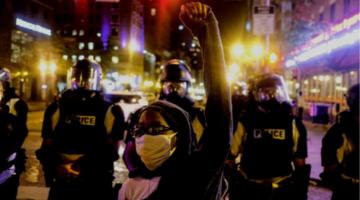 With the ritualistic murder of George Floyd by the occupation forces referred to as the police that roam the streets and barrios of the Black and Brown colonized communities in the United States, the…


