“The reform of mass incarceration, as it has been absorbed by the cultural ensemble of the state and its distensions, endorses an expansion of policing logics.”
“Mass incarceration,” “police brutality,” “school-to-prison pipeline,” and other terms of crisis have permeated the political theater of post-racialism and its apparent white nationalist aftermath. Such keywords of the early-21st century liberal-to-progressive critique of racist state violence form an increasingly shared vernacular for academic scholarship, policy reform, nonprofit campaigns, foundation grants, and ongoing dialogue and debate across various communities and publics.
But there is something troublesome in the ongoing, industrialized circulation of these keywords, a territorialization and corruption—at times, a statecraft—of crisis-terms that undermines the collective genius of periodic radical rearticulation (e.g. Black radical and anti-colonialist practitioners seizing control of these terms and transforming them into active literatures of liberation combat, to paraphrase Frantz Fanon). As the particular phrase “mass incarceration” spreads across venues and publics, a relatively coherent reform parable attains increasing political-ideological traction.
We can concisely outline the progression of this increasingly hegemonic, liberal-progressive mass incarceration reform narrative as such:
First, there is an uneven though growing national acknowledgement that over the course of the last few decades, there has been a systemic expansion of the institutional and cultural capacity and will to profile, criminalize, incarcerate, and denigrate targeted bodies, places, and populations. We might consider this as a spreading, though sometimes hesitant and certainly overdue acknowledgement of the raw, long-irrefutable facts of gendered racist state terror.
“The parable holds that targeted Black and Brown incarceration is not the problem in-and-of-itself.”
Next in this parable, quickly and slowly, alarmed responses spill across journalistic, testimonial, activist, and social scientific revelations of the damage done to communities, families, and otherwise good people. This is confirmation of the suspicion that the contemporary carceral domestic war may have misidentified or exceeded its operational objectives. (We should be clear that this part of the reform narrative is the counter-abolitionist, counter-Black radical rejoinder: [targeted Black, Brown] “incarceration” is not the problem in-and-of-itself; rather, it is the excess of “mass” incarceration—the white supremacist embarrassment it creates for respectable liberal/post-racial white nationhood—that requires reform.)
The mass incarceration parable then opens into spreading, dense accounts of the degradation and suffering that traverse stories of individualized tragedy to collectively-communally voiced, insurgent outrage. These accounts are mobilized and repurposed by various narrators (journalists, reform advocates, progressive pundits, elected officials, academics) as the ethnographic, deeply personalized, and urgent reasons for reforming “mass incarceration”—here, they proclaim, is the accumulated primary evidence of the state’s alleged criminological dysfunction. (Of course, what complicates this part of the narrative is that many of these accounts not only preceded the recent, increasingly generalized acknowledgement of the so-called mass incarceration crisis, but also seem to suggest that what has happened during the time in question is not the result of a dysfunctional state, but rather of an entirely functional one.)
“Well-placed intellectuals collectively strive to restore a paradigmatic liberal faith in the virtues and possibilities of righteous national reform against the state sanctioned climate of atrocity.”
And now, a protracted skirmish ensues, as organized political blocs, cultural institutions, and emergent grassroots-to-social media collectives struggle to make sense—that is, to definitively narrate—this turmoil.
Entering the skirmish (at the same time they are formed by it) are multiple coalescences of organic and professional intellectuals—of the racial state, nonprofit/foundation regimes, and liberal cultural industry, including thinktank and foundation commissioned academics, writers, and artists. These are the well-placed ones who collectively strive to restore a paradigmatic liberal faith in the virtues and possibilities of righteous national reform against the state sanctioned climate of atrocity. From here grows a definitive, outraged rhetoric of liberal humanist alarm that strives for a sense of shared moral grievance: in 2012, a writer for The New Yorker asserts that “The scale and the brutality of our prisons are the moral scandal of American life,”[i] while in 2014, the Soros Foundation announces a $50 million grant to the ACLU, to which is appended the proclamation that “America’s bloated prisons are an appalling and expensive failure… overwhelming common sense and human decency.”[ii]
Morality, Common Sense, Decency: these are rhetorical signals of a violently hopeful thinking, one that requires a full, radical, abolitionist rebuttal all the time, and everywhere. The thinking that must be so resolutely refuted goes something like this: that if there is such a massive problem as mass incarceration, it can be fixed, if “we” bring rational heart to mind in another adventure of humanist reform, if we follow the stories into the tragedy and insist over-and-over-again that such harrowing details are not the primary or intended outcome of this state, its policy, its martialing of cultural and domestic force, then solutions can be found in vigorous reform, the threads of post-American apartheid racial modernity can again be pulled taut around the jagged, always-disarticulating edges of the civil underside, where statecraft unfolds on the intimate geography of the flesh.
(etc etc, to be continued.)
“The reformist ‘mass incarceration’ narrative is in most ways entirely symbiotic with an expansion of police force and of its various capacities to occupy the lifeworlds and ecologies of criminalized people and communities.”
In fact, the reform of mass incarceration, as it has been absorbed by the cultural ensemble of the state and its distensions, endorses an expansion of policing logics (including carceral policing logics) beyond the discrete institutional sites of prisons, jails, detention centers, and juvenile facilities. In a longer version of this piece, I consider how the Holder-Obama-Clinton ensemble’s reformist auto-critique of mass incarceration proliferates an invigorated and refurbished technology of policing, which is to say that the “mass incarceration” narrative is in most ways entirely symbiotic with an expansion of police force and of its various capacities to occupy the lifeworlds and ecologies of criminalized people and communities. In this sense, any shared radical abolitionist praxis in this moment must pay close analytical and practical attention to the moments in which those who allegedly embrace the objective of “ending” or “reducing” mass incarceration may also advocate the absolute necessity of police, criminal jurisprudence, and incarceration as permanent conditions of sociality, collective safety, and even “democracy.”
Let us end with a question about the implications of “mass incarceration” as a vernacular of militant state reform: it seems to be an almost canonized liberal common sense assumption within this narrative that the well-noted asymmetries of misery, suffering, displacement and terror catalyzed by mass incarceration are an “unintended consequence” of state policy and the contemporary racial-cultural formation of the United States. We must ask: what if this assumption is false?
Dylan Rodríguez is a Professor in the Department of Media and Cultural Studies (and formerly in the Department of Ethnic Studies) at UC Riverside. He received his Ph.D. and M.A. degrees in Ethnic Studies from the University of California, Berkeley (2001), and earned two B.A. degrees and a Concentration degree from Cornell University (1995). Prof. Rodríguez is the author of two books: Forced Passages: Imprisoned Radical Intellectuals and the U.S. Prison Regime (University of Minnesota Press, 2006) and Suspended Apocalypse: White Supremacy, Genocide, and the Filipino Condition (University of Minnesota Press, 2009).
References:
Adam Gopnik, “The Caging of America,” The New Yorker, January 30, 2012.
https://www.newyorker.com/magazine/2012/01/30/the-caging-of-america (accessed January 2018).
Chris Stone, “Ending Mass Incarceration,” Open Society Foundations, November 7, 2014. https://www.opensocietyfoundations.org/voices/ending-mass-incarceration (accessed January 2018).





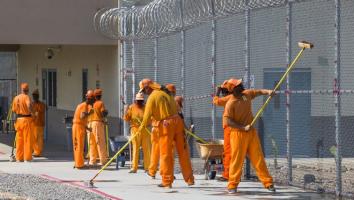

 In this week’s segment, we hear about the ongoing uprising in France against neo-liberal austerity, colonialism, and white supremacy. But first, we discuss a new report that reveals a 25% decline in…
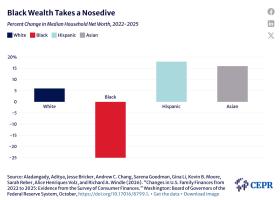 The Center for Economic and Policy Research (CEPR) recently reported on Federal Reserve data indicating that Black people in the U.S. have lost 25% of their wealth between 2022 and 2025. Whites,…
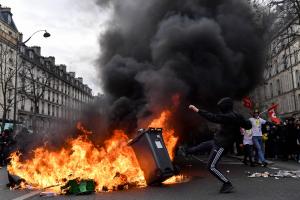 Bouna Mbaye is an activist, writer, and a member of the Pan-African League-Umoja, the Pan-African Brigade for Palestine, and the US Out of Africa Network. He joins us from Paris to discuss the…
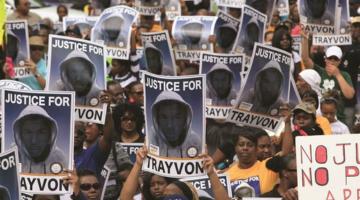 As Black Agenda Report is poised to celebrate its 20th anniversary, we reprint Glen Ford's commentary on the killing of Trayvon Martin and the impunity provided to his killer in a criminal justice…
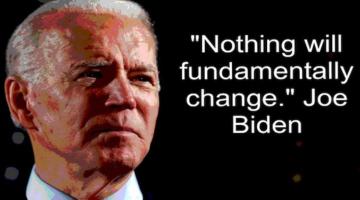 The Democratic Party is terrified of even small liberal reforms and will not abide left leaning democrats thwarting their plans for austerity and neoliberal orthodoxy.


