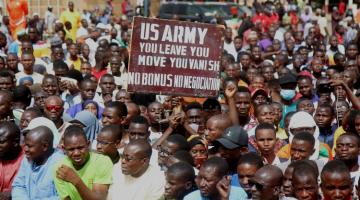
Demonstrators participate during a protest against a US-backed Ebola quarantine plan on the establishment of a facility to host Americans exposed to Ebola, in Nanyuki town, in Laikipia County, Kenya, on 1 June, 2026. REUTERS - John Muchucha
The United States announced that Kenya, with the permission of a comprador government, would serve as an Ebola quarantine hub for Americans, ignoring the will of the Kenyan people and treating the nation as a medical dumping ground.
Western nations have a long history of deciding that African land is available for their use and exploitation for any reason they choose. Donald Trump’s declaration that Kenya would serve as an Ebola virus disease quarantine hub for U.S. citizens in Africa who are exposed to the disease is a reminder that these colonial ideologies still exist.
For those in the U.S. watching from afar, this may seem like a foreign policy story with little relevance to their daily lives, but it isn’t. The same entitlement that has directed the Trump administration's decisions domestically has shaped its actions abroad. Global health experts will tell you, “viruses don’t know borders,” meaning containment of a virus should not be treated as a localized event, but as an international responsibility. But this Ebola virus disease quarantine hub is not about protecting those in the U.S. It's about exploitation and exerting power, and Kenyans have experienced this before.
Kenya gained independence from British colonial rule in 1963 after decades of foreign control that treated Kenyan land and people as resources to be exploited for British interests. While colonial rule formally ended, Kenyan governments have at times aligned themselves with U.S. and other Western foreign policy priorities, often without broad public support. The Ruto government's decision to deploy Kenyan police to Haiti is one recent example. That history makes it difficult to ignore the parallels when U.S. officials publicly discuss using Kenya as a quarantine site before meaningful public consent has been established.
As a Kenyan-American, I was horrified and offended by the announcement, and as a public health professional, I was equally troubled by the logic behind this decision. Why would the United States offload its responsibility to protect the health of its citizens to another country? What’s more troubling is that when the announcement was made in late May, the Kenyan government had not publicly approved the plan. Yet Kenya was already being discussed as though its participation was guaranteed, and its approval was unnecessary.
A few days later, a Kenyan high court blocked this decision and barred the operation from proceeding. The ruling came after a petition from a civil rights organization, the Katiba Institute, which asserted that the Ebola quarantine hub would pose a threat to the public health of Kenyan citizens. The backlash was not limited to the courts. Many Kenyans viewed the proposal as a threat to national sovereignty and public health and took to the streets to demand why their country was being asked to assume risks that the United States was unwilling to manage itself. Despite legal challenges and public opposition, President Ruto agreed to move forward with the proposal in exchange for $13.5 million in funding for the facility. However, Kenya’s Health Minister was forced to halt construction after being found in contempt of court for allowing construction to proceed. Yet the power dynamic that led to the government acquiescing to the Trump administration must be examined.
The entitlement that allows U.S. officials to publicly discuss intervention plans in a nation where they have no jurisdiction reflects the same mindset that characterized colonial rule. That same mindset leads with the assumption that economic power, political influence, or strategic interests grant a nation the right to shape the affairs of others. This is not a partnership; it’s influence exercised through financial leverage, media dominance, and unequal power dynamics, also known as neocolonialism. The issue is that the proposal was introduced as though Kenyan consent was unnecessary, limiting their right to choose what happens in their country. The proposal sparked widespread opposition from citizens, civil society organizations, and legal institutions. In Nanyuki, where the center was to be built, hundreds of residents protested, and one protester was killed by police. Despite these concerns, political leaders negotiated an agreement that overrides public and institutional objections.
Experts have warned that the current outbreak could be the worst Ebola outbreak in history if containment efforts fall behind. Addressing a threat of this scale requires strong surveillance systems, trained workforces, and international cooperation. Yet the United States has moved to reduce support for many of the institutions responsible for coordinating these efforts.
The Trump administration has withdrawn from the World Health Organization (WHO) and implemented significant funding cuts affecting agencies such as the Centers for Disease Control (CDC) and the US Agency for International Development (USAID), institutions that have historically contributed research, personnel, surveillance, and funding to global outbreak prevention and response. Rather than strengthening the global infrastructure needed to contain outbreaks, the administration has proposed shifting responsibility elsewhere. Reducing investment in international public health infrastructure while simultaneously positioning the United States as an authority on how other nations should manage outbreaks not only raises important questions about what global health leadership truly means but echoes with colonial entitlement.
The proposal to use Kenya as an Ebola virus disease quarantine hub was not simply a public health controversy. It reflects a modern form of colonial thinking in which powerful nations continue to treat African countries as places where risks can be offloaded while influence and decision-making remain concentrated elsewhere. As one of the world's most influential powers, the United States has the capacity to strengthen the international partnerships and institutions that prevent global health crises. Instead, its actions reflect a broader pattern of prioritizing dominance in global affairs over equitable cooperation, without regard for the consequences imposed on other nations and their citizens.
Beverley Waithaka is a Public Voices Fellow of The OpEd Project in partnership with the National Black Child Development Institute. She writes about the intersections of public health, beauty, digital culture, and the impacts on early childhood.



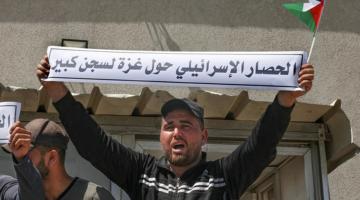 Three years into Israel's genocide in Gaza, the consequences of a decision driven by siege, settlement expansion, and assaults on Al-Aqsa are still unfolding.
 In this week’s segment we hear about the right-wing politics of the anti-migrant movement in South Africa, ANC failures, and upcoming elections in that country. But we begin with the first and only…
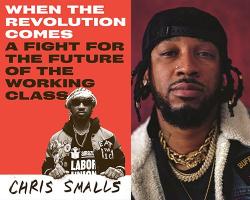 Chris Smalls discusses his memoir, "When the Revolution Comes: A Fight for the Future of the Working Class," published by Penguin Random House. He is the first and only union leader to successfully…
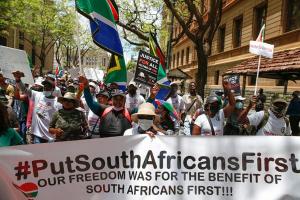 Our guest is Nairobi based political writer and strategist Clinton Nzala. He joins us to provide an update and an analysis of the South African anti-migrant March and March movement, which is…
 The Hague Group’s goal is to “. . . take coordinated legal and diplomatic measures against Israel’s violations of international law.” But international law was never a reality.


