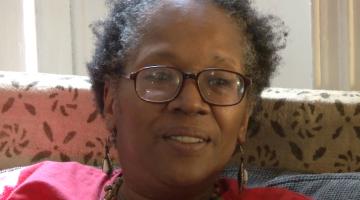
The late Dr. Johanna Fernández left an awesome intellectual and activist legacy that includes her 2010 documentary film “Justice on Trial: The Case of Mumia Abu-Jamal.”
Global peace and justice communities lost a warrior queen on July 30, 2026, when Dr. Johanna Fernández, associate professor of history at Baruch College and the CUNY Graduate Center in New York, joined the ancestors.
She had been suffering from non-small cell lung cancer, which is particularly painful in its late stages. At her memorial, a number of speakers expressed gratitude that she was finally free of pain.
Others said that she feared dying alone, not having a significant other at this point in her life, but she did die surrounded by friends and family. Someone said that her significant other was Mumia Abu Jamal because she had devoted so much of her life to advocating for his freedom and for that of other innocents behind bars because of our racist, vindictive criminal justice system.
Johanna will also be remembered for her book The Young Lords, a Radical History, which I will discuss in a future column. Today I’m addressing her advocacy for Mumia in her meticulously researched documentary Justice on Trial: The Case of Mumia Abu-Jamal.
Justice on Trial: The Case of Mumia Abu-Jamal
Johanna’s documentary begins in the early night of December 9, 1981, when Mumia was moonlighting as a cab driver, and he saw his brother William pulled over by police next to his VW Beetle. He stopped to see what was happening, and both he and Officer Daniel Faulkner were shot in an ensuing altercation.
Crime scene photographer Pedro P. Polakoff heard the news on H-band that an officer was down and rushed to the scene from a fire he was documenting. He said he arrived in no more than 12 minutes and began taking photographs.
At first, Polakoff was convinced that Mumia must have committed the crime, but he came to doubt that after deeper study of the photographs. The infamous Judge Albert Sabo refused to allow Mumia’s court-appointed lawyer to submit Polakoff’s photographs into evidence at Mumia’s first trial. Court stenographer Terri Maurer-Carter, in a sworn affidavit, later said that she heard Sabo say, “I’m going to help them fry the nigger.”
Mumia’s sister rushed to the hospital that Mumia had been taken to and told him that he would have to have emergency surgery. He agreed, then told her that he hadn’t killed anyone. His face was so bruised and swollen by a police beating that she couldn’t recognize him at first.
We see footage of the Philadelphia Fraternal Order of Police and their allies, all of whom are white, rallying to demand Mumia’s execution, then footage of Mumia’s supporters, all of whom are Black, demanding justice for Mumia. Film narrator Juan Gonzalez tells us that Mumia’s case is more than a trial; it is a battle over what justice means in America.
What follows is a well-documented analysis of Mumia’s initial prosecution, which continues to be the official account.
We hear arguments of the prosecutors and of an individual who grew up with Faulkner and testifies to his character, presumably giving evidence that he would not have shot anyone without just cause.
J. Patrick O’Connor, the Editor of an online publication called Crime Magazine, which specializes in, among other things, innocence cases, testified that he didn’t even know if there was a crime scene investigation. He said that one of Polakoff’s photographs revealed that police had held Mumia’s gun, meaning the claim that Mumia’s fingerprints were on the gun was implausible.
O’Conner also said that since officers testified that the most basic procedures for investigating a crime were not done, he could only conclude that they were negative, that they did not implicate Mumia.
Photographer Polakoff said that his own photos were not admitted in evidence, and that in itself revealed that Mumia’s first trial was unfair.
Veronica Jones
The Crime Magazine Editor says that if we see one piece of evidence offered in Mumia’s case, it is that there was another witness, Veronica Jones.
A few months before Jones was scheduled to testify, she was arrested and jailed on a robbery charge, then unable to make bail. Fifteen officers came to her in jail and told her that if she would testify against Mumia, as she did, they would keep her from going to prison.
In remorseful tears, Jones says that she had known nothing about Mumia and that no one who had not faced 15 years in prison could understand how desperate it feels.
From Death Row
Mumia was convicted of first-degree murder on July 3, 1982. The next day he was sentenced to die by lethal injection. On June 1st, 1995, Pennsylvania Governor Tom Ridge signed the death warrant scheduling his execution for August 17, 1995, at 10 pm.
Mumia had long since fired his court-appointed attorney and handed his defense to a team of lawyers and supporters who had scheduled their major petition for a retrial on August 21, 1995, four days after the date that Ridge had suddenly scheduled his execution. What could make it clearer that the State of Pennsylvania was vengefully determined to kill Mumia without further legal appeal?
On August 8, 1995, Judge Albert Sabo, the same judge who had sentenced Mumia to death, issued an indefinite legal stay, halting the execution so that post-conviction evidentiary hearings could proceed.
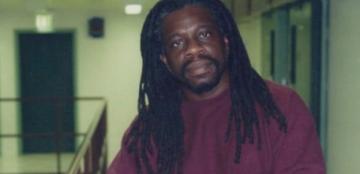
Mumia sat on death row for 29 years, where he wrote 10 books, including Live from Death Row: A Radio Reporter's Impassioned Writings on Injustice, Racism, and Prison Brutalities, a collection of the radio editorials he produced with the help of radio professional Noel Hanrahan.
On December 7, 2011, his death sentence was set aside and converted to life without parole and he was moved from death row to the general prison population.
During that time, his daughter Samiya “Goldii” Abdullah Jamal and his wife Wadiya Jamal joined the ancestors, and now Johanna has as well. In his radio editorial dedicated to Johanna, Mumia said, “This piece is one of the hardest things I’ve ever had to do.
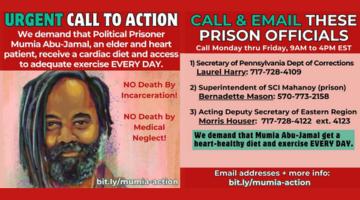
We can honor both Johanna and Mumia by watching “Justice on Trial: The Case for Mumia Abu-Jamaal,” learning and sharing the details of how he was framed, and continuing to advocate for his freedom.
We can also write to Mumia at:
Smart Communications/PADOC
Mumia Abu-Jamal, AM 8335
SCI Mahanoy
c/o PO Box 33028
St Petersburg, FL 33733
Ann Garrison is a Black Agenda Report Contributing Editor based in the San Francisco Bay Area. In 2014, she received the Victoire Ingabire Umuhoza Democracy and Peace Prize for her reporting on conflict in the African Great Lakes region. She can be reached at ann@anngarrison.com. You can help support her work on Patreon.


 The Islamic Revolutionary Guard Corps (IRGC) has issued a letter addressed to the American people, outlining its views on recent developments and Iran-U.S. relations.
 The Trump administration's new sanctions on Cuba, are part of a dual strategy to create unendurable hardship while simultaneously making Cuba financially dependent on the United States.
 The armed groups in Haiti are not a spontaneous wave of banditry, but a scheme orchestrated by imperialist powers in concert with a reactionary and subservient Haitian political class. The…
 A coalition of Pan-African and socialist organizations has launched an international campaign to defend Cuba, arguing that African peoples must remember the sacrifices Cuban internationalists made…
 If international law and justice are buried in the rubble of Gaza, the global community will ultimately be digging its own grave.


