Ralph Poynter delivered a solidarity message from Lynne Stewart, who was in prison at that time, to a Mumia Abu-Jamal teach-in in Philadelphia in February 2010. He said that she insisted ‘the case for Mumia needs to come before everything and everybody.’
Ralph Poynter was a pioneer in the fight against white supremacy, oppression, and injustice around the world. His voice and presence cannot be replicated.
Whether you were tuned in to “What’s happening,” a weekly WBAI radio show hosted by Ralph Poynter and Betty Davis, or if you followed them in a Black Lives Matter caravan during the COVID crisis, you knew you were among those fighting for liberation. In December, one of the last email posts for their radio program read: “Warfare + colonialism = Palestine! Warfare + colonialism = Cop City.” Betty Davis reported that Ralph’s final words to all his friends and supporters were: “It is on you now. Continue the struggle.”
According to a brief biography posted on WBAI, Ralph Poynter was the son of a union organizer. His family was located in the Pittsburgh area, which was a major steel producer at that time. He graduated from Duquesne University with a master’s degree in music education.
Grounded in union principles, he joined the United Federation of Teachers, UFT, when he began working at P.S. 175 in Harlem as a 5th-grade substitute teacher in the mid-1960s. It was at the time when the struggle for community control of the city’s public schools first erupted.
Community school boards throughout the city were attempting to exercise their control of the teaching staff to reflect the needs of the children in their communities. Poynter joined the first demonstrations in Harlem and Brooklyn in 1967.
On May 9, 1968, a racist confrontation arose between the UFT and the New York City Central Board of Education against the majority Black and Puerto Rican community school board in Ocean Hill-Brownsville. The UFT and the city administration refused to negotiate and went on the offensive. In the end, the communities throughout the city lost local control of their children’s schools.
In Ocean Hill-Brownsville, Poynter and 10 other teachers took over P.S. 175, resisting police violence during the protests. He ended up on Riker’s Island for a few months after defending protesters from a police assault during a demonstration.
According to Poynter, “When the UFT colluded with management to support the racist Board of Education against Black communities’ demands for community control of schools, I founded the Teachers’ Freedom Party and became a leader in that fight.”
“Much of my 50+ years of political activism has focused on improving our public schools. My leadership facilitated appointments of NYC’s first Black and Puerto Rican principals. Doing this required confronting the NYPD Army of Occupation installed to maintain ideological control of schools. In the course of self- and community-defense, I was convicted and served time on Rikers Island, where I organized fellow prisoners in one of the first successful prison rebellions, winning important concessions.”
Ralph Poynter met Lynne Stewart when she was a librarian, and he was a teacher at P.S. 175 in the 1960s. They were both fighting for Black control of the Black community and its schools.
Stewart became well known as a “people’s lawyer.” During Bush’s “War on Terror” in 2005, she was thrown into a federal prison in Fort Worth, Texas, for four years and disbarred. She was prosecuted by Attorney General John Ashcroft on a phony charge of materially aiding terrorism. Stewart had distributed press releases on behalf of her jailed client, the blind Egyptian cleric Omar Abdel-Rahman, who had been accused of having a role in the attack on the World Trade Center. Earlier, she had defended David Gilbert, who was part of a Weather Underground action.
Poynter was her greatest defender while she was in prison, first in 2005. He led an international movement to “Free Lynne Stewart.” When she was jailed with a 10-year sentence in 2010, that movement won her freedom. She was finally released in 2013. Lynne Stewart, who had been denied adequate care for breast cancer while in prison, died in 2017.
Poynter said that one of their “primary focuses was on freeing U.S. political prisoners serving unconscionable sentences.” He supported Stewart in her lifelong struggle against the U.S. “injustice system.” Together, they fought for the freedom of Mumia Abu-Jamal. At rallies for Lynne Stewart, Ralph told her supporters that she asked them to fight to free Mumia before protesting for her release.
Together with Betty Davis, Poynter and Stewart co-founded the New Abolitionist Movement, working to eliminate miseducation in New York City. Betty Davis said she was a warrior in the struggle for community control of education ever since she heard Ralph Poynter speak at a pro-union rally supporting the social workers’ strike in 1967. Davis said, “Later that year, I met Stewart and Poynter at a Teachers’ Freedom Party social. Lynne Stewart’s account of the history of the struggle for freedom and democracy in education solidified my resolve to join the struggle. I was a social worker soon to become an educator.”
Up until the very last breath of his 89 years, on December 25, Ralph Poynter fearlessly rallied to fight racism, oppression, and injustice.
Lallan Schoenstein is a writer for Struggle La Lucha.


 Chile, Colombia, Bolivia, Honduras, Peru, and Costa Rica have all elected right-wing presidents in the past year, and most are open Trump allies. Brazil's runoff between Lula and Flávio Bolsonaro is…
 October 7, 2023, was not an isolated attack, but the culmination of generations of Palestinian imprisonment and resistance in Gaza, comparable to Nat Turner's rebellion. History will record the Al…
 The 2026 French uprising is a continuation of the anti-colonial struggle, rooted in the 1961 Paris massacre of Algerians and the ongoing neocolonial relationship between France and its former…
 Disregard for Palestinian rights is a feature of Israeli politics rather than a bug. The upcoming Knesset election will change nothing for Palestinians, because every candidate across the political…
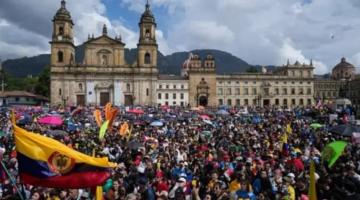 Thousands of people took to the streets across Colombia on Wednesday in the first national strike against President Abelardo de la Espriella’s administration, as police used tear gas, rubber bullets…



