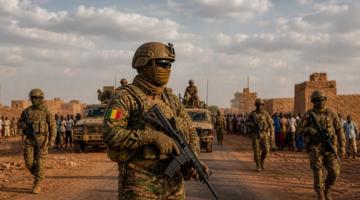
The Chadian troops arriving in Haiti are the visible arm of imperialist intervention in which the United States projects force without putting its own boots on the ground.
Originally published in Rezo Nodwes.
The Chadian deployment in Haiti involves more than just international security assistance. What is at stake goes beyond the fight against gangs, even beyond the humanitarian emergency invoked to legitimize the intervention. It is a shift in the modus operandi of the major powers—particularly the United States—that is unfolding before our eyes: a war without a flag, influence without a uniform, domination without formal occupation.
Haiti, once again, is being used as a testing ground.
In this new architecture, Chad is neither an autonomous actor nor simply a multilateral partner. It is a military interface, an operational relay in a system where strategic power resides elsewhere. This externalization of force, carefully packaged in the language of the United Nations and international cooperation, constitutes one of the most significant turning points in the contemporary management of so-called “peripheral” crises.
The rise of a model: intervening without appearing
Since the political failures and reputational costs of direct interventions—from Iraq to Afghanistan—the United States has gradually redefined its intervention doctrine. Frontal occupation is giving way to hybrid mechanisms: security partnerships, military delegation, and coalitions under international mandate.
In this scheme, the objective is clear: to control without taking responsibility, to influence without exposing oneself, to stabilize without getting bogged down. Haiti fits perfectly into this category of situations where direct intervention would be politically toxic, but where the absence of intervention risks producing uncontrollable chaos on the doorstep of the Caribbean region, an area of strategic interest to Washington. The solution? Outsource the coercion.
The choice of Chad: a logic of military and political compatibility
Why Chad? Chad possesses several characteristics that make it an ideal candidate for this type of operation: an army experienced in asymmetric conflicts (Boko Haram, the Sahel, regional operations); a tradition of participation in international missions; a historical relationship of security cooperation with the United States; and a structural dependence on Western military and logistical aid. In other words, Chad is interoperable, disciplined within multilateral frameworks, and politically willing to play this role.
But there is more. In contemporary geopolitics, certain states are gradually being transformed into “security providers” for foreign theaters of operation. They are becoming functional extensions of strategies conceived elsewhere. Chad, in the Haitian case, is not merely present: it is being mobilized.
Haiti: A Laboratory for Outsourced Security
Since the gradual collapse of Haitian institutions, security has become the central argument for all international initiatives. But what is changing today is not the foreign presence itself—it is its nature. MINUSTAH, an emblematic mission of the past, was based on a visible multinational occupation, with a relatively identifiable chain of command. It left behind a heavy legacy: accusations of abuse, the introduction of cholera, and institutional dependency.
Today, the new architecture is more diffuse, more technical, more opaque. The force being deployed—logistically supported by the United States—operates according to a different logic: increased offensive capability
Arrest warrants, targeted operations against armed groups, integration of contingents from third countries. And at the heart of this system, Chadian troops appear as a pivotal element.
The United States, seemingly in the background, but in real control
It would be naive to interpret this configuration as an American withdrawal. It is, in reality, a strategic repositioning. The United States continues to play a decisive role on several levels: Intelligence: surveillance, analysis, targeting; Logistics: transportation, supplies, equipment; Training: doctrinal structuring of the forces involved; Diplomacy: orchestrating the multilateral framework.
Thus, even in the absence of visible American troops, the operational framework remains deeply influenced by Washington. What we observe is not an absence—it is an organized invisibility.
A proxy war? Not exactly, but almost.
The term “proxy war” may seem excessive. Yet, certain elements strongly resemble it. Chad is active on the ground, taking risks and deploying its troops. But the essential parameters—objectives, financing, strategic architecture—are largely beyond its control. This is not a conflict between rival powers, but an asymmetrical model of power projection, where: central states retain the decision-making power, peripheral states execute, and fragile territories serve as theaters of operation.
In this configuration, Haiti is neither an actor nor an arbiter. It is the arena of application.
The consequences for Haitian sovereignty
This is where the problem becomes political. Because beyond the immediate security issue, this situation produces structural effects.
1. Erosion of sovereignty
When national security depends on foreign forces, even indirectly, the state loses its monopoly on legitimate violence.
2. Abuse of responsibility by local elites
Haitian leaders, often trapped in internal power struggles, find in this outsourcing an escape from their own failures.
3. Institutionalization of dependency
Each intervention reinforces the idea that the solution will come from the outside.
4. Risks of abuse and impunity
Past experience shows that international forces are not always subject to clear accountability.
An absent, or even complicit, political class
While this architecture is being put in place, the Haitian political class is notable for its silence — or worse, for its opportunism.
Instead of defining the terms of the debate, demanding guarantees, and defending a sovereign vision of security, it becomes bogged down in positional squabbles and a perpetual struggle for power. This attitude reveals a disturbing reality: the absence of a national project. In this strategic vacuum, decisions are made elsewhere.
The regional factor: Haiti as a key to Caribbean stability
It would be reductive to limit the analysis to a simple bilateral relationship between Haiti and the United States. The Haitian crisis has major regional implications: migratory flows towards the United States and the Caribbean, instability on the Dominican borders, and risks of transnational crime.
In this context, stabilizing Haiti becomes a geopolitical priority. But stabilizing does not mean rebuilding. And that is the crux of the ambiguity surrounding the current intervention.
Chad: actor or instrument?
Let's return to the central question. Is Chad a sovereign actor in this mission, or simply an instrument?
The answer likely lies somewhere in between. On the one hand, N'Djamena reaps benefits: international recognition, diplomatic support, and strengthened military capabilities. On the other hand, it operates within a framework that transcends its own control. Chad acts, but within a context defined by others. It executes orders, but does not have sole control.
Towards a normalization of military subcontracting
What is happening in Haiti could well signal a broader trend. Faced with the multiple crises of the 21st century, major powers seem to favour a model where: interventions are indirect, responsibilities are diluted, and political costs are externalized.
In this system, some countries become global security operators, intervening where central powers no longer wish to be present.
And what about Haiti in all of this?
Haiti, once again, finds itself at the heart of a system that transcends it. Not as a subject, but as an object. Not as a decision-maker, but as a battleground.
The question is therefore not only one of security. It is existential: What kind of Haitian state will emerge from a system where security is imported, managed and executed from the outside?
Conditional sovereignty
The Chadian deployment in Haiti is not simply a military act. It is a signal. The signal of a world where power is being reconfigured, where interventions are being concealed, where fragile states are becoming spaces for management rather than partners.
In this configuration, Haiti risks becoming permanently entrenched in a position of security dependence. And perhaps the most worrying aspect is not Chad's presence. It is the tacit acceptance of a system where sovereignty becomes negotiable, security is outsourced, and the future is controlled remotely.


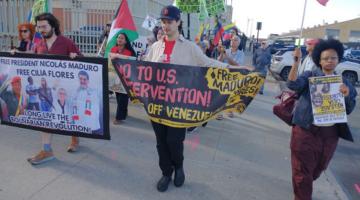 While Trump pardoned an actual drug lord president, he keeps a kidnapped Venezuelan president, Nicolas Maduro, and his wife, First Combatant Celia Flores, in a mold-infested Brooklyn jail on false…
 Jeffrey Isaac Jarquin was deported from the U.S. by ICE and upon arrival in Managua was sent to prison by Nicaraguan authorities. Corporate media has decried the detention of a “torture victim” and “…
 In this week’s segment, we discuss student protests by Black and brown youth in France against austerity measures and race-based inequality in the education system. But we begin with a discussion of…
 Brazil's incumbent president Lula da Silva finished second behind Flavio Bolsonaro in the first round of the presidential election. Because neither man received at least 51% of the vote, a run-off…
 Students in France are engaging in mass protests. Hundreds of them have been arrested and injured by police, and many schools are closed. Annick Metefia joins us from Paris. She is a member of the…


