A Black Agenda Radio commentary by executive editor Glen Ford
For the third time in two years, inmates in solitary confinement at California’s most notorious prison have gone on hunger strike. Record numbers of prisoners across the state have joined the Pelican Bay strikers, some of whom “have not seen the natural light of day for more than 20 years.”
Tens of Thousands of California Inmates Join Pelican Bay Hunger Strikers
A Black Agenda Radio commentary by executive editor Glen Ford
“Prison is the ultimate surveillance regime, a place where the sense of self, of human agency, and of privacy is systematically crushed, in the name of security.”
About 30,000 California prisoners have joined the hunger strike
The Pelican Bay inmates carry a certain moral authority, in that they represent the most long-suffering, intensely persecuted group in the largest and most barbaric prison system in the world – the approximately 80,000 U.S. prison inmates held under solitary confinement. Pelican Bay is the site of more than 1,000 solitary confinement cells, where prisoners are isolated from other human contact for at least 22 and a half hours a day. Around the state, about 4,500 people are held in Special Housing Units, or SHUs, with 6,000 more enduring some other form of solitary. Some of the SHU inmates have not seen the natural light of day for more than 20 years.
The State calls the SHU inmates the “worst of the worst” in order to justify a punishment regime more barbaric, in many respects, than any in recorded history – a massive, multi-billion dollar enterprise whose mission is to destroy the minds of men and women. Inmates are locked away for years on end for possession of literature, or for mere suspicion of political militancy. By far the largest number of SHU inmates are accused of belonging to gangs, and can only be released from solitary by accusing other inmates of gang affiliation – a process that is euphemistically called “debriefing” – thus turning everyone into a potential snitch against everyone else.
“Two-thirds of the state’s prisons have been affected.”
Prison is the ultimate surveillance regime, a place where the sense of self, of human agency, and of privacy is systematically crushed, in the name of security. It is no coincidence that the world’s prison superpower, the United States, which accounts for one out of every four incarcerated persons on the planet, is also engaged in spying on every other nation and population on Earth. It is as if the United States is determined to surveil – with the implicit threat to crush – every expression of the human soul.
Both U.S. global surveillance and American prison policies violate international law. The Center for Constitutional Rights has sued
California’s inmates aren’t waiting for the UN or the courts to come to the rescue. They’ve issued five core demands
For Black Agenda Radio, I’m Glen Ford. On the web, go to BlackAgendaReport.com.
BAR executive editor Glen Ford can be contacted at Glen.Ford@BlackAgendaReport.com .

 $13 billion aircraft carriers, $10 pencils and $500 hammers, renamed “portable hand-held transcribing devices” and “impact fasteners;” so war-profiteer pimps—war
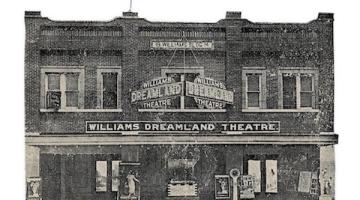 In 1921 thousands of whites attacked the Black population of Tulsa, Oklahoma with machine guns, airplanes, fire and pure hatred, killing at least 300.
 More policing rarely results in justice for anyone, and only puts Black, Indigenous, and other communities of color (BIPOC), including Asian people, at risk for more violence.
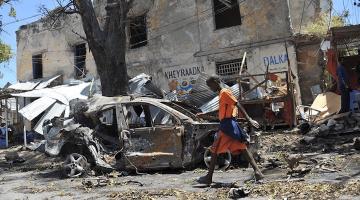 “Bombing Somali civilians is one of AFRICOM’s main projects,” writes Mohamed Haji Ingiriis, a young Somali historian.
 The worldview animating Haitian masses today is leading to a social context ungovernable within the framework of prevailing economic neo-liberalism.


