This piece was originally published in Black Agenda Report in 2017.
Malcolm X understood that “oppressed peoples must commit themselves to radical political struggle in order to advance a dignified approach to human rights.” What’s needed is a bottom-up mass movement for People(s)-Centered Human Rights, a “political project in the service of the oppressed” that “names the enemies of freedom: the Western white supremacist, colonial/capitalist patriarchy.” Social revolution is the only solution.
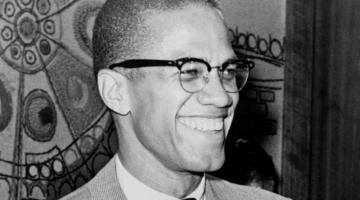
52 years ago, on February 21st, the world lost the great anti-colonial fighter, Malcolm X. Around the world, millions pause on this anniversary and take note of the life and contribution of Brother Malcolm. Two years ago, I keynoted a lecture on the legacy of Malcolm X at the American University in Beirut, Lebanon. While I had long been aware of the veneration that Malcolm inspired in various parts of the world, I was still struck by the love and appreciation that so many have for Malcolm beyond activists in the black world.
There are a number of reasons that might explain why, 52 years later, so many still pay homage to Malcolm. For those of us who operate within the context of the Black Radical Tradition, Malcolm’s political life and philosophy connected three streams of the Black Radical Tradition: nationalism, anti-colonialism and internationalism. For many, the way in which Malcolm approached those elements account for his appeal. Yet, I think there is something else. Something not reducible to the language of political struggle and opposition that I hear when I encounter people in the U.S. and in other parts of the world when they talk about Malcolm. I suspect it is his defiance, his dignity, his courage and his selflessness. For me, it is all of that, but it is also how those elements were reflected in his politics, in particular his approach to the concept of human rights.
The aspects of his thought and practice that distinguished the period of his work in that short year between his break with the Nation of Islam (NOI) in 1964 and his assassination in 1965 included not only his anti-racism and anti-colonialist stance but also his advocacy of a radical approach to the issue of human rights.
Human Rights as a De-Colonial Fighting Instrument
Malcolm – in the tradition of earlier black radical activists and intellectuals in the late 1940s – understood the subversive potential of the concept of human rights when philosophically and practically disconnected from its liberal, legalistic, and state-centered genesis.
For Malcolm, internationalizing resistance to the system of racial oppression in the U.S. meant redefining the struggle for constitutional civil rights by transforming the struggle for full recognition of African American citizenship rights to a struggle for human rights.
This strategy for international advocacy was not new. African Americans led by W.E.B. DuBois were present at Versailles during the post-World War I negotiations to pressure for self-rule for various African nations, including independence from the racist apartheid regime in South Africa. At the end of World War II during the creation of the United Nations, African American radicals forged the possibilities to use this structure as a strategic space to pressure for international support for ending colonization in Africa and fight against racial oppression in the United States.
Malcolm studied the process by which various African American organizations – the National Negro Congress (NNC), National Association for the Advancement of Colored People (NAACP) and the Civil Rights Congress (CRC), petitioned the UN through the Human Rights Commission on behalf of the human rights of African Americans. Therefore, in the very first months after his split with the NOI, he already envisioned idea that the struggle of Africans in the U.S. had to be internationalized as a human rights struggle. He advised leaders of the civil rights movement to “expand their civil rights movement to a human rights movement, it would internationalize it.”
Taking a page from the examples of the NNC, NAACP and CRC, The Organization of Afro-American Unity (OAAU), one of the two organizations Malcolm formed after leaving the NOI, sought to bring the plight of African Americans to the United Nations to demand international sanctions against the U.S. for refusing to recognize the human rights of this oppressed nation.
However, there was something quite different with Malcolm’s approach to human rights that distinguished him from mainstream civil rights activists. By grounding himself in the radical human rights approach, Malcolm articulated a position on human rights struggle that did not confine itself to just advocacy. He understood that appealing to the same powers that were responsible for the structures of oppression was a dead end. Those kinds of unwise and potentially reactionary appeals would never result in substantial structural changes. Malcolm understood that oppressed peoples must commit themselves to radical political struggle in order to advance a dignified approach to human rights.
“We have to make the world see that the problem that we’re confronted with is a problem for humanity. It’s not a Negro problem; it’s not an American problem. You and I have to make it a world problem, make the world aware that there’ll be no peace on this earth as long as our human rights are being violated in America.”
And if the U.S. and the international community does not address the human rights plight of the African American, Malcolm is clear on the course of action: “If we can’t be recognized and respected as a human being, we have to create a situation where no human being will enjoy life, liberty, and the pursuit of happiness.”
Malcolm’s approach to the realization of human rights was one in which human agency is at the center. If oppressed individuals are not willing to fight for their human rights, Malcolm suggested that “you should be kept in the cotton patch where you’re not a human being.”
If you are not ready to pay the price required to experience full dignity as a person and as members of a self-determinant people, then you will be consigned to the “zone of non-being,” as Fanon refers to that place where the non-European is assigned. Malcolm referred to that zone as a place where one is a sub-human:
“You’re an animal that belongs in the cotton patch like a horse and a cow, or a chicken or a possum, if you’re not ready to pay the price that is necessary to be paid for recognition and respect as a human being.
“And what is that price?
“The price to make others respect your human rights is death. You have to be ready to die… it’s time for you and me now to let the world know how peaceful we are, how well-meaning we are, how law-abiding we wish to be. But at the same time, we have to let the same world know we’ll blow their world sky-high if we’re not respected and recognized and treated the same as other human beings are treated.”
People(s)-Centered Human Rights:
This approach to human rights struggle is the basis of what I call the People(s)-Centered approach to human rights struggle.
People(s)-Centered Human Rights (PCHR) are those non-oppressive rights that reflect the highest commitment to universal human dignity and social justice that individuals and collectives define and secure for themselves through social struggle.
This is the Black Radical Tradition’s approach to human rights. It is an approach that views human rights as an arena of struggle that, when grounded and informed by the needs and aspirations of the oppressed, becomes part of a unified comprehensive strategy for decolonization and radical social change.
The PCHR framework provides an alternative and a theoretical and practical break with the race and class-bound liberalism and mechanistic state-centered legalism that informs mainstream human rights.
The people-centered framework proceeds from the assumption that the genesis of the assaults on human dignity that are at the core of human rights violations is located in the relationships of oppression. The PCHR framework does not pretend to be non-political. It is a political project in the service of the oppressed. It names the enemies of freedom: the Western white supremacist, colonial/capitalist patriarchy.
Therefore, the realization of authentic freedom and human dignity can only come about as a result of the radical alteration of the structures and relationships that determine and often deny human dignity. In other words, it is only through social revolution that human rights can be realized.
The demands for clean water; safe and accessible food; free quality education; healthcare and healthiness for all; housing; public transportation; wages and a socially productive job that allow for a dignified life; ending of mass incarceration; universal free child care; opposition to war and the control and eventual elimination of the police; self-determination; and respect for democracy in all aspects of life are some of the people-centered human rights that can only be realized through a bottom-up mass movement for building popular power.
By shifting the center of human rights struggle away from advocacy to struggle, Malcolm laid the foundation for a more relevant form of human rights struggle for people still caught in the tentacles of Euro-American colonial dominance. The PCHR approach that creates human rights from the bottom-up views human rights as an arena of struggle. Human rights does not emanate from legalistic texts negotiated by states—it comes from the aspirations of the people. Unlike the liberal conception of human rights that elevates some mystical notions of natural law (which is really bourgeois law) as the foundation of rights, the “people” in formation are the ethical foundation and source of PCHRs.
Trumpism is the logical outcome of the decades long assault of racialized neoliberal capitalism. Malcolm showed us how to deal with Trumpism, and the PCHR movement that we must build will move us to that place where collective humanity must arrive if we are to survive and build a new world. And we will – “by any means necessary.”
Ajamu Baraka is an editor and contributing columnist for the Black Agenda Report. He is the Director of the North-South Project for People(s)-Centered Human Rights and serves on the Executive Committee of the U.S. Peace Council and leadership body of the U.S.-based United National Anti-War Coalition (UNAC).



 The 2026 French uprising is a continuation of the anti-colonial struggle, rooted in the 1961 Paris massacre of Algerians and the ongoing neocolonial relationship between France and its former…
 Disregard for Palestinian rights is a feature of Israeli politics rather than a bug. The upcoming Knesset election will change nothing for Palestinians, because every candidate across the political…
 Thousands of people took to the streets across Colombia on Wednesday in the first national strike against President Abelardo de la Espriella’s administration, as police used tear gas, rubber bullets…
 As we are experiencing a world order in disorder, with war and conflagrations and a shifting balance of power, Issa Shivji calls for a Sovereign Pan-African Project. The analyses recap the…
 In this week’s segment, we see through supposed disagreements between the US and Canada and recognize their partnership in settler colonialism, enslavement, and imperialism. But we begin with a…


