Under the guise of a farcical “pilot zone” project to restore Lebanon’s sovereignty, Israel is pursuing a scorched-earth strategy while entrenching its occupation.
Back in June, United States Secretary of State Marco Rubio unveiled a “Trilateral Framework” signed by Lebanon, Israel, and everyone’s favorite tyrannical global superpower, which, Rubio boasted, constituted “another major milestone in President Trump’s effort to bring lasting peace and stability to the region.” As per Rubio’s vision, the agreement established “a clear and structured process to restore Lebanon’s sovereignty.”
As might be guessed by anyone familiar with the imperial lexicon – and the US tendency to purge terms like “freedom” and “democracy” of any actual meaning – Lebanese “sovereignty” is not in fact the goal here. After all, literal sovereignty would require Israel to cease occupying the country and slaughtering people left and right with the help of billions of dollars in US military aid and arms transfers.
Ever since the state of Israel up and invented itself on Palestinian land in 1948, setting the ball rolling in the direction of the current genocide in the Gaza Strip, the Israelis have harbored designs on Lebanese territory, as well. The 1982 Israeli invasion of Lebanon killed tens of thousands of people and prompted the formation of Hezbollah, whose ensuing resistance activities would henceforth be labeled “terrorism” and provide an ongoing pretext for Israel’s own terrorization of the country.
From 1978 until 2000, Israel oversaw a torture-happy occupation of southern Lebanon, only to be forced out by the “terrorists.” But the Israelis were back in 2006 for a 34-day assault, which killed some 1,200 people and was lauded by then-US Secretary of State Condoleezza Rice as the “birth pangs of a new Middle East.” In the midst of the devastation, the US government expedited bomb shipments to the Israelis to assist in the, um, birth. When I hitchhiked through Lebanon a month after the war, sections of the country had been reduced to rubble.
Once the genocide kicked off in Gaza in October 2023, it wasn’t long before Lebanon came under fire, too, as Israel creatively expanded its terror repertoire by not only blowing up entire apartment blocks but also engineering the simultaneous explosion of personal electronic devices across the country. More than one million people have been were displaced by Israeli aggression that, like in Gaza, now continues unabated in spite of a series of ostensible “ceasefires.” Since March of this year, the death toll from Israeli attacks in Lebanon has surpassed 4,380, with over 12,420 wounded.
Then on October 12, a New York Times analysis revealed that 48 out of roughly 60 towns occupied by Israel had thus far been “mostly leveled,” as the Israelis carried on with applying the “Gaza model” to Lebanon.
In early August, the Israeli defense minister bragged that Israel had seized a “security zone” in southern Lebanon encompassing 700 square kilometers – approximately 270 square miles – and that no fewer than 24 villages had been completely destroyed. This, mind you, was about five weeks after Rubio’s triumphant proclamation regarding the impending restoration of Lebanese “sovereignty.”
Supposedly, the current path to sovereignty runs through three so-called “pilot zones” in the south Lebanese villages of Froun, Srifa, and Zawtar al-Gharbiya. According to the original plan, Israel was supposed to hand these villages over to the Lebanese army in order to determine, basically, if Lebanon is capable of administering its own territory in a manner that is satisfactory to the Israelis.
In any remotely just world, of course, an illegal occupation army of genocidal war criminals would not be allowed to call the shots in such a situation and would instead be forced to cease its occupation as a prerequisite to conflict resolution. Unfortunately, however, we do not inhabit such a world.
Further complicating matters is that the three appointed pilot zones were not even occupied by the Israelis in the first place, thus raising the question of how this amounted to Israel handing anything over. More significantly, the Israeli military’s uninterrupted quest to obliterate numerous other south Lebanese villages from the face on the earth as part of a scorched-earth strategy would seem to be compelling evidence that the pilot zones are not a blueprint for an eventual Israeli withdrawal but rather a distraction from an all-out land grab.
And yet from the looks of it, neither Israel nor the US is overly concerned with keeping up the distraction. Since the US State Department announced the ostensible launch of the first pilot zones in July, little has been said about this particular “milestone” – perhaps because it has entailed little to no changes on the ground.
In a recent dispatch from Zawtar al-Gharbiya titled “Drones, explosions and soldiers in bulldozers: surrounded by Israelis in Lebanon’s ‘model town,’” even the Reuters news agency found it difficult to downplay the ludicrousness of the spectacle. Much of the village was pulverized by Israel before it was proposed as a pilot zone; now, “booms echo throughout the morning as Israel’s military destroys homes in the surrounding occupied towns with controlled detonations and bulldozers.” One of the article’s protagonists, 67-year-old villager Mariam al-Yaghi, is “often trailed by a small Israeli surveillance drone as she toils in her garden.”
Meanwhile, Israeli media outlets have predictably busied themselves making a fuss over the alleged presence in Lebanon’s pilot zones of “Hezbollah terror operatives” who are “flying under the radar by posing as civilians” – the implicit upshot being that the Lebanese army simply can’t get its shit together and that Israel will thus have to stick around indefinitely.
And as the surveillance drone continues to ensure that Mariam al-Yaghi isn’t doing anything terroristic in her garden, it’s worth reiterating that there’s nothing sovereign about scorched earth.
Belén Fernández has written for Harper’s Magazine, The New York Times, Al Jazeera, and other outlets. She is the author, most recently, of The Darién Gap: A Reporter’s Journey through the Deadly Crossroads of the Americas, published last year by Rutgers University Press.

 Joseph Kabila, former president of the Democratic Republic of Congo, named himself president of the Front for the Rebuilding of the Nation. He is now formally allied with M23, the Rwanda-backed…
 Isaac Saney is a Cuba and Black Studies specialist and historian at Dalhousie University in Halifax, Nova Scotia, Canada. He discusses the U.S./Canadian partnership in settler colonialism,…
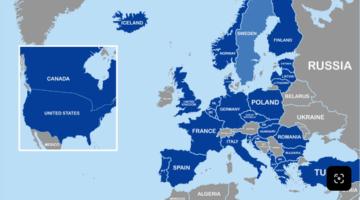 European puppet states have undermined themselves and their peoples' needs at the behest of the U.S. Now, that subservience may lead to war.
 Marco Rubio's appeals to Western civilization, Christian heritage, and the defense of Western dominance are fundamental to the consolidating global fascist project, functioning to transform a crisis…
 “So we started to preach the doctrine of self-organization. And we made it very clear what we were after — the genuine multiracial and democratic power of the working people.”



