“[T]he United States on March 31, 1917,...acquired the three Danish West Indian isles…subsequently rechristened “the Virgin Islands of the United States.”
One must be a fool, and idiot, or an astonishingly credulous liberal to have been surprised at Donald Trump’s recent raft of imperialist actions: his kidnapping of Nicolas Maduro, President of the Bolivarian Republic of Venezuela, his childish proclamation that he, not Maduro, was now Venezuela’s president, his repeated threats to annex Greenland, Canada, and Mexico and overthrow the governments of Cuba and Colombia, and his acts of executive murder and state terrorism directed against Caribbean nationals in international waters. For Trump, such actions, as devilish as they are, go with the territory. He has the cartoonish but deadly personality traits of the comic strip villain: vanity, narcissism, megalomania, the thin skin of a middle-school bully, the overblown ego of the under-average white man, erratic in action and purpose until it comes to money, likes, and power, and surrounded by a coterie of smarmy, scheming sycophants with their warped hidden agendas, barely concealed perversions, and shocking love of cruelty.
So, yes, Trump should not surprise us. But nor should the United States. Trump is the symptom. He is hardly the first US leader to advocate for annexation and imperialist expansion. Such sentiments have been a part of the Republic’s DNA since the original thirteen colonies shook the colonial yoke of England. Imperialism has been, and is, a way of life and for nearly 250 years the United States has believed in its divine right to the Americas, and to its “moral” obligation to interfere in the rest of the world. Be it Jefferson’s “empire of liberty,” or the 1823 Monroe Doctrine put forth by President James Monroe (from which we have been gifted by lazy pundits the incredibly stupid appellation the “Donroe Doctrine”), or the mid-nineteenth century claim that it was the country’s “manifest destiny to overspread the continent allotted by Providence for the free development of our yearly multiplying millions," to the incessant war-mongering of every single president since the beginning of the so-called “American Century”— empire was the rallying cry for settler colonialism, indigenous genocide, and the enslavement of Africans; for the various annexationist claims on Cuba, Puerto Rico, the Philippines, Guam, and Hawaii; for military rule in Haiti, Nicaragua, Panama, and the Dominican Republic; and for the support of regime change and political assassinations around the world, from Chile to Ghana, from the Congo to Iran. Imperialism is the true paradise of the republic. Trump is merely its latest exterminating angel.
Yet US imperialism is so normalized and naturalized as to almost be forgotten by the imperial citizenry. To give but one example, few ask of the origins of the US Virgin Islands. The US Virgin Islands are an archipelago in the eastern Caribbean (that includes the notorious “Epstein Island,” a place a certain sector of the white male global super-elite knows very, very well). The islands’ indigenous Taino populations were wiped out by subsequent European colonizers and they became part of the Kingdom of Denmark in 1874. As with elsewhere in the Caribbean, in the Virgin Islands, a profitable sugar complex was built up on the backs of imported enslaved Africans. In 1917, the US purchased the islands from Denmark for $25,000,000 as part of its grand military and commercial strategy in the Caribbean and the Pacific, centered on the supposed defense of the Panama Canal.
And as with other colonies, the island fell under US fascist rule — a point emphasized by the Guyana-born writer and editor Eric D. Walrond in his 1923 Current History essay, “Autocracy in the U.S. Virgin Islands.” Yet in the essay, Walrond also describes the mobilization of forces against US rule. Linking contemporary protest to the 1733 revolt of enslaved Africans in present-day Saint Thomas, Walrond outlines the mobilization and demands of Virgin Islanders in the archipelago and in the diaspora – especially via the efforts of Harlem businessman and numbers runner Casper Holstein. In so doing, Walrond makes an implicit observation for us today: wherever there is US imperialism, there will always be resistance from the forces of anti-imperialism. To this we might add, the anti-imperialist forces will be the forces of victory.
We reprint Eric Walrond’s “Autocracy in the U.S. Virgin Islands” below.
Autocracy in the U.S. Virgin Islands
Eric D. Walrond
Under “an act to provide a temporary Government” the United States on March 31, 1917, for the sum of $25,000,000 acquired the three Danish West Indian isles of St. Croix, St. Thomas, and St. John, subsequently rechristened “the Virgin Islands of the United States.” From a strategic point of view the Virgin Islands are necessary to the safety and protection of the Panama Canal and also to American interests in the Antilles. Shortly after the transfer of the Administration fell into the hands of the Navy Department, exactly as in Haiti and Santo Domingo. With 93 percent of its 27,086 inhabitants classed as negroid, an aggravating racial situation developed. Formerly the Danes thought nothing of fraternizing socially and ethnologically with the natives, who are largely descendants of Caribs, [Arawaks] and African slaves. In fact, under Danish rule they enjoyed every kind of equality. Some of the best negro teachers, merchants, journalists and tradesmen were educated in Denmark. Unfortunately, to the emissaries of the United States Navy this soaked of miscegenation, which, it held, out to be abolished. The Virgin Islands being now an American possession, American laws and customs should prevail. As a result there have been riots and racial clashes. Other acts of a grossly tyrannical nature helped to bring to the attention of the outside world what is now known as the Virgin Islands problem.
In St. Croix, birthplace of Alexander Hamilton and scene of several “buckra” slave uprisings, is the headquarters of the St. Croix Labor Union, a negro organization headed by D. Hamilton Jackson, a negro lawyer and editor, educated in Europe and America. Organized in 1914, three years before the transfer, the St. Croix Labor Union is, from one point of view, a Caribbean attempt to copy, on a relatively lower scale, the Communist experiment now taking place in Russia; from another standpoint it is really an effort to teach the natives the value of cooperative Government. With a bank, a newspaper, a warehouse, and eight of the sugar estates on which its members formerly worked (nearly every workingman belongs to the union) in its possession, it would be most unwise to think of destroying an organization so firmly entrenched in the minds of the people. Its success lies chiefly in the dynamic personality of its leader. Without employing any of the oratorical pyrotechnics one expects to find in the average negro leader, Jackson is a shrewd, honest, level-headed mystic, more of the dreaming poet type that the fiery apostle of polemics he is often pictured.
Jackson a year ago wrote an editorial in the St. Croix Herald, organ of the labor union, in which he mildly criticized the Road Commissioner of Christiansted. For this he was brought before a Magistrate, charged with “contempt” and sentenced to serve six days in prison. Appealing to the Supreme Court of the Virgin Islands, which is located Philadelphia, Jackson spent a large amount of money endeavoring to have the sentence reversed, but all to no avail. Early this year Jackson, while serving sentence, was elected by the people to represent them on the Colonial, or island Legislature, defeated by an overwhelming majority the Government candidate.
One of Jackson’s most loyal associates is the Rev. R.G. Barrow, a Barbadian minister of the African Methodist Episcopal Church. Last year the Rev. Barrow, who, like that other Barbadian of Danish West Indian fame, Buddhoe, is an uncompromising lover of freedom and righteousness, made a speech to the members of the labor union in which he counseled them to stand together and fight their battles like men. For this he was arrested as an “undesirable alien” and forthwith deported. Very significantly, Mr. Barrow’s deportation took place just when Jackson was on a visit to the United States.
The suppression of free speech and the muzzling of the native press are not the only thorns in the side of the natives. Before the transfer from Danish to United States sovereignty the manufacture of sugar and rum was the chief industry of the islands. Hundreds of dock laborers, coal carriers, blacksmiths, coopers and caulkers today are out of work because of the economic strangulation caused by prohibition. Tourists from Europe and America pass by the Virgin Islands and go to the nearby British isle of Tortola, which poor in former days, is now prosperous and self-sufficient. All that is on account of the enactment of prohibition in the Virgin Islands.
The franchise is another cause of discontent. Of the 14,901 persons in St. Croix, only 193 can vote; and of the 8,000 to 10,000 in St. Thomas, only 231. This is because the old Danish law, which based the franchise on property exclusively, is still kept in force by the democratic American Government. Here in the United States the Virgin Islanders, who number about 20,000, according to a recent ruling of the State Department, cannot vote because they are not citizens and cannot become citizens because they are not aliens.
To determine their status politically and to alleviate generally the conditions of their brethren “at home,” Virgin Islanders on this side of the water have formed a Virgin Islands Congressional Council, of which Mr. Casper Holstein, a Harlem negro merchant, is President. At a mass meeting held in New York City in June, 1922, it adopted a resolution, which was broadcast all over the country, asking for the abolition of government by the Navy Department. The people of the islands claim that the organic act under which the Government of an American dependency is in the hands of one of the military departments was confessedly a temporary device and in the opinion of an overwhelming majority of the natives it is high time that Congress set up a civil administration for the islands such as Porto Rico has. Besides being liable to abuse, administration by military or naval officers is, they claim, contrary to the tradition of all civilized nations as well as to the historic precedents of the United States.
One of the demands which is being urged by the Virgin Islands Congressional Council is the appointment of a resident Commissioner at Washington. It is pointed out that, whether administered by the Navy Department or by a civil Government, the islands are in the position of a Territory without a voice in Congress. As long as the territorial status lasts, if the Virgin Islanders had a resident Commissioner at Washington, such as the Filipinos have, their wants and needs could be effectively placed before Congress from time to time. Attention is also drawn to the fact that the Filipinos have an elaborate system of self-government, while the Virgin Islanders have not. The argument, therefore, that justifies the existence of a resident Commissioner at Washington for the Philippines applies with double force to one for the Virgin Islands.
Not the least of the evils against which the Virgin Island Congressional Council is protesting is the dual and even triple functions exercised by the same officers. Grave objection is taken to the combination in one person of judicial and administrative functions. At present the Naval Governor exercises, not only executive and judicial but also legislative functions. At one time Mr. Washington Williams of Baltimore acted for the Government as an attorney, magistrate, police chief, and member of the Board of Parole and Pardons. Again, the Governor has the power of appointing members of the Colonial Council. This, it is pointed out, savors of the British practice in the Crown Colonies, which are administered on a theory of political dependence. Furthermore, the Virgin Islanders argue that Government employment, as far as possible, should be utilized to satisfy the aspiration of the natives.
Finally, the Virgin Islands Congressional Council is asking the United States Government to send a commission to the islands “made up, not of Congressmen, but of men who could give to the task of gathering facts the full time that may be necessary.”
“Such a commission should be empowered to make an adequate study of conditions administrative, economic and political and to formulate a report with recommendations as a basis for Congressional action. This commission to act fairly, impartially, independently, and free from the influence of local monopolists and capitalists.”
Eric D. Walrond, “Autocracy in the Virgin Islands,” Current History 19, No. 1 (October, 1923), 121-123





 Chile, Colombia, Bolivia, Honduras, Peru, and Costa Rica have all elected right-wing presidents in the past year, and most are open Trump allies. Brazil's runoff between Lula and Flávio Bolsonaro is…
 October 7, 2023, was not an isolated attack, but the culmination of generations of Palestinian imprisonment and resistance in Gaza, comparable to Nat Turner's rebellion. History will record the Al…
 The 2026 French uprising is a continuation of the anti-colonial struggle, rooted in the 1961 Paris massacre of Algerians and the ongoing neocolonial relationship between France and its former…
 Disregard for Palestinian rights is a feature of Israeli politics rather than a bug. The upcoming Knesset election will change nothing for Palestinians, because every candidate across the political…
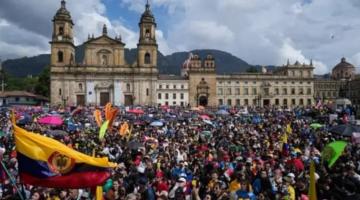 Thousands of people took to the streets across Colombia on Wednesday in the first national strike against President Abelardo de la Espriella’s administration, as police used tear gas, rubber bullets…


