Erik Prince, the founder of Blackwater, at the Conservative Political Action Conference (CPAC). © Zach D Roberts / NurPhoto via AFP
Erik Prince's mercenary operations in the Democratic Republic of the Congo serve U.S. imperial and corporate interests in critical minerals rather than the Congolese people's need for security.
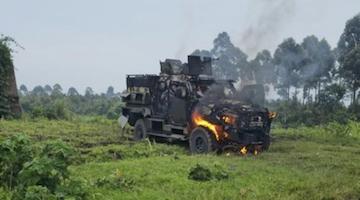
A lot of news has circulated across various global media platforms following reports that militias affiliated with Erik Prince—the U.S. billionaire and founder of the infamous military contractor Blackwater, which has a track record of abuses and killings in several Global South countries—suffered significant field losses in the eastern Democratic Republic of the Congo. This followed an ambush that resulted in the death and injury of at least 20 people, including Tim Kennedy, a famous UFC athlete and former US Army Special Forces soldier.
Erik Prince is a U.S. businessman and former US Navy SEAL who founded Blackwater in 1997, transforming it into one of the world's most notorious military mercenary companies. He capitalized on the U.S. military's growing reliance on private military and security firms to provide paid combat and security services. Educated at Hillsdale College, a conservative religious institution, he later served in the US Navy SEALs. His career illustrates the intersection of private capitalist interests and U.S. military expansion, where wars and military interventions become profit-making ventures. After selling Blackwater in 2010, Prince continued his operations through other companies and networks, including Frontier Services Group, which expanded into providing logistical and security services for commercial and mining projects in Africa. In recent years, he branched out through Vectus Global, whose activities in the DRC expanded from collecting mineral resource revenues to providing operational support to the Congolese army.
Under President Felix Tshisekedi, a documented attempt to enlist foreign military contractors (mercenaries) dates back to 2023. At the time, the Rwanda-backed M23 militia was making field advances in North Kivu province, and the government was looking for ways to bolster its military capabilities and secure mining areas in the east. In this context, a plan was revived to bring in about 2,500 military contractors from Colombia, Mexico, and Argentina to halt the rebel advance and secure mineral-rich regions. Preparations included establishing barracks in Mubambiro, near Sake and adjacent to a Congo Protection training camp, to host the first batch in late July 2023. Containers of equipment arrived at the site that same month. Erik Prince spearheaded the negotiations to deploy these foreign contractors, part of a plan heavily promoted by Kahumbu Bula Mandungu, known as "Kao," an advisor to President Tshisekedi, amid reports linking the scheme to arrangements between Kinshasa and Abu Dhabi. Ultimately, the project stalled, and the Latin American contractors never arrived in the DRC.
Prince returned to the Congolese scene through a seemingly different avenue in late 2024, striking an agreement with the Congolese government to improve public revenue collection from the mining sector and combat mineral smuggling in copper- and cobalt-rich areas. The government signed a five-year deal with Prince through a network of commercial shell entities. In June 2025, Quantum Global Consulting, a UAE-based firm linked to Prince, registered a subsidiary in the DRC, Quantum Global Consulting Africa, to act as its legal representative. This subsidiary then registered Vectus Global as a local legal entity. The contract with the Congolese Ministry of Finance included a financial mandate to increase government revenues from extractive industries while curbing smuggling, corruption, and tax evasion. However, it also contained a secret military component: advising the Congolese Armed Forces, providing aerial capabilities, and recruiting foreign military personnel. The contract was valued at approximately $700 million over five years.
The initial plan involved dispatching about 100 advisors and technical experts to monitor mining operations and revenues, starting with major mines before gradually expanding. The goal was to improve the oversight of production and exports and ensure compliance with the Congolese mining code. The priority was the Katanga region, particularly around the city of Kolwezi, the hub of the copper and cobalt industry. This area was far from the main combat zones where the M23 militia operated in North Kivu.
A major turning point occurred in late 2025 and early 2026 as the war in eastern Congo escalated, spreading to strategic areas in South Kivu. This was especially pronounced after the M23 militia seized Uvira, a key city on the Burundian border along the shores of Lake Tanganyika. This posed a severe threat to the Kinshasa government. In response, Erik Prince, through Vectus Global, deployed a team to support the Congolese army in the region. The mission involved operating drones and providing operational support to government forces, marking the first known participation of Prince’s forces in frontline combat operations within the DRC.
The military activity of foreign contractors in Congo was not limited to Americans. Israeli military advisors worked in coordination with Prince, participating in training two Congolese Special Forces battalions for day and night operations. Contractors from El Salvador, mostly former military and police personnel, were also recruited. A July 2026 report by the Critical Threats Project noted that in April of that year, the Congolese government announced the UAE's commitment to help fund the training of a paramilitary force exceeding 20,000 personnel, ostensibly to protect mines in the south. Two months earlier, the UAE had dispatched a government and trade delegation to Lualaba province, holding meetings in Kolwezi with officials from the mining, energy, and infrastructure sectors, culminating in the announcement of 16 memorandums of understanding across multiple fields.
Prince is a staunch supporter of Donald Trump, and his company's activities in Congo intersect closely with Washington's economic and security objectives. His forces were deployed at a time when the Trump administration sought to link economic and security cooperation with Kinshasa to securing broader access for American companies in the critical minerals sector. This was framed as an effort to counter Chinese influence, rather than a genuine push to defeat M23 or contain the ambitions of Rwandan President Paul Kagame. On March 2, 2026, the US Treasury Department sanctioned the Rwandan Defense Forces and four of its senior officials. On June 25 of the same year, it sanctioned a Rwandan gold refinery and a network accused of smuggling minerals from Congolese territory controlled by M23. Yet, these measures failed to dismantle the smuggling networks, resolve the conflict, stop the militia's atrocities, or cut off the crucial Rwandan support driving M23's expansion. A March 8, 2026, Washington Post investigation cited a US official stating that Paul Kagame successfully delayed the sanctions for several months by reaching out to Senator Lindsey Graham, who intervened with the White House. The report noted that Graham served as an advisor to Trump—a detail previously highlighted by the Wall Street Journal—illustrating the limits of American pressure. According to the official's account, these high-level political channels allowed Kagame to buy time.
The US-Congolese agreement established a mechanism called the Strategic Asset Reserve. Under this framework, American investors receive the right of first refusal on listed projects and preferential access to specific investment opportunities in the Congolese resource sector. In April 2026, Reuters published an investigation detailing how Virtus Minerals, an American company, acquired Chemaf's mining assets for $30 million. In February 2026, a proposed deal emerged to sell a 40% stake in the Mutanda and Kamoto Copper Company mines to the Orion Critical Mineral Consortium, backed by the US International Development Finance Corporation (DFC) and the UAE's ADQ fund. These deals positioned American and Emirati investors prominently within Congolese copper and cobalt assets. The clearest indicator of US objectives is the Lobito Corridor project, which links mining zones in Congo and Zambia to the Atlantic port of Lobito via Angola. The US supports this project through development financing and infrastructure investments, aiming to create an alternative export route for Congolese copper and cobalt to Western markets, bypassing trade networks linked to East and Southern Africa or those dominated by Chinese firms.
Erik Prince and his state backers are not the saviors the Congolese people are waiting for to end militia violence and Rwandan interference. The man the Congolese government has hired for security and military services is neither a neutral mediator nor someone operating outside the very interests that fuel and profit from these conflicts. He is a criminal who embodies the nexus between capitalist economic interests, the privatization of warfare, and the defense of US imperial hegemony. This is not just an assumption; in an episode of his podcast Off Leash, Prince explicitly called for the US to resume a direct imperial role, stating it was time to "put the imperial hat back on" and govern countries he claimed are incapable of governing themselves. He made sweeping racist generalizations about Africa, asserting that most of its nations cannot manage their own affairs. When his co-host, Mark Serrano, pointed out that this sounded like a call for a return to colonialism, Prince replied bluntly: "Absolutely, yes!"



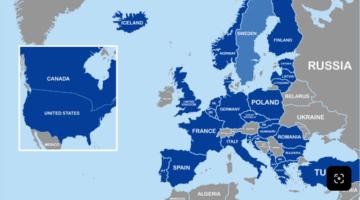 European puppet states have undermined themselves and their peoples' needs at the behest of the U.S. Now, that subservience may lead to war.
 Marco Rubio's appeals to Western civilization, Christian heritage, and the defense of Western dominance are fundamental to the consolidating global fascist project, functioning to transform a crisis…
 “So we started to preach the doctrine of self-organization. And we made it very clear what we were after — the genuine multiracial and democratic power of the working people.”
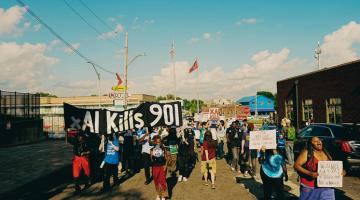 Artificial intelligence and hyperscale data center buildout constitute a new front of environmental racism and a project to optimize white supremacy, with Black communities targeted as sacrifice…
 Mali, Burkina Faso, and Niger are leading the way toward the realization of Pan-Africanism and Internationalism in the 21st century.


