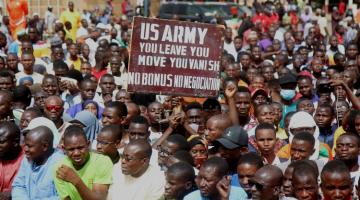
Nigerians protest against the "Christian genocide" in Trafalgar Square, London. Photo: ALAMY
A false narrative of "Christian genocide" is being weaponized against Nigeria, which is itself victimized by western neo-colonial policies.
U.S. politicians, like Senator Ted Cruz and media personality Bill Maher, have embarked on a campaign alleging a “Christian genocide” in Nigeria, with Cruz citing a dubious figure of 50,000 Christians killed since 2009 and Maher inflating this even further to over 100,000. This narrative is false. To understand this sudden and dubious campaign, however, we must apply the science of dialectical materialism, moving beyond the idealist, religious narrative they promote to analyze the concrete, material conditions that form the base of its claims. This narrative of a “Christian genocide” is not a spontaneous expression of moral concern by these US characters, but a superstructural weapon. In Marxist theory, the ideological superstructure refers to the realm of ideas, culture, religion, and political narratives that are built upon and serve to justify the economic "base" of a society—its mode of production and class relations. This narrative is an ideological tool emerging from the fundamental, material base of imperialist political economy. Its function is to mystify the real, antagonistic class contradictions in Nigeria and provide a pretext for deepening neo-colonial control.
Furthermore, this superstructural narrative serves a vital secondary function: deflecting from and justifying the ongoing genocide in Gaza. By loudly promoting the false specter of a "Christian genocide" in Nigeria, figures like Maher and Cruz are advancing a core Zionist talking point. This point claims that the world, driven by antisemitism, unfairly singles out Israel while ignoring the "real" persecution of minorities elsewhere, in this case, Christians by Muslims. Maher made this explicit, stating the violence in Nigeria is being ignored because "Jews aren't involved." This is a deliberate, cynical falsehood. The massive global movement in support of Palestine is a response to the ICJ-recognized genocide, decades of military occupation, and a system of apartheid, documented by leading human rights organizations. The "Christian genocide" narrative is manufactured to create a moral equivalence where none exists, painting Muslims as perpetual aggressors and Israel as a victim of biased scrutiny. It is a propaganda tool designed to shield the Israeli state from accountability by inventing a rival, and entirely fictional, humanitarian crisis.
Crucially, this false narrative is being directly challenged and debunked by the Nigerian people and their government. The Nigerian government, through its Minister of Information Mohammed Idris, has stated unequivocally that portraying the violence as a targeted campaign against Christians is “a gross misrepresentation of reality.” The Nigerian Senate has introduced a motion to counter this dangerous misinformation, affirming that the country's security challenges are complex and affect citizens of all faiths. Nigerians themselves are insisting that their reality is one of multifaceted conflict driven by material factors, not a one-sided religious war.
In Nigerian society, the primary, antagonistic contradiction is between the interests of international monopoly capital, supported by its domestic comprador allies, and the interests of the Nigerian working class and peasantry.
This contradiction comes from the brutal economic shock therapy prescribed by institutions like the World Bank and IMF and implemented by President Bola Tinubu. The removal of the fuel subsidy and the free-floating of the Naira currency were not mere policy adjustments; they were qualitative acts of class war designed to fully subordinate Nigeria’s economy to the dictates of global capital. The quantitative changes, a 488% fuel price hike, a currency devalued to a fraction of its worth, have reached their limit, leading to a qualitative transformation of society into a state of unprecedented hunger, sparking “Hunger Protests” that were violently suppressed. This is a clear manifestation of the law of transformation from quantity to quality: gradual economic pressures have precipitated a sudden, leap-like transformation in the social fabric, pushing millions into poverty.
This collapsing economic base directly generates and intensifies the secondary contradictions that are now being mislabeled as a religious war. The conflict in the Middle Belt, often cited as evidence of persecution, is a clear example of the struggle of opposites over dwindling material resources. This is a manifestation of the “unity of opposites”: the predominantly Muslim Fulani pastoralists and Christian farmers are locked in a conflict that defines them as a single, interconnected system. They are "united" not in cooperation, but in their mutual dependence within the same exploitative economic framework, a system that pits them against each other in a desperate, zero-sum competition for survival. Their struggle is not a holy war but a direct consequence of an economy engineered for their shared deprivation.
But westerners such as Cruz and Maher are depicting these conflicts only in religious terms. Their claims are backed by reports of groups like Intersociety, which attributes 7,087 Christian deaths in 220 days to 22 jihadist organizations. By collapsing the distinct crises of Boko Haram's anti-state insurgency (whose primary victims are Muslims), resource-based farmer-herder conflicts, and profit-driven criminal banditry into a single, religiously-defined category. In other words, these reports impose a simplistic, Manichean framework onto a complex society, willfully ignoring the historical context and material roots of the issue. This is the core of neo-colonial knowledge production: Western-aligned institutions become the sole arbiters of truth, defining and quantifying suffering on their own idealist terms.
To define this conflict issue on purely religious terms is dubious on the part of westerners. For anti-imperialists, we risk making an error if we follow the same logic. What is happening in Nigeria must be analyzed through a materialist lens. From this collapsing material base – in Nigeria and elsewhere – arises the ideological superstructure. As materialist philosophy teaches, our ideas, which are a product of the material world, determine our behavior, which in turn impacts the material world. The ruling classes, both foreign and domestic, have a vested interest in preventing the Nigerian masses from developing a correct, scientific understanding of their predicament. Falling for the trap that this conflict is primarily a religious one allows mystification of its real material origins and consequences. Doing so redirects the legitimate anger of a Christian farmer, whose livelihood is destroyed by World Bank policies, away from the comprador bourgeoisie and international finance capital, and towards a Muslim “other.” This is a classic application of the law of contradiction to divide the oppressed. It prevents the unity of the working class and peasantry across religious lines, thereby retarding the development of a revolutionary class consciousness that could challenge the real source of their shared immiseration.
Furthermore, this superstructural narrative serves as the antithesis generated by Nigeria's defiance of imperialist foreign policy. Nigeria’s support for Palestine at the UN, where Vice President Kashim Shettima argued for a two-state solution, was a direct challenge to the U.S.-Zionist designs. The materialist dialectic shows that every action provokes a reaction. The political and ideological reaction from imperialism is the manufactured crisis of a “Christian genocide.” The calls from Congressman Riley Moore and Senator Ted Cruz to designate Nigeria as a “Country of Particular Concern” (CPC) are not humanitarianism; they are the political expression of an economic agenda. As Cruz stated, his “Nigeria Religious Freedom Accountability Act” aims to “impose real costs on the Nigerian officials.” This is a tool to discipline a nation that steps out of line, ensuring the Nigerian state remains a pliable instrument for extraction. The goal, as explicitly stated by Emeka Umeagbalasi of Intersociety, is to frame this as a civilizational struggle, an “Islamization agenda” and a modern “jihad,” which perfectly serves the imperialist objective of framing a complex class struggle as a primordial religious war.
The current situation presents a stark choice of syntheses. In dialectics, a synthesis is the new stage of development that resolves the conflict between a thesis (the existing status quo) and its antithesis (the force opposing it). The synthesis offered by imperialism is more of the same: deeper austerity, more privatization, and intensified sectarian division. This path leads only to barbarism.
However, the law of negation reveals the potential for a revolutionary synthesis. This law describes how development occurs through successive overcomings: a new form (the negation) replaces the old, but is itself eventually replaced (negated in turn), leading to a higher level of development. The Nigerian state's violent crackdown on “Hunger Protests,” which left at least 24 dead, is a moment of open, antagonistic contradiction. It exposes the state's true nature as a committee for managing the affairs of the comprador bourgeoisie and their foreign masters. This “negation” of the people's right to protest is, in turn, generating its own negation: the deepening resistance and the potential for the old state structure to be overthrown. The Nigerian Senate’s motion to counter the “Christian genocide” narrative, sponsored by senators from diverse regions, is an attempt by sections of the state apparatus to manage this contradiction and preserve national unity against external manipulation.
The path forward is for the Nigerian masses to achieve a correct, scientific analysis of their conditions. They must see that the struggle of the Christian farmer in Benue and the Muslim worker in Kano are one and the same, a struggle against the capitalist system that impoverishes them both.
The task is to champion class consciousness and unite on the basis of shared material interest, transcending the ideological superstructure of religious division. The struggle is not between the mosque and the church, but between the masses who produce the wealth and the bourgeoisie who appropriate it. The only true resolution is the revolutionary negation of the capitalist relations of production. This negation, as the law dictates, will not destroy everything of the old society. It will retain the productive forces and all that is valuable in science and culture, but it will fundamentally resolve the antagonistic class contradiction in favor of the oppressed. The choice for Nigeria is not between a Christian or Muslim future, but between a future for the exploiters or a future for the exploited masses, a future won through the scientific application of revolutionary theory against the neo-colonial weapon of division. The unity of the colonized and oppressed, across all religious lines, is the only force capable of negating the current state of barbarism and achieving a truly liberated synthesis, a new, higher form of social organization free from both imperialist and comprador domination.
Tunde Osazua is the National Co-Coordinator of the Black Alliance for Peace and a member of the Steering Committee of the International Campaign to Free Kamau Sadiki.


 The 2026 French uprising is a continuation of the anti-colonial struggle, rooted in the 1961 Paris massacre of Algerians and the ongoing neocolonial relationship between France and its former…
 Disregard for Palestinian rights is a feature of Israeli politics rather than a bug. The upcoming Knesset election will change nothing for Palestinians, because every candidate across the political…
 Thousands of people took to the streets across Colombia on Wednesday in the first national strike against President Abelardo de la Espriella’s administration, as police used tear gas, rubber bullets…
 As we are experiencing a world order in disorder, with war and conflagrations and a shifting balance of power, Issa Shivji calls for a Sovereign Pan-African Project. The analyses recap the…
 In this week’s segment, we see through supposed disagreements between the US and Canada and recognize their partnership in settler colonialism, enslavement, and imperialism. But we begin with a…


