The West, especially the U.S. has kept Haiti in a state of instability in order to achieve its imperialist aims. The violence we see today in the country is the result of the violence inflicted on it for centuries. Now, the only way for Haiti to finally gain its sovereignty and stability is to choose a different solution that prioritizes peace through dialogue.
Originally published in CEPR.
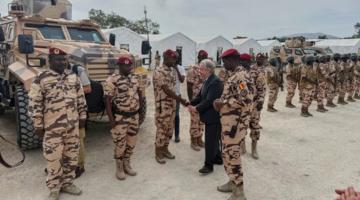
At 9:16 a.m. on June 25, a Kenya Airways plane touched down in Port-au-Prince, Haiti. On board were some 200 Kenyan police, the vanguard of the Multinational Security Support (MSS) mission approved by the United Nations Security Council late last year. Eventually, the force is expected to consist of 2,500 officers from at least a half dozen countries who will be tasked with restoring security and clearing the way for free and fair elections.
It’s certainly not the first such mission in Haiti, where, since the mid-1990s, there have been nearly constant UN and foreign security deployments. Almost 10,000 troops were stationed in Haiti between 2004 and 2017, only to be replaced by a smaller successor mission. It was only five years ago that the last foreign officers departed the country.
Since that time, violence and insecurity have indeed gotten significantly worse, but not simply because they left. While providing some superficial short-term improvements, those interventions ended up undermining local institutions, including the Haitian National Police (HNP), and eroding democracy. They provided stability, but for an inherently unsustainable status quo — paving the way for the situation today, where armed groups exert control over large swaths of the capital; the free movement of people and goods is impossible; more than half a million people have been displaced; and, in many communities, death has become a daily risk.
As foreign powers debated the deployment of yet another force to Haiti, we heard the consistent refrain that they had “learned the lessons of the past.” This time, it would be different. Yet even as the first boots hit the ground, there remain myriad outstanding questions.
There are no clear rules of engagement, no announced accountability or oversight mechanisms, nor even a concrete timeline. It is not apparent who, ultimately, will be in charge. Authorized by the UN Security Council, led by Kenya, financed by the US, and all ostensibly in support of the Haitian authorities, nobody can yet say with whom the buck stops.
Perhaps the biggest question is: what will be the actual strategy to deal with the nearly 200 armed groups that have been terrorizing the population? The answer to that question will have massive implications for whatever comes next. The risk of civilian harm, as armed foreign troops potentially shoot it out with gangs amid densely populated neighborhoods, is obvious. But already the various actors involved have expressed at-times contradictory ideas.
During a visit to Washington, DC in May for a state dinner at the White House, Kenyan president William Ruto pledged to “break the back” of the gangs. “They have no religion. They have no language,” and must be dealt with “firmly, decisively,” Ruto, a staunch Evangelical, said. Not long after, US Ambassador to Haiti Dennis Hankins gave members of armed groups a stark choice: “The cemetery or jail.”
The next day, UNICEF released a report estimating that up to 50 percent of those in the armed groups are children who are “pushed to join … out of pure desperation, including horrific violence, poverty and a breakdown in the systems that should protect them.” Though likely an overestimate, it highlights the dangers of an iron-fisted approach to the ongoing violence.
Are their only options now death or the rest of their lives in a jail cell? And what incentive does that provide for ending the terror today?
Striking a different tone was Leslie Voltaire, a member of Haiti’s transitional presidential council (TPC), which took the reins of the country’s government this spring following US-backed political negotiations. He suggested that, while “nobody favors amnesty,” the council would create a truth and justice committee to facilitate gang members disarming, appearing before victims, and repenting.
The day before the arrival of the Kenyans, Jimmy “Barbecue” Cherizier, a former cop and the self-declared leader of the Living Together gang coalition, released a video appealing directly to the recently installed prime minister, Gary Conille. “We need dialogue today, prime minister,” he pleaded.
“The response is clear,” Conille said days later while flanked by top Kenyan security officials. “First, the weapons must be surrendered; then, recognize the authority of the Haitian state … and we will see what we can do.”
Though not closing the door to peace talks, Conille’s response reveals a deeper misunderstanding of the crisis. What state authority does Conille refer to? His own? He was not elected, nor appointed or confirmed by any elected representatives. There hasn’t been a vote since 2016. What’s the rationale for recognizing the authority of a state that is as responsible for the violence as any armed group? Even before the deterioration of the security situation, the state was barely present in most Haitians’ lives. It is not just the country’s armed groups the state must win over, but the population itself — and one cannot wait for the other.
While calls for dialogue are often interpreted as support for gangs or as an effort to ensure impunity continues, that does not need to be the case.
Dialogue is not an abdication of justice. If done correctly, it could be an essential first step, not only in ending the violence and delivering the justice that victims deserve but in refounding a state that has failed the population writ large. Dialogue offers an opportunity to end the cycle of instability while rendering the question of an ill-defined and open-ended foreign intervention moot.
Haiti’s gangs are often portrayed as monolithic, but they encompass a diverse array of actors. They operate in different ways: some remain deeply enmeshed within their communities, others as occupying forces. Some have been around for decades; others represent a newer generation. Some have political ambitions, while others seek only to further enrich themselves and their supporters. Some serve as mercenaries for economic or political interests; others act independently.
None of this is meant to downplay or ignore the horrors inflicted on the population. Mass rapes, often perpetrated in front of family members, have been common. Entire communities have been burned to the ground. Symbols of the state such as police stations and ministries have been attacked; universities, pharmacies, and hospitals have been pillaged and destroyed. Many street vendors, the backbone of commerce in the capital, have lost everything. In some areas, schools have been closed for two years. An entire generation has been traumatized.
At the root of the crisis, however, is a quiet, pervasive, and systemic violence that has been magnified and reflected outward, that has traumatized the traumatizers. Of course, not all of those with automatic weapons are children or young men forced to commit such heinous acts. Some have chosen this path, well aware of the harm caused.
Still, the violence today stems from a broken social contract, from the absence of the state, and from the disenfranchisement of the impoverished majority in a country with the worst inequality in the region. This reality has been perpetuated by the armed groups’ bombastic leaders, by the graying political and economic elite in their suits and ties, and even by the men and women in uniform tasked with protecting the population — not to mention the omnipresent international community, most specifically the United States. The lines between each group fade upon closer inspection, forming a solid mass of repression surrounding those most harmed by the status quo.
In early April, all the sectors represented in the presidential council signed a political accord outlining their shared priorities in this transitional period. Among the initiatives is a national dialogue to bring all sectors of life together, as well as the formation of a truth, justice, and reparations committee. These are not ideas to put on the back burner to be picked up after a foreign military intervention provides security; rather, they are an essential part of any lasting security strategy, which must address all forms of insecurity, including those affecting livelihoods, food, water, health, and education.
First, because justice cannot just mean the cemetery or jail for those wielding weapons of war. It also requires dismantling the elite networks that have nurtured and supported the gangs, and who are welcomed at the negotiating table on a daily basis. The testimony of individuals, even those responsible for heinous crimes, is the only way to ensure accountability extends beyond the streets.
Second, because real stability will require building trust in the state. The goal of this transition period is to eventually hold free and fair elections. But that is easier said than done, and even if well-organized, trust in the process is abysmally low. The last election saw turnout of 18 percent; a repeat of that will not help anything. A dialogue process that can actually engage the citizenry offers an opportunity to begin repairing that broken relationship while identifying a new generation of leaders.
That is why I think a dialogue process is necessary, as is what could possibly be achieved through it. But how to actually go about making that a reality?
I don’t have all the answers, but the place to start would be by asking the communities most affected what they want, not just today but moving forward. What do the hundreds of thousands displaced by violence think can sustainably stop it? How about those still living in gang-controlled neighborhoods — those who are likely to be collateral damage in the looming intervention, but on whose behalf that intervention is ostensibly being pursued? In the absence of the state, communities have taken their safety, and the provision of justice, into their own hands — as witnessed through the proliferation of neighborhood watches, makeshift barricades, and the Bwa Kale vigilante movement targeting suspected gang members.
Dialogue cannot simply be a negotiation between armed actors and the state, nor does it necessarily mean giving the loudest voices a seat at the table or declaring a blanket amnesty for the heinous crimes committed. Peasant organizations, long defined as second-class citizens by the state, need a seat at the table. Women’s groups, especially given the lack of representation in government, must be involved. Grassroots organizations from the impoverished communities in the capital need to be engaged. The madan sara, the women who bring food from the provinces to feed the capital, could play a critical role as they have served as a bridge between Haiti’s divergent realities for decades.
The state must play the leading role but that doesn’t mean it will not need help. There are many organizations and individuals in Haiti already pursuing these types of solutions, although on a much smaller scale. Civil society’s engagement is crucial. Countries across the globe have offered to send troops to fight the gangs. Surely some could offer their expertise and wisdom on the process of reconciliation and peace. Colombia, which has pursued its own — no doubt at times fraught — peace process, would be a natural ally. Earlier this year, Colombian president Gustavo Petro, speaking alongside President Luiz Inacio Lula da Silva of Brazil, spoke about a “peace plan” for Haiti. Both countries are evaluating how they might help with such an effort if the Haitian state were interested. One key lesson from the Colombian experience is that peace is not just about incentivizing criminals to give up the game; it’s also about giving communities a reason to trust the state. That work is far more difficult, but it is one that could offer some hope of a different future and not just the restoration of the status quo.
The looming foreign intervention has been presented as the only path forward. It doesn’t have to be. Instead, it is long past time to give peace a chance.
Jake Johnston is a Senior Research Associate at the Center for Economic and Policy Research in Washington, D.C.


 “So the calypso ceases to be entertainment on a trivial level and becomes a vehicle whereby the society is going back and searching for its soul.”
 The protests spreading across Spain, India, France, Chile, and other countries are responses to the global neoliberal order of austerity, privatization, and deregulation.
 Chile, Colombia, Bolivia, Honduras, Peru, and Costa Rica have all elected right-wing presidents in the past year, and most are open Trump allies. Brazil's runoff between Lula and Flávio Bolsonaro is…
 October 7, 2023, was not an isolated attack, but the culmination of generations of Palestinian imprisonment and resistance in Gaza, comparable to Nat Turner's rebellion. History will record the Al…


