by Sikivu Hutchinson
Enormous pressures push African Americans to embrace a Black “hyper-religiosity” – or, at least, to profess to it – despite the fact that “the proliferation of storefront churches in urban black communities is a symptom of economic underdevelopment.” However, “a growing segment” maintains that “morality is defined by just deeds, fairness, equality and respect for difference; not by how blusteringly one claims to adhere to ‘Godly’ principles.”
Not Knocking on Heaven’s Door: Black Atheists, Urban America
by Sikivu Hutchinson
“Racial segregation, the historical role of the Black Church, and African American social conformity reinforce Christianity’s powerful hold on black communities.”
Late Saturday afternoon, like clockwork, the street corner preachers on Crenshaw and King Boulevard in South Los Angeles take to the “stage.” Decked out in flowing robes and dreadlocks, they fulminate into their mikes about the universe, God’s will and “unnatural” homosexuals to a motley audience waiting for the next express bus. Members of the Black Israelites, they are part of a long tradition of performative religiosity in urban African American communities. This particular corner of black America is a hotbed of social commerce. Kids who’ve just gotten out of school mingle jubilantly as pedestrians flow past fast food places, mom and pop retailers, street vendors and Jehovah’s Witness’ hawking Watchtower magazines. The Israelites have become a fixture of this street corner’s otherwise shifting tableaux. Exclusively male and virulently sexist and homophobic, they are tolerated in some African American communities in part because of the lingering visceral appeal of Black nationalism.
While the Israelites’ millennialist “racial uplift” ethos ostensibly fits right in to the bustle of this prominent South L.A. street, other belief systems are not as easily assimilated. Since 2006, the L.A.-based street philosopher Jeffrey “P Funk” Mitchell has been documenting his conversations with everyday folk on questions of atheism and faith. Using the handle “Atheist Walking,” Mitchell also conducts free-ranging inquiries into Christianity’s contradictions with a rolling video camera and a satirically raised eyebrow. Adopting the role of the bemused urban flaneur, ala the commentator-pedestrian immortalized by French poet Charles Baudelaire, he delves into “atheist spirituality,” biblical literalism and the paradoxes of faith.
“There is a longing for community amongst non-theist African Americans who feel marginalized in a sea of black hyper-religiosity.”
Mitchell is a member of the L.A.-based Black Skeptics, a group that was formed earlier this year to provide an outlet and platform for secular humanist African Americans. The Skeptics are part of a small but growing segment of African Americans who are searching for humanist alternatives to organized religion. In May, the Washington DC Center for Inquiry’s first annual African Americans for Humanism conference drew over fifty participants. Chat groups and websites like the Black Atheists of America have sprung up to accommodate the longing for community amongst non-theist African Americans who feel marginalized in a sea of black hyper-religiosity. Organizations such as the Institute for Humanist Studies cultivate African American secularist scholarship and advocacy.
With over 85% of African Americans professing religious belief, black religiosity is a formidable influence. Racial segregation, the historical role of the Black Church, and African American social conformity reinforce Christianity’s powerful hold on black communities. Indeed, I was recently told that I’d been deemed an unsuitable culmination speaker for a bourgie philanthropic organization’s young women mentees because of my decidedly unladylike public atheism (Perhaps the Israelite’s Old Testament shout-out to silent prostrate women would be more acceptable). Proper role models for impressionable black youth are, at the very least, skillful church lady pretenders with ornate hats in tow. Secular organizations that seek to build humanist community with a predominantly African American base and social justice worldview are challenged by the association of charitable giving, philanthropy, poverty work and education with faith-based communities. For many, successfully emulating the strong social and cultural networks that have sustained church congregations is an elusive goal.
“Humanism asks why we should cede enlightenment and the potential for restoration to the supernatural.”
And then, there is the deep and abiding desire for belief in the supernatural, the ineffable faith-passion that propels some through the trauma of racial indignities and personal crisis. Yet, humanism asks why we should cede enlightenment and the potential for restoration to the supernatural. Humanism challenges the implication that the sublimity of the natural world, and our connection to those that we love, admire and respect, is somehow impoverished without a divine creator. In one of his bus stop monologues, Mitchell comments, “I want people to look at each other with the same reverence that they look at God and realize that ‘we’ did this, we made this happen.” The “we” represents will, agency, and motive force; qualities that many believers would attribute to God as omniscient architect and overseer. Non-believers are compelled to ask whether individual actions (for good or ill) are determined by God, or whether human beings simply act on their own volition in a universe overseen by God. Since time immemorial, non-believers have questioned whether God exercises control over those who commit evil acts or whether hell is the only “medium” for justice. By refusing to invest supernatural forces with divine authority over human affairs, humanism emphasizes human responsibility for the outcome of our pursuits. Morality is defined by just deeds, fairness, equality and respect for difference; not by how blusteringly one claims to adhere to “Godly” principles.
“Religious dogma anesthetizes as it bonds.”
However, in communities that are plagued with double digit unemployment and a sense of cultural devaluation, notions of self-sufficiency and ultimate human agency may be perceived as demoralizing if not dangerously radical. As a child preacher steeped in the fiery oratory of the Black Church, writer James Baldwin recounted his growing cynicism about spreading “the gospel.” Lamenting the grip of religion on poor blacks, Baldwin said, “When I faced a congregation, it began to take all the strength I had not to…tell them to throw away their Bibles and get off their knees and go home and organize.” In Baldwin’s view organized religion’s requirement that believers suspend disbelief and submit to “God’s will” is a liability for working class African Americans. Religious dogma anesthetizes as it bonds, a dangerous combination in an era in which the proliferation of storefront churches in urban black communities is a symptom of economic underdevelopment.
Echoing Baldwin, Chicago-based Education professor and atheist Kamau Rashid argues that “Freethought is an extension and expression of the struggle that African Americans have waged for self-determination. In fact it represents a heightened phase of such a struggle wherein one of the final stages of ‘conceptual incarceration,’ the belief in a God or gods, is discarded for a belief in the human potential, for a belief in ourselves.”
And why, in a heritage steeped in the revolutionary thought of such dirty outlaw skeptics as Frederick Douglass, W.E.B. DuBois, Baldwin, Zora Neale Hurston, Langston Hughes, Nella Larsen, A. Philip Randolph, James Forman and Alice Walker, would this be so viscerally frightening?
Sikivu Hutchinson is the editor of blackfemlens.org and a senior fellow for the Washington D.C.-based Institute for Humanist Studies.

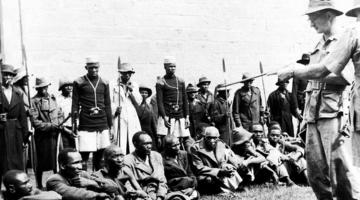 The British sought to cover up their atrocities in Africa and the Caribbean by manipulating information to obfuscate history.
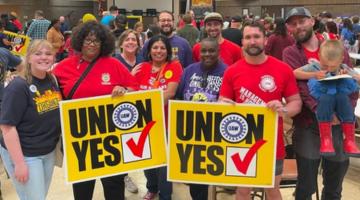 The vote by Volkswagon workers in Tenessee to unionize with the United Auto Workers union is a clear indication that it is possible to organize in the South.
 The destruction of the environment and acceleration of the climate crisis happen silently under the veil of “national security,” despite the fact that the environmental toll of war is the most…
 This week we discuss the proliferation of lies about non-citizen voting and U.S. policy toward Niger. First, we talk to Danny Haiphong about U.S. policy toward China and what we can learn from…
 We are joined by Danny Haiphong to discuss the current delegation to China that Margaret Kimberley has joined, U.S./China relations, and the importance of studying Chinese socialism.


