The Inescapable Tasks Africa's Leaders Try to Ignore
by Mark P. Fancher
"The continent will be unable to address its many
problems and take its place in the world as long as it is broken into 53 little
pieces."
There was a time when the mere mention of the word "Algeria"
triggered euphoric intoxication for many revolutionaries and would-be
revolutionaries throughout Africa and the African Diaspora. This was due in no
small part to the fact that in the 1960s, Martinique-born psychiatrist Frantz
Fanon fired the imaginations of many by enlisting in the armed struggle for
Algeria's independence, and then recording his observations and analyses in a
series of books. The best known of his works, Wretched of the Earth,
became a Bible of sorts for the Black Panther Party, and required reading for
all other self-styled "Black militants." To top it all off, when
Panther leader Eldridge Cleaver went into exile, he found in Algeria a
sanctuary for freedom fighters from throughout the world.
Nearly five decades later, and after a series of government shake-ups, the
Algeria of revolutionary dreams has been supplanted by a country that like so
many other former colonies struggles in quiet desperation to cope with
colonialism's seemingly unshakeable legacy. Not long ago, a BBC periodical
reported that Algeria's economy, which is powered by oil and gas production, is
booming. It has made it possible for the country to reduce its foreign debt by
$23 billion over the last nine years. However, it is not possible for Algeria, or
any African country to exist as an island, and the economic woes of the
country's neighbors have a considerable impact on efforts to maintain domestic
stability and continuing growth. A reported 30,000 Africans from neighboring
countries attempt to migrate into Algeria each year in search of opportunities
to work there or to book passage to Europe. The population influx has
reportedly strained not only the economy, but also relations between Algerians
and immigrants who are perceived to be taking limited jobs. On the other end of
the continent, rampant xenophobic attacks have reportedly caused thousands of
immigrants from Malawi, Mozambique, Zimbabwe and other neighboring states to
flee South Africa and return en masse to their home countries.
Although African countries have made valiant attempts
since the defeat of colonialism to go it alone, parochialism does not fit
Africa well. Not only does it retard economic growth, it also creates problems
that would otherwise not exist. For example, if state boundaries were erased in
Africa, Algeria would be no more likely to have an "immigration
crisis" than would the state of New York if large numbers of New Jersey
residents were to cross the river in search of job opportunities in The Big
Apple. Whatever issues that might arise from such temporary population shifts
would become very manageable concerns of a larger sovereign rather than the
overwhelming headache of a relatively small micro-state. When African countries
can't avoid the spillover problems of their neighbors, national borders are
often an impediment to efficient resolution of those problems.
"Rampant xenophobic
attacks have reportedly caused thousands of immigrants from Malawi, Mozambique,
Zimbabwe and other neighboring states to flee South Africa."
Since at least 1945, progressive African leaders have urged the dissolution of
these borders and extolled the virtues and benefits of their vision of a united
Africa. It is difficult to forget their analysis because in all likelihood, on
each and every day, in every corner of the continent, the recorded voice of Bob
Marley can be heard demanding: "Africa unite for the benefit of your
people! Unite for it's later than you think!" Nevertheless, African unity
has proven to be a most elusive objective. This is likely a source of great
frustration for much of Africa's mass population because there is a growing
awareness that the continent will be unable to address its many problems and
take its place in the world as long as it is broken into 53 little pieces that are
easily managed, manipulated and exploited by multi-national corporations and
western states.
Many were encouraged when the African Union was established
several years ago. The announced plans for a continent-wide parliament, a
unified currency, relaxed border restrictions, and other projects appeared to
be movement in the right direction. At least one of the African Union's
planning documents designated the year 2025 as the target date for completion
of "continental integration." The African Union has even included the African
Diaspora in its plan. However, if the African Union has recognized that genuine
continental integration will require complete and total nationalization of
Africa's valuable natural resources, some of its publications suggest otherwise.
An African Union document promoting an economic development forum that was
scheduled for earlier this year stated:
"As a means of fast-tracking Africa's economic integration,
growth and development, the African Union has made private sector development a
priority area. This is in line with strategies adopted in most parts of the
continent, recognizing the private sector as the engine of growth, while
the public sector takes on the role of greasing the engine and ensuring an
enabling environment for the engine to effectively run."
This is not the path to the type of total economic
independence that will allow genuine African unity. History makes plain that
the mere presence of foreign and private corporations that dominate major
resources creates not only division and wholesale leeching of national wealth,
but also economic imbalances among the people of Africa that are the source of
destabilizing class tension. A so-called "free market" permits foreigners to
make mischief, facilitates the loss of Africans' control of their natural
resources, and encourages heads of state to feed their greed at the expense of
the mass population. Many neo-colonial puppet leaders are quite delighted with
being big fish (with big Swiss bank accounts) in their little micro-state
ponds. There is no way that they will lift even a finger to expel foreign
corporations from their countries.
"A so-called ‘free market' permits foreigners to make
mischief, facilitates the loss of Africans' control of their natural resources,
and encourages heads of state to feed their greed."
The challenge doesn't end there. Among much of
Africa's mass population, there is considerable national pride and jealous
protection of local tradition and culture that, in the absence of an informed,
comprehensive, continent-wide analysis likely causes a reluctance to surrender
identification with micro-states. And then in the Diaspora, there are legions
of Africans who don't buy the suggestion that, even if they feel no connection
to Africa, much of the rest of the world presumes the intimate connection of
all Black people everywhere to what is widely perceived to be a powerless,
hopeless continent. When that is the perception, it is much easier to target
African descended people for abuse and discrimination. Why not? Nobody who
should presumably care about these people - including an entire continent - has
the power to retaliate. Ignorance and confusion account for a lack of readiness
by Africans at every level to see that a continent-wide socialist national
structure and political unity do not require cultural homogenization or social
disruption.
Ultimately, a new united Africa can be a place where the people of Algeria,
South Africa and other African countries will not only open wide their arms to
visitors from neighboring states, but also play an active role in developing a
solution to the problems that prompt their neighbors to cross borders in the
first place. The solution to the poverty, unemployment, illness and internecine
violence that cause mass migrations can be found in a combination of both unity
and socialism. Unfortunately, there are no significant signs that most African
governments are anywhere close to embracing both elements of the solution.
Mark P. Fancher is a human rights lawyer, writer and member of the
All-African People's Revolutionary Party. He can be contacted at mfancher@comcast.net.

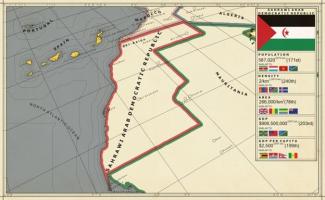 After 30 years of peace, the Polisario Front holds its 16th Congress amidst the war against Morocco’s invasion.
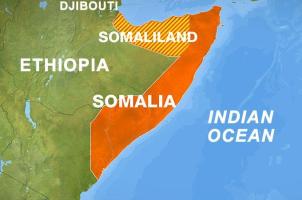 Even as the US and UK are increasingly legitimizing secessionist rule in Somaliland, whose sovereignty has no international recognition, a unionist movement seeking a united Somalia threatens to…
 Why have Europe's politicians followed U.S. dictates regarding Ukraine and undermined the wellbeing of their own nations? The influence wielded by the World Economic Forum's Young Global…
 The United States has targeted Nicaragua ever since the days of Ronald Reagan. Members of a recent delegation made observations that are far different from hostile narratives presented by the U.S.…
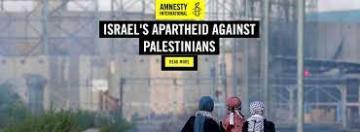 EU foreign policy chief Josep Borrell says that calling Israel an apartheid state is anti-Semitic.


