Operation Al Aqsa Flood was immediately cast as unprovoked terrorism. This review examines a work that dares to reframe it as the inevitable act of a people pushed to the brink.
Originally published in Cage International.
In The Sword and the Neck, the young Indian Marxist writer Yanis Iqbal offers one of the most intellectually ambitious and morally charged responses yet written to the events of 7 October 2023 and the devastating Israeli assault on Gaza that followed. It is not a work of journalism or policy. It is, rather, a philosophical intervention — a demand that we think the Palestinian struggle not through the soft abstractions of humanitarian pity, but through the hard categories of history, power, and class.
The book’s title evokes both the sword raised in rebellion and the neck bowed in submission — a pairing that Iqbal uses to explore the dialectic between domination and resistance. It begins with a long, impassioned preface by the American philosopher Daniel Tutt, who frames the book as a “call to arms for critical theory and Marxist thought in our time.” The argument unfolds across five dense chapters, ranging from an analysis of Zionism and apartheid within the “long arc of liberalism” to a critique of thinkers such as Edward Said, Slavoj Žižek, and Étienne Balibar.
Iqbal’s central thesis is stark: that Western liberal modernity — with its self-congratulatory language of human rights and democracy — is structurally complicit in the colonial domination of Palestine. Liberalism, he argues, has always been a creed of exclusion, a “community of the free” sustained by the subjugation of others. From the American Revolution’s slaveholding elites to South African apartheid, liberal democracy has relied on the violent production of racial and political outsiders. Zionism, in Iqbal’s view, is not an aberration from liberalism but one of its purest expressions — the belief that a “civilised” community may secure its freedom through the dispossession of a lesser race.
Against this metaphysics of the oppressor, Iqbal proposes what he calls the “physics of the oppressed”: a politics that begins not from ideals but from the material reality of ruins, blockades, and hunger. He insists that October 7 cannot be abstracted from history. To condemn it as “barbarism” without recognising the decades of systematic strangulation that produced it is, he says, to side with the coloniser’s narrative. Violence, in his account, is not an ethical anomaly but a historical necessity in the long process of decolonisation — a desperate act of reasserting life against a world that denies one’s right to exist.
The book’s intellectual scaffolding is unmistakably Marxist. Drawing on the Lebanese thinker Mahdi Amel, Iqbal reads Palestine as trapped within a “colonial mode of production,” in which capitalist exploitation coexists with archaic domination. The result, he argues, is that only revolutionary rupture — not reform — can break the chains that bind the Palestinian people to their colonisers. He criticises Edward Said for his “exilic cosmopolitanism” and Slavoj Žižek for his “abstract negativity,” both of which, he says, reflect the impotence of a bourgeois philosophy that has lost contact with reality. True solidarity, for Iqbal, is not moral sympathy but praxis: the active alignment of thought with the struggle for liberation.
There is much in this book that demands admiration. Iqbal writes with formidable clarity and moral courage. He refuses the lazy comfort of “both sides” discourse, exposing how calls for “peace” and “dialogue” often mask complicity in oppression. His reading of Zionism within the genealogy of Western liberalism is powerful and persuasive. So too is his refusal to separate Gaza’s tragedy from the wider history of colonial capitalism. One senses, in his writing, a fierce love for the oppressed and a genuine yearning for justice.
And yet, as a Muslim — and as someone who would call himself a gentle Muslim, seeking justice through compassion and steadfast faith — I cannot help but feel a deep sorrow as I close the book. For Iqbal’s world, though ablaze with moral intensity, seems to have no heavenly horizon. It is a universe stripped of transcendence, of mercy, of the divine telos that gives struggle its ultimate meaning.
His vocabulary is Marxist through and through: modes of production, class contradictions, historical materialism, praxis. When he writes of “life created through struggle,” I hear a distant echo of jihad, but I also sense that he has substituted God with History. Liberation, for him, is not deliverance from injustice before God, but the self-realisation of the oppressed class through revolutionary violence. The sacred has been dissolved into the dialectic.
For the Muslim reader, this immanent vision can feel suffocating. The Qur’an calls us to stand firmly for justice, as witnesses to Allah, but always within the remembrance that life and death belong to Him alone. Struggle, in our faith, is not self-justifying; it is a moral trial, bounded by restraint and mercy. It is hard to imagine Hamas holding out as long as they have without a belief in the afterlife. In The Sword and the Neck, resistance becomes an absolute in and of itself — the sword raised high to strike but never lowered in prayer.
This is not to say that Iqbal glorifies violence for its own sake. His argument is more sophisticated: that revolutionary force can be a necessary act of rehumanisation when all other avenues are closed. Yet even here, the absence of metaphysical depth is palpable. The moral burden of taking life — the trembling awareness that every soul is sacred — is nowhere acknowledged. Violence appears as a historical inevitability rather than a tragic necessity. There is passion, yes, but no contrition; defiance, but little humility.
What troubles me most is that the book’s materialism, however penetrating as social critique, ultimately leaves the human being without a soul. The Palestinians of Iqbal’s pages are heroic and defiant, but not spiritual; their suffering is historical, not eschatological. He writes of liberation as if it were an end in itself, a secular salvation. Yet for Muslims, liberation is only meaningful as a step towards nearness to God, towards the eternal justice of the Akhirah. To fight oppression without remembrance of the Divine is to risk reproducing the very arrogance one seeks to overthrow.
And yet I cannot dismiss the book. It is too serious, too sincere, too necessary. In a Western world where Gaza is reduced to statistics and moral platitudes, Iqbal demands that we see the situation for what it is: not a “conflict,” but a colonial project of extermination. He exposes the hypocrisy of philosophers who preach compassion while denouncing those who dare to resist. For that, he deserves gratitude.
But as Muslims, we must respond differently. We cannot allow History to replace God, or revolution to replace redemption. We must struggle, but we must also forgive; we must resist, but we must also pray. Justice, for us, is not merely the rearrangement of power but the restoration of moral order — the return of human beings to their proper relationship with the Creator.
The Sword and the Neck is a book of fire. It burns through liberal pretence and forces us to confront the unbearable reality of Gaza. But it offers no refreshing water — no mercy, no transcendence, no reminder of the tenderness that must temper righteous anger. For that, we must turn elsewhere: to the Qur’an, to the Prophetic example, to the long and gentle tradition that teaches us that even in the midst of oppression, the heart must not harden.
In the end, I close Iqbal’s book with admiration for his intellect and gratitude for his courage — but also with the conviction that resistance without remembrance is only half of the path. He shows us the necessity of struggle, but not its meaning. He teaches us to confront injustice, but not how to remain human — or faithful — while doing so.
Dylan Evans is a British former academic, author, and activist.

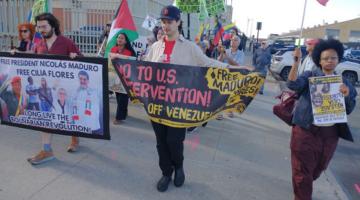 While Trump pardoned an actual drug lord president, he keeps a kidnapped Venezuelan president, Nicolas Maduro, and his wife, First Combatant Celia Flores, in a mold-infested Brooklyn jail on false…
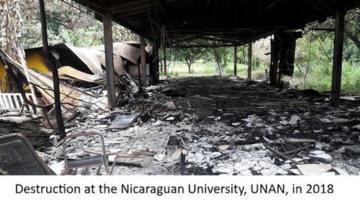 Jeffrey Isaac Jarquin was deported from the U.S. by ICE and upon arrival in Managua was sent to prison by Nicaraguan authorities. Corporate media has decried the detention of a “torture victim” and “…
 In this week’s segment, we discuss student protests by Black and brown youth in France against austerity measures and race-based inequality in the education system. But we begin with a discussion of…
 Brazil's incumbent president Lula da Silva finished second behind Flavio Bolsonaro in the first round of the presidential election. Because neither man received at least 51% of the vote, a run-off…
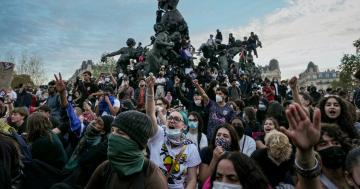 Students in France are engaging in mass protests. Hundreds of them have been arrested and injured by police, and many schools are closed. Annick Metefia joins us from Paris. She is a member of the…


