Concrete examples of Black-Palestinian solidarity. (Illustrated by Hady Dbouk; Al Mayadeen English)
While revolutionary Black organizations after the Panthers continued to support Palestine vocally, the realities of COINTELPRO and mass incarceration have had a profound impact on the organization and scale of Black resistance inside this country.
Originally published in Al Mayadeen.
In the past decade, whenever there is an uptick in Palestinian revolutionary activity or Zionist aggression, calls come from the USA, Canada, and Western Europe to activate or otherwise recognize historical Black-Palestinian solidarity.
While there are certainly bases for this solidarity, often they are defined in the negative. The argument follows that our common oppressors–the imperialist USA and the Zionist genocidaires–collaborate in repressing our movements through joint police training exercises, weapons trade, colonialism, and criminalization of revolutionaries. This negative solidarity is based on the fact that our oppressors are in solidarity with one another, therefore we must do the same. Undoubtedly true, this argument does not get to the root of the issue. Which Black people and Black movements are in solidarity with which Palestinian people and movements historically and in the contemporary juncture? The question must be asked again in light of Kenyan President Ruto’s statement in support of "Israel", other African states’ relations with the colony, and the existence of groups like IBSI, which promote “Black-Israeli” solidarity. The question must be asked again, also, in order to clear the air and answer the fundamental question of politics and war posed by Mao Zedong: who are our enemies? Who are our friends?
In this article, I hope to look at concrete examples of Black-Palestinian solidarity, with an eye toward class and nation, which are often erased in the general call for Black solidarity with Palestine. This is done in order to define exactly what Black-Palestinian solidarity has been, is, and what it can be.
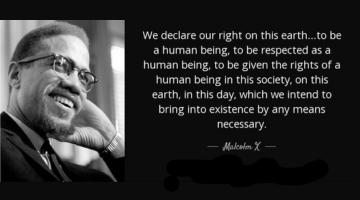
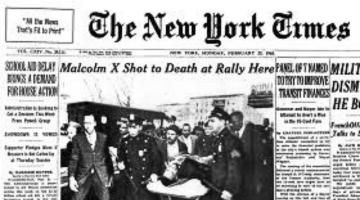
In 1964, Malcolm X (Al Hajj Malek El Shabazz) wrote a piece in the Egyptian Gazette, where he detailed the relationship between Zionism and imperialism.
The Israeli Zionists are convinced they have successfully camouflaged their new kind of colonialism. Their colonialism appears to be more "benevolent" more "philanthropic" a system with which they rule simply by getting their potential victims to accept their friendly offers of economic "aid," and other tempting gifts, that they dangle in front of the newly independent African nations, whose economies are experiencing great difficulties.
The Honorable Malcolm X understood the international element of imperialism and its counterpart in the internationalist movements of the day. This statement is particularly true today as the Zionist regime is trying to dangle economic aid in the face of the Malawian government in exchange for migrant farm labor.
Martyr Malcolm continues:
The number one weapon of 20th-century imperialism is Zionist Dollarism, and one of the main bases for this weapon is Zionist Israel. The ever-scheming European imperialists wisely placed Israel where it could geographically divide the Arab world, infiltrate and sow the seed of dissension among African leaders and also divide the Africans against the Asians.
The imperialist strategy of "divide and conquer" is present in much of the early Zionist writing, which saw Palestine as the "gate to Africa and bridge to Asia." The division of Arabs and Africans along racial lines and the conflation of pre-modern slavery in the Islamic world with American chattel slavery is part and parcel of this imperialist strategy.
Although Malcolm X did not live to see the 1967 war and its aftermath, the Black Panther Party took up this mantle of Black anti-Zionism after his martyrdom.
After the 1967 war against the Zionists, the plight of the Palestinians was injected into the consciousness of many anti-colonial groups worldwide. The Black Panther Party (BPP) in the USA made its first statement in support of Palestine in 1970, according to Dr. Greg Thomas.
The statement reads:
We support the Palestinian’s just struggle for liberation one hundred percent. We will go on doing this, and we would like for all of the progressive people of the world to join in our ranks in order to make a world in which all people can live.
The BPP was a Marxist-Leninist formation, inspired by the ideas of Juche in the DPRK, as well as other Marxist tendencies of the day. Their ideas of inter-communalism came in part from this revolutionary Marxist understanding, paired with their own revolutionary understanding of being members of the Black nation in the USA. Thomas continues, showing that the BPP was in "daily communication" with the PLO through their office of international affairs in revolutionary Algiers. The Panthers’ second statement in 1974 not only called for a Zionist retreat to pre-67 borders but also called for a form of revolutionary inter-communalism and a "people's republic of the Middle East." Indeed, many Palestinian and Arab revolutionaries share this vision of a region liberated from Zionism, colonialism, and imperialism.
While revolutionary Black organizations after the Panthers continued to support Palestine vocally, the realities of COINTELPRO and mass incarceration have had a profound impact on the organization and scale of Black resistance inside this country. From his cell in "Ramon" prison, PFLP Secretary-General Ahmad Sa’adat highlights the prison as a tool of the oppressors and a site of struggle for the oppressed:
From Ansar to Attica to Lannemezan, the prison is not only a physical space of confinement but a site of struggle of the oppressed confronting the oppressor. Whether the name is Mumia Abu-Jamal, Walid Daqqa or Georges Ibrahim Abdallah, political prisoners behind bars can and must be a priority for our movements.
This statement by Sa’adat is written as part of the introduction to a new printing of Huey Newton’s book Revolutionary Suicide. Sa’adat continues in his introduction, stating that the message and necessity of the Black Panthers is still alive today with mass incarceration and police violence coloring the relationship between the police and the Black masses in America. While movements such as Cooperation Jackson exist today – headed by the Malcolm X Grassroots Movement and some former leaders of the Black Liberation Army – we cannot help but call for a rejuvenation and reuniting of revolutionary Black forces in this country after years of repression.
We must renew the calls for a Republic of New Afrika in the Black Belt as one possible solution to the political necessities of ending the settler colonial entity of the United States. Max Ajl comments in his response to Patrick Wolfe’s work on settler colonialism that “Palestinians from Hamas to the PFLP to Islamic Jihad are using land from which they forced settlers, as the physical land-base for an armed nationalist struggle."
So while we Palestinians can and must learn from and collaborate with revolutionary Black movements worldwide, we must also shine as a beacon of light on the other side of the revolutionary field of action. Our liberation is incomplete without the liberation of Africa and the Black masses of the Americas.
Hanna Eid is a teacher, political analyst, and judoka.





 “So the calypso ceases to be entertainment on a trivial level and becomes a vehicle whereby the society is going back and searching for its soul.”
 The protests spreading across Spain, India, France, Chile, and other countries are responses to the global neoliberal order of austerity, privatization, and deregulation.
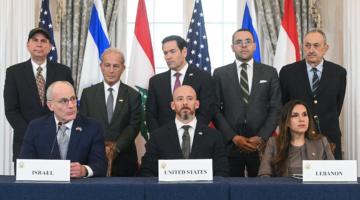 Under the guise of a farcical “pilot zone” project to restore Lebanon’s sovereignty, Israel is pursuing a scorched-earth strategy while entrenching its occupation.
 Chile, Colombia, Bolivia, Honduras, Peru, and Costa Rica have all elected right-wing presidents in the past year, and most are open Trump allies. Brazil's runoff between Lula and Flávio Bolsonaro is…
 October 7, 2023, was not an isolated attack, but the culmination of generations of Palestinian imprisonment and resistance in Gaza, comparable to Nat Turner's rebellion. History will record the Al…


