In this series, we ask acclaimed authors to answer five questions about their book. This week’s featured authors are Tracy Rosenthal and Leonardo Vilchis. Rosenthal is a writer and co-founder of the L.A. Tenants Union. Vilchis has been organizing tenants in Boyle Heights for more than thirty years and is co-founder of the L.A. Tenants Union. Their book is Abolish Rent: How Tenants Can End the Housing Crisis. We interviewed Tracy Rosenthal about their book.
Roberto Sirvent: How can your book help BAR readers understand the current political and social climate?
Tracy Rosenthal: The statistics are so familiar they often fail to produce a sense of shock: The average landlord spends just four hours a month maintaining a property, while the average two-bedroom apartment demands its tenants work four full-time minimum-wage jobs. Some tenants go without food, medication, and basic necessities to secure a roof over their head, while others are flung into over-policed streets.
Abolish Rent analyzes that capitalist housing system from the perspective of tenants—those it immiserates. We offer an account of the routine machinations of landlords, developers, real estate speculators, to historicize their capture of the state and the law, and to show how we can fight back, beginning in our own building and on our own blocks.
The book can help readers understand the economic and political system that produced both Donald Trump and Breonna Taylor—the former, a slumlord found guilty of violating fair housing who became the President of the United States; the latter, a Black woman who was murdered by Louisville PD for standing in the way of a development scheme. It can help explain the rising populist backlash against unhoused people, and why “progressive” cities are leading the charge.
What do you hope activists and community organizers will take away from reading your book?
If we put class conflict at the center of the housing question, and the housing question at the center of class conflict, we recognize the strategic power of organized tenants. Our jobs may be where we produce value, but our homes are where the rich store and grow their stolen hoard. 65% of the world’s wealth is held in real estate and 75% of that is in housing: the places we rent are a crucial choke point in capitalist reproduction. By displacing our landlords’ power and reclaiming our homes, tenants can be key political subjects, the architects of a long-term project of expropriation through which that hoarded wealth becomes shared by us all.
As Leo often says, you can’t fight a war without territory. We get our power as tenants by staying put, occupying not only our homes but our buildings, blocks, and neighborhoods. Occupation is both a necessity and a strategy. We hope organizers will use the tools we outline—rent strikes, eviction defense, direct action—to take on individual landlords, but also to extend the territory of our struggle beyond our own front doors. As we build democratic infrastructures locally and citywide, manage and recirculate our own resources, address our own needs collectively, and grow our power to extract resources from the state, we reclaim the space of the city, seize control over our housing and our neighborhoods.
We know readers will learn a lot from your book, but what do you hope readers will un-learn? In other words, is there a particular ideology you’re hoping to dismantle?
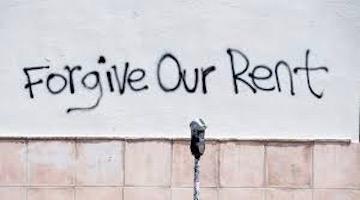
We hope the book helps think our way out of the dominant understanding of “the housing crisis.” If the purpose of a system is what it does, what does our housing system do? It puts trillions of dollars into the hands of landlords and speculators and it ejects people onto the streets. Rent is the crisis: the power relation that forces us to hand over our wages as a monthly tribute which builds our landlord’s wealth. Rent isn’t just the dispassionate outcome of supply and demand, which adequately distributes the resource of housing. It is a product of exploitation and domination. We pay rent at the peril of our need and at the barrel of a gun. We don’t just pay rent because it is a human need to have housing, we pay rent because the police will throw us out of our homes if we can’t pay, or arrest us and lock us in a cage if we end up outside. Similarly, housing policy is not the state’s neutral arbitration between tenants and landlords: it actively facilitates our exploitation and domination. In the book, we call this the war on tenants.
We want readers to unlearn their sense of incapacity. As we show through the successes of our own members, tenants are political subjects, capable of collective action that can extract concessions, tip the balance of power, and reveal our landlords’ dependance on us. We hope these stories of ordinary, poor and working-class people, politicized by the struggle to stay put, to keep their housing or even their encampments, will encourage others to organize, to take calculated risks with their neighbors wherever they are. We have to act like it is possible to win back control over our housing, our cities, and our lives—if we take our own power seriously.
Which intellectuals and/or intellectual movements most inspire your work?
We often say that we act our way into thinking, which means the most important intellectuals who inform our work are the members of the LA Tenants Union, people taking collective risks in their everyday lives. As our union is predominantly made of Latinx immigrants and their kids, we understand ourselves as situated in a long lineage of Latinx resistance nationally and internationally, a thread that links the Young Lords of ’70s NYC to Brazil’s MST today.
We rely on scholarship to back up our members’ insights and insurgent practices, to deepen our analysis of the crisis we’re in, so we can strategize how to get out of it together. We often cite Marxist and abolitionist thinkers who help us name our conjuncture within racial capitalism, including Ruthie Gilmore, Robin DG Kelley, and James Boggs; those highlighting the role of property and urban space in that conjuncture, including Ananya Roy, Sam Stein, Mark Vestal, and K-Sue Park; and those who sharpen our strategies for organizing against it, including Dean Spade and Frances Fox Piven.
Which two books published in the last five years would you recommend to BAR readers? How do you envision engaging these titles in your future work?
There are many. Top of mind, we’d like to recommend The Jail is Everywhere: Fighting the New Geography of Mass Incarceration by Jack Norton, Lydia Pelot-Hobbs and Judah Schept, just out from Verso, and The Asset Economy by Lisa Adkins, Melinda Cooper, and Martijn Konings, published by Polity in 2020. These books have crucial insights into the two poles of the US’s response to the housing question: incarceration on the one hand, and private homeownership on the other. Both should be considered publicly-financed housing: each one costs the government almost $200 billion. But while one produces intergenerational wealth, the other traps us in poverty; while one christens upstanding “stakeholders” with full citizenship, the other brands a scarlet letter of exclusion on those deemed deserving of punishment. We want to push further into the role of criminalization in holding up the housing market, as we organize more unhoused tenants and those who live in SROs, and orient our movement around the most vulnerable amongst us.
Roberto Sirvent is the editor of the Black Agenda Report Book Forum.




 Ending the war in Sudan will require real Sudanese dialogue to carve out a new political course. The people must be wary of a manufactured process, run by a political and economic elite…
 The reactionary government of the Dominican Republic has continued to pursue its racist policies against Haiti, deporting Haitians while exploiting the nation for its economic gain. Widespread sexual…
 Florida’s ban takes effect May 1, 2024, and the fate of Arizona’s abortion access is in the throes of legal, political, and legislative battles.
 President Bola Tinubu’s lifting of fuel subsidies and liberalization of currency trade has pleased the IMF and increased hunger in Africa’s most populous country.
 Incarcerated People in Texas Weather Extreme Heat in non-Air Conditioned Prisons.


