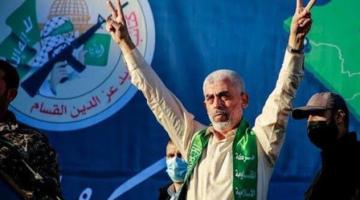
Yahya Sinwar, the leader of Hamas who was killed in combat with Israeli occupation forces in Gaza on 16 October 2024, greets supporters as he tours Gaza City’s al-Rimal neighborhood on 26 May 2021, to assess the damage from Israeli bombing. Ashraf AmraAPA
Yahya Sinwar was a man who became a larger-than-life symbol of Palestinian resistance and struggle. Myths and rumors surrounded him in life and now in death but he did not need anyone, friend or foe, to tell his story for him.
Originally published in Electronic Intifada.
Since the founding of the organization, the lives of Hamas leaders have ended in martyrdom at the hands of the Israelis: Sheikh Ahmad Yassin, Abd al-Aziz al-Rantisi, Ismail Haniyeh, and now Yahya Sinwar, all understood this.
Palestinian resistance organizations are built to withstand the deaths of their leaders, whose speeches frequently invoke martyrdom.
Yahya Sinwar was no exception. In many appearances, Sinwar expressed that there were things worth dying for: the country, the movement, principle and faith. Quoting Imam Ali, Sinwar said in a speech: “There are two days in a person’s life. The day when death is not your destiny, and the day when death is your destiny. On the first day, no one can harm you, and on the second day, no one can save you.”
He also said that he feared dying of a heart attack or coronavirus much more than dying in battle.
Much of Sinwar’s biography – including the meanings he ascribed to the events in his life – can be gleaned from his novel, The Thorn and the Carnation. Written and smuggled out of the Israeli prison where Israel had planned for him to spend the rest of his life, it is full of insight into how Sinwar saw the world and the perspective from which he built up the resistance movement.
The most important character in his novel, Ibrahim, is born in the 1960s (Sinwar himself was born in 1962), and chooses to study in Gaza (like Sinwar, who studied literature at the Islamic University) and to stay in Gaza and struggle despite having the opportunity to study and make a life in exile.
Family life, campus life, religious life, work, prison and resistance life are the daily settings of the book. Characters belonging to different factions debate one another at length on the question of negotiation versus resistance. The narrator occasionally summarizes Israeli methods of infiltration and intelligence-gathering and provides insights into errors made by the resistance or details of operations.
The book was completed in 2004. Perhaps unsurprisingly, since its author was serving multiple life sentences, the novel reads like a work intended to be the legacy of a fighter, a document that could convey valuable experience to the next generation: from daily details of how the occupation works to what to expect when visiting a prison. Or how to comport yourself as a prisoner.
“Moral obligation”
Despite the plans of the Israelis, Yahya Sinwar did not die in prison and was one of more than 1,000 Palestinian prisoners freed in a prisoner exchange deal in 2011.
He came to be Hamas’ leader in Gaza in 2017 and led his followers through tumultuous years of action. In 2018, in the context of the nonviolent Great March of Return that was crushed by Israel, he was interviewed by Italian journalist Francesca Borri over the course of five days, outlining the reasoning and hopes Hamas had in a long-term ceasefire (a recurring theme of Sinwar’s political life).
“Have you ever seen Gaza pictures from the 1950s? When in summer everyone was coming here on holiday?” Sinwar asked the journalist.
“Around 45 percent of the population here is less than 15 years old,” Sinwar observed. “They don’t even know what is Hamas, what is Zionism. At night they walk by the sea and wonder what the world is like beyond the waves.”
Sinwar told Borri about his obligation to the prisoners. “For me it is a moral obligation: I will try more than my best to free those who are still inside.”
In another important interview with Vice correspondent Hind Hassan after the 2021 war, Sinwar compared the racism experienced by Black Americans to that experienced by Palestinians.
He returned to the theme of a long-term ceasefire, but reminded the interviewer, who criticized the rockets and accused Hamas of war crimes, that human nature compelled resistance.
“What are we supposed to do? Raise the white flag? That’s not going to happen,” Sinwar said. “Should we be well-behaved victims while we’re being massacred? Be slaughtered without making a noise? That’s impossible. We decided to defend our people with whatever weapons we have.”
At the end of the 2021 war, Sinwar famously dared the Israelis to assassinate him, noting at a public press conference that he would walk to his home, a known location, and if they chose to target him, he was not hiding.
Upon arrival at home, he posed for an iconic photograph sitting on a plush chair amid the wreckage.
Israel’s genocide has dispelled many long-held illusions about human rights, international law, freedom of expression, diplomacy, progressive politics, and professional ethics, all of which have proven to be subordinate to support for Israel in the West.
No surrender
Like many journalists this year, Seymour Hersh, an American reporter with a network of inside sources that enabled him to break the My Lai, Abu Ghraib, and Nord Stream stories over his long career, tarnished his own record to sell lies about Israel’s genocide.
Shortly after 7 October 2023, Hersh reported to his readers that the al-Shifa hospital “has long been known by Israeli intelligence to be a Hamas redoubt and perhaps the last existing Hamas command-and-control center in Gaza City.” The ground war, Hersh said in November 2023, was “turning out to be a piece of cake” for Israel, “essentially won.”
But Yahya Sinwar had left the north, and “would likely surround himself with hostages in any final confrontation,” complicating the situation for the Israelis who wanted to kill him but, according to Hersh, were concerned about the lives of these Israeli captives. “Israel is still trying to negotiate a way out for the hostages,” Hersh quoted his Israeli insider saying, “but Hamas must surrender first and bring the hostages out.”
There was no bunker under al-Shifa. Yahya Sinwar was above ground battling the Israelis, not surrounded by hostages. And he did not surrender.
In the final scene of The Thorn and the Carnation, Ibrahim phones the narrator, Ahmad, and tells him that he’s seen a vision. “I saw myself fasting, and the Prophet Muhammad told me, ‘Your iftar is with us today, Ibrahim,’ as if awaiting me.” Ahmad knew what Ibrahim was implying, and became upset. Ibrahim calmed him down: “Do not shout, Ahmad. I am taking all precautions, but such an invitation cannot be declined.”
Ahmad’s feeling turned out to be right: Ibrahim was martyred by an airstrike on his car.
And so, after spending his youth in the resistance, resigning himself to a life in prison, miraculously being freed in a prisoner exchange, becoming the leader of the movement in Gaza, being credited with being the architect of the 7 October 2023 operation – whose intent was to capture a large number of Israeli military prisoners to exchange for the thousands of Palestinian prisoners and fulfill his “moral obligation,” while placing Palestinian liberation back on the world’s agenda – Sinwar died in battle with the Israelis, like the main character of the novel he wrote.
He was not surrounded by hostages and he did not surrender – these turned out to be nothing more than calumnies written for him by his genocidal enemies. For those who wish to understand what he knew, they’re best ignored: Yahya Sinwar wrote his own story.
Justin Podur is the author of Siegebreakers, a 2019 novel in which Palestinians in Gaza win a war of liberation. He runs the Anti-Empire Project podcast and YouTube channel, including the Gaza War Sit Rep series, with several videos on the military situation per week.


 As we are experiencing a world order in disorder, with war and conflagrations and a shifting balance of power, Issa Shivji calls for a Sovereign Pan-African Project. The analyses recap the…
 In this week’s segment, we see through supposed disagreements between the US and Canada and recognize their partnership in settler colonialism, enslavement, and imperialism. But we begin with a…
 Joseph Kabila, former president of the Democratic Republic of Congo, named himself president of the Front for the Rebuilding of the Nation. He is now formally allied with M23, the Rwanda-backed…
 Isaac Saney is a Cuba and Black Studies specialist and historian at Dalhousie University in Halifax, Nova Scotia, Canada. He discusses the U.S./Canadian partnership in settler colonialism,…
 European puppet states have undermined themselves and their peoples' needs at the behest of the U.S. Now, that subservience may lead to war.


