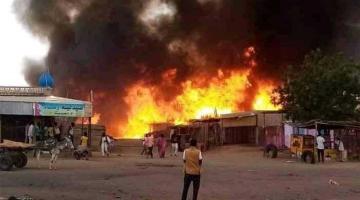
A market in Khartoum, Sudan that was destroyed in the fighting between rival factions. (Photo: Ayin Network)
The ceasefire agreement between rival military factions in Sudan was extended on May 29 as it was on the verge of collapsing. Civilians are suffering, and the Sudanese Communist Party is under attack.
Originally published in Peoples Dispatch.
Amid calls for the extension of the ceasefire set to expire by 9:45 pm local time in Sudan on Monday, May 29, the Sudanese Armed Forces (SAF) and paramilitary Rapid Support Forces (RSF) are clashing with heavy weapons in the capital Khartoum. Clashes have also continued since Sunday in its sister-city Omdurman.
Both sides have violated several terms of the ceasefire, which came into effect on May 22, two days after it was brokered by US and Saudi Arabia in the city of Jeddah.
In a joint statement on May 28, the US and Saudi Arabia, which have three members each in the ceasefire monitoring committee, said, “In violation of the prohibition against aerial attacks and the use of military aircraft or drones, the Sudanese Armed Forces (SAF) has flown military aircraft daily during the ceasefire, including a confirmed airstrike on May 27 in Khartoum that reportedly killed two people and a separate airstrike on the same day that damaged Sudan’s currency printing press.”
The RSF, on the other hand, has “continued encroachment in civilian areas… including occupation of civilian homes, private businesses, and public buildings,” added the statement.
Only days after committing to “refrain from occupying” civilian properties by signing the “Agreement on a Short-Term Ceasefire and Humanitarian Arrangements,” the RSF occupied the office of the Sudanese Communist Party (SCP) on May 25.
“The occupation of our party office is a part of the ongoing attempts by the RSF and the SAF to silence the voice of the democratic forces that opposed this catastrophic war,” SCP spokesperson Fathi Elfadl told Peoples Dispatch.
A statement by the party’s Secretariat of the Central Committee said, “Such attacks.. will not discourage the Sudanese Communist Party from standing in the front lines with the masses of the Sudanese people.. demanding an end to the war and the prosecution of.. all parties that have contributed to igniting it.”
Although there was a reduction in the intensity of the fighting during the ceasefire, “the war has continued in the capital as well as in Darfur. Victims continue to fall every now and then. People cannot move freely,” said Elfadl.
Taking advantage of the fighting, armed fighters from the Sudan People’s Liberation Movement-North (SPLM-N) faction of Mallik Agar have also taken to the streets of Khartoum, looting civilians, he added. Agar is one of the Juba peace agreement signatories, whom SAF chief and chairman of the military junta, Abdel Fattah al Burhan, recently appointed as the deputy chairman after removing RSF head, Hemeti, from the position.
Ceasefire failed to facilitate humanitarian aid or restoration of essential services
The very first provision of the ceasefire agreement stated its “purpose.. is to achieve a short-term ceasefire to facilitate the delivery of emergency humanitarian assistance and restoration of essential services.”
However, Elfadl maintained, “so far, there is no humanitarian corridor. Some medical aid has reached the River Nile state (where many of the displaced are taking refuge). But the areas worst-affected by the fighting – the capital region and Darfur – have not been able to receive any aid. We continue to suffer shortages of food, medicines and water.”
The joint statement by US and Saudi Arabia noted that “On May 24, SAF elements commandeered medical supplies from two separate facilities to which those goods had just been delivered. On May 25, fuel funds and two vehicles in a humanitarian convoy were stolen – one in an area between SAF and RSF forces and one in an area controlled by RSF.”
The SCP had earlier insisted that unless the humanitarian corridors were brought under the control of civil society groups, such as the Sudan Doctors Union (SDU) and the Sudanese Red Crescent (SRC), the supplies would inevitably be diverted away from the civilians in need.
“Facilitating repair and restoration activities for essential services and infrastructure, such as electricity, water, and communications facilities,” was one of the main commitments made by SAF and RSF in the US-Saudi brokered agreement.
However, the brokering parties said on May 28 that “Maintenance personnel have been unable to access essential infrastructure facilities to conduct repairs due to the presence of armed actors at those facilities and heavy fighting in proximity to them.”
Their statement concluded by saying, “Realizing it was imperfectly observed, we have urged both parties to agree to an extension of the current ceasefire, to provide more time for humanitarian actors to undertake that vital work.”
The SAF and RSF both issued statements over the weekend declaring their willingness to discuss extension of ceasefire, before setting out to fight each other even before its expiry. Earlier on Friday, SAF also announced its decision to “enlist the participation of all retired officers and soldiers of the armed forces.”
While the initial statement had called for “all those who can carry arms” to enlist, “it was quickly retracted and replaced with a revised statement specifying that it was limited to retired army officers and soldiers under 65,” Sudan Tribune reported.
Civilians bear the brunt
The fighting between SAF and RSF has directly claimed the lives of at least 865 civilians caught in the crossfire, and injured more than 3,600 other people, according to the SDU. Then there are the secondary casualties of war. 50 children, nearly half of them babies, have died in Sudan’s largest orphanage in Khartoum of malnourishment, dehydration and infections that could not be treated due to severe shortage of staff, food, medical supplies and electricity.
“In East Darfur, more than 30 babies have died at a hospital in Ad Du’ayn since the start of the fighting, according to the World Health Organization (WHO), including six new-born babies who reportedly died in one week alone due to problems including lack of oxygen amid electricity blackouts,” according to a report by the UN Office for the Coordination of Humanitarian Affairs (OCHA).
“At least 38 attacks on health care have been verified by WHO,” added the report. “Across North, South and West Kordofan states, most health facilities are closed, and those that are functioning lack supplies and staff. Health staff have not been paid, and most of them have relocated to safer areas.”
Prices of bottled water, food and fuel have gone up 40-60% in conflict-affected areas. The World Food Program (WFP) expects a further 25% spike in food prices, and projects that 18 million people, which is nearly 40% of Sudan’s population, will be left unable to to afford basic food in the coming three to six months if the fighting does not stop.
“Nearly 1.4 million” have fled their homes, over a million of whom are displaced within Sudan, OCHA said. 69% of these internally displaced were forced to flee from Khartoum. About 345,000 others have crossed into neighboring countries. 126,000 of them have taken refuge in Egypt. Tens of thousands have also crossed into South Sudan and Chad.
The SCP insists that representatives of civilians, who are suffering the most in this war, should play a central role in monitoring any ceasefire agreement. Calling for a regionally constituted peacekeeping force to be deployed under the flag of the African Union (AU), it has stressed the need for a greater participation of the regional countries and institutions, cautioning against monopolization of the peace process by the US and Saudi Arabia.
Pavan Kulkarni is a writer for People's Dispatch.

 Over a year in advance, the Black Misleadership Class has kicked their efforts to corral Black people into the Democratic party, despite the Dems’ apathy toward Black politics or the concerns of…
 The US empire is continuing its psychological warfare campaign by conducting a mass mobilization of resources and waging a propaganda offensive to protect its interests in the Middle East.
 Despite the reality of US intervention causing inhumane conditions in the region, Venezuela’s push for the annexation of Guyana’s Essequibo region prioritizes its own political objectives,…
 Survivors open up about struggles with lingering post-traumatic stress disorder 18 years after the storm
 The high court in Nairobi will issue a ruling on a legal challenge to the deployment of 1,000 Kenyan police forces to Haiti as part of a “multinational force.” The US and UN-backed mission has been…


