Venezuelan President Nicolás Maduro, Cuban President Miguel Díaz-Canel, and Nicaraguan President Daniel Ortega at the ALBA summit in La Habana in December 2021 (Photo credit: Cuba's presidential office)
The U.S. and Western powers talk about a "Troika of Tyranny" in Latin America because the nations in that region recognize the dangers of the U.S./EU/NATO Axis of Domination. But any tyranny taking place is forced upon them by the U.S. and its NATO allies.
This article was originally published in Multipolarista.
President Joe Biden’s top Latin America advisor has admitted that US sanctions against Russia over Ukraine intentionally seek to hurt Venezuela, Nicaragua, and Cuba as well.
The United States imposed a series of harsh sanctions on Russia following Moscow’s recognition of the independence of the Donetsk and Lugansk People’s Republics in Ukraine’s eastern Donbas region on February 21, and its subsequent military intervention in Ukraine on February 24.
Juan S. González, Biden’s special assistant for Latin America and the US National Security Council’s senior director for the Western Hemisphere, made it clear that these coercive measures against Russia are also aimed at damaging the economies of Venezuela, Nicaragua, and Cuba.
Venezuela, Nicaragua, and Cuba have socialist governments that Washington has long tried to overthrow. All three currently suffer under unilateral US sanctions, which are illegal according to international law.
Former US National Security Advisor John Bolton, an architect of the Iraq War, referred to these three Latin American nations as the so-called “Troika of Tyranny.”
Biden’s advisor González did an exclusive interview with Voz de América, the Spanish-language arm of the US government’s propaganda outlet Voice of America, on February 25.
Voz de América published his comments in a report titled “US sanctions on Russia will impact Venezuela, Nicaragua, and Cuba, White House estimates.”
“The sanctions against Russia are so robust that they will have an impact on those governments that have economic affiliations with Russia, and that is by design,” González explained.
“So Venezuela is going to start feeling that pressure. Nicaragua is going to feel that pressure, along with Cuba,” he added.
Biden’s Latin America advisor noted that Washington has imposed sanctions on 13 top financial institutions in Russia, including some of the largest in the country. He proudly said that these coercive measures will, “by design,” harm other countries that do a lot of trade with the Eurasian power.
González also used his interview with the US-funded Voz de América to reiterate Washington’s call for regime change against these three socialist governments in Latin America.
His comments were reported by the independent Bolivia-based news website Kawsachun News.
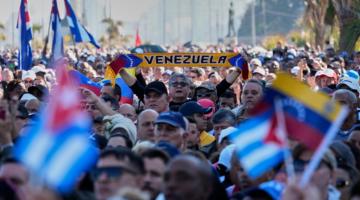
Venezuela, Nicaragua, and Cuba stand with Russia against US and NATO
Venezuela, Nicaragua, and Cuba have stood with Russia against NATO expansion and Western military encirclement.
President Nicolás Maduro said that Venezuela “laments the mockery and breaking of the Minsk agreements by NATO, promoted by the United States of America.”
Maduro stressed that Washington and NATO bear responsibility for the conflict, and “have generated strong threats against the Russian Federation.”
Cuba blamed Washington for the crisis as well. Its Foreign Ministry stated, “The U.S. determination to continue NATO’s progressive expansion towards the Russian Federation borders has brought about a scenario with implications of unpredictable scope, which could have been avoided.”
Denouncing Western governments for sending weapons to Ukraine, Cuba declared, “History will hold the United States accountable for the consequences of an increasingly offensive military doctrine outside NATO’s borders, which threatens international peace, security and stability.”
Nicaragua’s President Daniel Ortega condemned Washington for sponsoring a 2014 coup in Ukraine, and joined Russia in recognizing the Donetsk and Lugansk People’s Republics.
The chairman of Russia’s State Duma, Vyacheslav Volodin, traveled to Nicaragua to meet with top officials from the Sandinista government, and thanked them for their support against NATO expansion and US threats.
Multipolarista is an independent news outlet documenting the transition to a multipolar world. Multipolarista is edited by journalist Benjamin Norton.

 Ethiopian American activist and community organizer Benyam Kitaw tells Ann Garrison that US hostility toward Ethiopia could lead to further sanctions, economic pressure, and perhaps even war.
 Raytheon’s craven raven Co-signing for mass murder: “Mowing the grass…” Now… Ladee Blu on a fool’s errand dis- seminating The Monroe Doctrine—this is what
 Contrary to the Black capitalist myth, most Greenwood residents were low wage working people employed by whites and living in substandard housing.
 Today’s colonialists recruit Black politicians and Black terrorist groups who are willing to play along.
 Joy James uses poet Lucille Clifton's image of “new bones” to reflect on a series of revolutionary anniversaries in 2021 and the nature of political leadership.


