Colombia's president Gustavo Petro met with Afro-descendant, Indigenous and peasant communities affected by illicit crops and guerrilla and paramilitary groups in Colombia. Talks between the government and the ELN are taking place in Cuba.
Originally published in Peoples Dispatch.
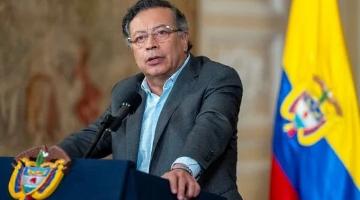
Colombian President Gustavo Petro, on Saturday, May 13, called on the National Liberation Army (ELN) guerrilla group to agree to a ceasefire in one of the regions of the country and then gradually expand it to the rest of the country as peace negotiations proceed. The delegations of the Petro government and the ELN were engaged in the third round of peace talks in Cuba and an agreement on a bilateral ceasefire was among the central themes of the current talks.
“I propose that we work seriously on a ceasefire, that they stop killing each other, that we stop killing each other and that the peaceful existence of the citizenry is put first. We can begin not with the national idea, as I proposed in December, [which is] complex, difficult, unstable and dangerous, but with the territorial and regional idea,” said Petro during a meeting in Bocas de Satinga, in the Nariño department, attended by Afro-descendant, Indigenous and peasant communities affected by the presence of illicit crops and guerrilla and paramilitary groups in the Pacific.
“We can choose a specific region and begin to expand it into Colombian territory… Let’s pick one region. It could be Nariño. I’m not imposing it, let’s discuss it, but let’s start a ceasefire, a cessation of hostilities, a process that can generate confidence in Colombian society that already mistrusts peace after so many decades of talking about it and not making it,” Petro added.
The president expressed confidence that a territorial ceasefire could open the door to the entry of the state in regions that for decades have been affected by the presence of guerrilla and paramilitary groups.
“The civil state could enter that ceasefire zone and demonstrate that it is possible to exchange one economy for another [illegal for legal], show that there can be prosperity in other types of production, trade… and the combatants, as part of the population, could share in the decisions, the design and the benefits of this new legal economy that can be built together for the prosperity of the territories,” he said.
“Undoubtedly the peace of Colombia today is more than anything a territorial peace. Conflicts are different from territory to territory, and for this reason they must be seen from a territorial point of view,” added the head of state.
Before Petro’s speech, community leaders from the Chocó, Valle, Cauca, and Nariño departments explained to Petro the situation in their regions and requested him to take action, not only to substitute coca in their territories, de-escalate the armed conflict and take steps to build peace, but also to ensure a comprehensive presence of the state to guarantee basic rights such as health, education and security.
Tensions at the negotiating table
President Petro’s announcement came just hours after the ELN delegation issued a statement rejecting remarks in which the head of state questioned whether those at the table really have the power to command, and claimed that most of the guerrilla group’s structures are engaged in illegal businesses.
“The words of the President of the Republic before the military leadership delegitimize the institutional architecture and the political sense of the Peace Talks with the ELN,” stated the group’s delegation.
“The direct questioning of the ELN Dialogue Delegation, the disrespectful and stigmatizing treatment of our organization, and the security doctrine he outlined in which, according to him, there is no longer a ‘conflict of ideologies or social conflict’ but a fight against ‘illicit economies,’ implies a fundamental questioning of the political sense of the Dialogue Table and its entire architecture,” added the delegation.
The delegation further added that they considered that “Petro’s position contradicts the Mexico Agreement signed by his government.”
For this reason, they requested that President Petro “urgently define whether his government continues to consider that, as stated in the Mexico Agreement signed by the parties and deposited with the guarantors, this is a serious political process that aims to ‘overcome the armed conflict that has taken place for six decades, eradicate violence to deal with political, economic and social contradictions, agree on democratizing transformations and move towards national reconciliation.’”
On Monday, May 15, the Central Command of the ELN, through a statement, said that the peace negotiations with the government are “in crisis” and that the talks cannot be subjected to the “ups and downs” of the Colombian president’s statements.
“The president’s statements publicly question our delegation, its representativeness. Therefore the government must publicly clarify whether it is a valid interlocutor to advance the Peace Process with the Government,” demanded the group.
Petro recognizes legitimacy of the ELN delegation
Hours later on Monday, President Petro addressed the conflict. In an official statement, the head of state assured that the government maintains its “serious and coherent commitment” to the request of the communities to end the violence in the territories.
He said, “The declarations of the last few days are a call to both parties to be responsible with the dynamics of the armed conflict and with what is happening in the daily life of the territories,” adding that, “as the national government, we recognize the legitimacy of the ELN delegation, the agenda and the support of the guarantor and observer countries in this dialogue process.”
The president reiterated that it is imperative to respond to the communities and agree to the cessation of hostilities, guaranteeing protection measures for the population and the participation of civil society in the development of the negotiations.
“Our commitment to peace cannot be postponed and every action that leads to peace will be a priority for us as the national government. We hope that the ELN’s response will be consistent with this invitation and this call,” concluded the statement.
This is not the first crisis in the peace negotiations. The first bump was after the government announced a six-month bilateral ceasefire with the ELN on December 31, and the latter quickly denied it because it had not been agreed upon at the negotiating table. The second crisis occurred after the attack carried out by the ELN in March on a military unit in the El Carmen municipality of the Norte de Santander department, which left nine soldiers dead and another nine wounded. Nevertheless, despite conflicts, both parties have repeatedly and explicitly reiterated that they are committed to achieving peace in Colombia.
Peoples Dispatch, formerly The Dawn News, is an international media project with the mission of bringing to you voices from people’s movements and organizations across the globe. Since its establishment three years ago, it has sought to ensure that the coverage of news from around the world is not restricted to the rhetoric of politicians and the fortunes of big companies but encompasses the richness and diversity of mobilizations from around the world. Peoples Dispatch also seeks to bring to you breaking news from a perspective widely different from that of the mainstream media.

 Dr. Jemima Pierre, BAR Editor and Contributor, joins Millennials are Killing Capitalism for a conversation about US-led Imperialism's latest schemes for the people of Haiti. They discuss tactics…
 The state of Israel is reviled by most people in the world as a genocidal, war criminal nation. Money, influence peddling, and brute force ensure that international condemnation is not allowed to…
 The US is behind the multinational military invasion and occupation of Haiti. How did we get here?
 Colombian President Gustavo Petro negotiated with President Trump to avoid armed conflict.
 "A whistle and honk for our cities under siege" is the latest from BAR's Poet-in-Residence.


