Health workers in major public hospitals in Haiti continue to strike over bad working conditions, as others join them to protest a rise in gang violence and kidnappings.
This article was originally published in Peoples Dispatch.
Health workers in major public hospitals in Haiti have reasserted their intention to continue striking on 28 March, citing lack of action by the Ministry of Health (MoH) on their earlier demands. Nurses, physicians, lab workers and other health professionals at the Haitian State University Hospital and Justinien Hospital among other places, began to strike near the end of February. They intend to continue the action until demands are met.
The workers are asking for salary adjustments, improvements to working conditions, and payment of arrears in the form of debit cards, but remain dissatisfied by the approach taken by the Ministry since they first stopped working. While emergency care services have remained operational throughout the duration of the strike, delivery of other forms of care has significantly slowed down, increasing pressure on the MoH.
In spite of this, the authorities have mostly remained silent. Jean-Louis Jean Walbert, trade union delegate of the Union of Health Workers (STS), said to Radio Resistencia that the government had made no effort to engage with the striking workers since they began their action and that at the moment “there are no materials to work in the hospital, without taking into account the problem of electricity.”
Previously, trade unions explained that the strikes in healthcare were not only oriented towards improving working conditions, but also securing a reform of the health system in Haiti, which has been struggling with lack of resources and the consequences of a wider social crisis for years. According to trade unions and health officials, public hospitals in particular had a hard time recovering from a residents’ strike in March 2016. While the strike ended with the promise of widespread improvements to the hospital system, such promises failed to materialise, leaving both health workers and patients to deal with deteriorating work and care conditions.
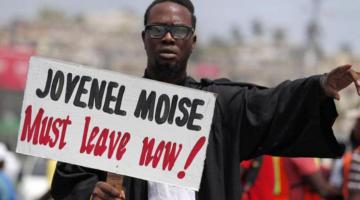
The economic crisis in 2018 weakened the health system even more, paving the way for inconsistent coverage of patients’ needs and a staggered pandemic response. From August 2021, when the first doses of COVID-19 vaccines were shipped to Haiti, to March 2022, only 1% of the population of Haiti have been fully vaccinated. After the assassination of de-facto president Jovenel Moïse in July 2021 and a strong earthquake in August of the same year, the people of Haiti have been struggling against rising levels of gang violence, fuel shortages, and food insecurity. Thousands of people have attempted to leave Haiti for the US in this period, but they have been stopped and deported by the Biden administration, fueling the social crisis even more.
Increase in kidnappings widens the strike to other health workers
Gang violence, especially kidnappings, has represented a particularly serious problem throughout the year. According to a UN report issued in February 2022, there has been a 180% percent increase in kidnappings in 2021 compared to the previous year: at least 655 people have been reported kidnapped by gangs, and the real number is expected to be even higher than that. Health workers themselves have been targeted by gangs, with two of them – physicians Pierre Boncy and Michel D’Alexis – being kidnapped at the beginning of March 2022.
The rising insecurity has been another reason for health workers outside the hospital system to protest. From 14 to 16 March, health workers staged a 3-day strike focusing specifically on this issue. Professional associations have warned the government that protecting health workers is essential if they want them to be able to provide care for patients. During a press conference where the strike was announced, Osni Eugène, vice-president of the Haitian Medical Association, stated: “The medical sector is taking a beating these days. If we don’t make our voices heard, I feel the situation in the country will worsen because we live in a country where many people perish because of stress, food insecurity…”
Health workers and trade unions agree that it will be impossible to resolve the situation if the MoH does not change its approach to the health system. Both groups are insisting that – instead of offering short-term and harm-reduction measures for problems that have developed after years of inadequate funding – the ministry should allocate more resources for the public health system, and invest their efforts to build a safe and effective health system.
By meeting the workers’ demands, the MoH would not only ensure that working conditions improve; they would also ensure that patients have access to adequate care. According to the trade unions participating in the public hospital strike, patients are well aware of this fact and most of them support the workers’ actions, seeing them as an attempt to revendicate a fairer response to rising living costs and societal needs.
Peoples Dispatch, formerly The Dawn News, is an international media project with the mission of bringing to you voices from people’s movements and organizations across the globe. Since its establishment three years ago, it has sought to ensure that the coverage of news from around the world is not restricted to the rhetoric of politicians and the fortunes of big companies but encompasses the richness and diversity of mobilizations from around the world.



 A photograph of Delcy Rodríguez smiling with Donald Trump after the U.S. kidnapped Nicolás Maduro is evidence of subordination to the United States. These images cannot be reconciled with the dignity…
 Imperialist competition and wars that facilitate extractivism have long shaped the use of seaports for access to resources, markets, and devalued labor. In the last decade, countries in the chain of…
 Iraqi Kurdish leaders say the US withdrawal will leave their region, long a CIA and Mossad hub, vulnerable to Iranian attacks.
 BAR Executive Editor and Senior Columnist Margaret Kimberley advises caution regarding the narrative that the US is in a state of decline. The US is committed to achieving full-spectrum dominance…
 In this week’s segment, we discuss events in the Horn of Africa as the Somaliland region requests U.S. recognition and the Trump administration ends some sanctions against Eritrea. But we begin by…


