Mural of Picasso’s Guernica. Image Credits: Jules Verne Times Two , CC BY-SA 4.0 via Wikimedia Common
As we are experiencing a world order in disorder, with war and conflagrations and a shifting balance of power, Issa Shivji calls for a Sovereign Pan-African Project. The analyses recap the fundamental and nonnegotiable characteristics of Pan-Africanism that should anchor the question of Africa’s position in the emerging multipolar world with competing regional hegemonies.
Originally published in Pambazuka News.
The World Order is in great disorder. The geopolitics are in turmoil. Regional wars are raging all over. On the African continent, the war in Sudan is tearing that country apart. Millions of people are being displaced while thousands are killed and injured. Some Gulf countries are heavily involved. It is no secret that the United Arab Emirates (UAE) is funding and arming the rebel Rapid Support Forces (RSF) while Saudi Arabia and Egypt are supporting the Sudan army. It is no secret that the UAE is a proxy of Israel and the United States (US). There is tension between Ethiopia and Sudan as Ethiopia hosts a UAE training camp for the RSF. Should an open war break out between Sudan and Ethiopia, the region would be drawn into a conflagration which would be very difficult to put down.
Worse is waiting to come, as Ethiopia and Eritrea amass their troops along their border. Abiy Ahmed Ali, the Ethiopian Prime Minister and a Nobel Laureate, is determined to capture Eritrea’s port Assab on the Red Sea. Will this not draw in both Ethiopia and Eritrea into the conflagration on the Red Sea currently raging around Yemeni nationalists and US’s client Saudi Arabia? Meanwhile, four states – Egypt, Sudan, Eritrea and Somalia – who have their own axe to grind against Ethiopia have issued a thinly veiled joint declaration against Ethiopia. The African Union (AU) has proved to be next to useless in intervening decisively in the existing and impending conflagration on the continent. Where does it stand?
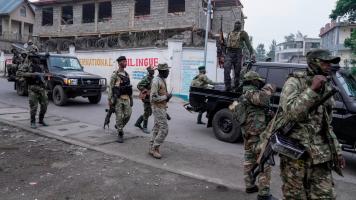
The Democratic Republic of Congo (DRC) has yet to come out of decades of wars. Now the armed rebellion is concentrated in Eastern Congo, where M23 (March 23 Movement), a heavily armed group supported by Rwanda, is proving to be formidable. There are several other groups of armed militias operating in this part of DRC. On top of it, Eastern Congo is now enveloped in the deadly outbreak of Ebola. Regional Pan-African organisations like the Southern African Development Community (SADC) and the East African Community (EAC) have proved to be ineffective against M23 and the recalcitrant Rwanda.
In West Africa, armed groups, a spillover from Libya after the killing of Mummar Gaddafi and the decimation of the country engineered by US and France, is wreaking havoc in the Sahel region. Chased out from Burkina Faso, Niger and Mali, France is busy creating a foothold in Anglophone East Africa through Kenya. President William Ruto of Kenya is a compliant client while other African “leaders” have no guts to stand up against France’s intrusion.
On the world stage involving big powers, the US-Israel war against Iran, is likely to get out of hand consuming not only Gulf countries but other countries and regions further afield, including eastern Africa. Europe on the other hand has not only failed to resolve the Ukraine war but has been thoughtlessly fuelling it on the pretext that Russia poses an existential threat to the European Union. Meanwhile, Israel is carrying out genocide in Gaza in real time with impunity as it is also invading and occupying Lebanon and displacing over a million people. In Syria it has intruded beyond Golan heights, creating what it calls a buffer zone controlling some 665 square kilometres of Syrian land.
In this geopolitical turmoil, the old post-WWII alliances (NATO, for instance) are unravelling. We are witnessing shifting alliances. The primary Pan-African institution, the AU has no policy or direction in providing leadership, at the least, to member countries, let alone have an independent geopolitical perspective from an African standpoint.
In sum, there is great chaos under the sun. How does one make sense of the chaos, uncertainties, shifting alliances and palpable breakdown of the post-WWII international order built around the United Nations and its institutional affiliates? Still, we must make sense of it.
I suggest that in the midst of the chaotic situation we can discern three tendencies which may help us to understand the bigger picture. First, there is a palpable tendency towards a multipolar world. The days of the bipolar or unipolar world are over. The post-WWII hegemonic power, the US, is declining. China is rising. China is fast surpassing the US in economic terms. Diplomatically, the US is losing credibility. Few around the world trust the word of its leaders. Politically, the Empire is turning on itself, with civil liberties and individual rights being progressively curtailed. Even the Supreme Court – the ultimate custodian of rights and freedoms – is rapidly sinking into the right-wing quagmire. The question I ask myself is this: is the multipolar world going to be without hegemonies? This brings me to the second tendency.
The second tendency, albeit in its infancy, is towards the rise of regional hegemons. In the Western hemisphere, the US is reclaiming its hegemony over Latin and Central America in the south and Canada in the north. The breaches that other big powers like China attempted to make like in Venezuela have been put to rest with the kidnapping of Maduro, a sitting president of a sovereign country. The first act of the imperialist bandit was to take control of Venezuela’s resources, in particular oil. Oil supplies to Cuba were then cut off and tankers carrying Venezuelan oil to China – the biggest importer of Venezuelan oil – have been sanctioned. Lately, the Trump regime has tightened the noose around Cuba’s neck by blockading oil supplies to that country. Cuba faces an existential crisis. The US wants an unchallenged hegemony in the Western hemisphere and with the right-wing turn in many countries in the region it is likely to get it. This is not 1962 when the Soviet Union under Khrushchev built nuclear missile bases in Cuba. In the cases of both Venezuela and Cuba, Russia and China, have done little more than issue squeaking condemnations, showing no real willingness to defend those countries.
In the Indo-Pacific region, hegemony is contested between China and India, with Pakistan waiting in the wings. The red line for China is of course Taiwan. Trump is likely to concede on that. What is more likely to be the bone of contention is the maritime dominance of the South Pacific. In Western Asia, or the so-called Middle East, the contention for hegemony is undoubtedly between Israel and Iran, with Turkey waiting in the wings. None of the Gulf countries, in spite of their wealth, is a candidate for the simple reason that they are all beholden to the US and through the US to Israel. Whether this alliance will hold remains to be seen. Will the current war resolve the issue of regional hegemony in Western Asia? I doubt though, the way the war ends will give us a clue as to the likely hegemon. One thing though is clear. Western Asia will not be the same again. Iran cannot be taken for granted, even militarily. Secondly, the unchallenged military superiority of Israel has been irreversibly dented. History teaches us that reconfiguration of hegemonies takes place through wars. The war on Iran is a classical case. Yet, sober analysis of geopolitics should not blind us to the enormous cost of wars to the millions of working people. Ruling classes can indulge in wars of choice. For the working masses, peace is not a matter of choice. It is a necessity.
What about Europe? Here regional hegemony is contested. Two important candidates – Germany and Russia – are fighting it out in Ukraine while France waits in the wings. Very often, Russia’s alliance with China is mistaken to mean Russia looking to the East. I don’t think so. Since Mikhai Gorbachev’s famous statement that Russia’s home is Europe, Russia sees itself as a European power. Gorbachev’s concept of the “Common European Home” envisaged a united Europe from the Atlantic to the Urals to which Russia’s future was inextricably tied by virtue of its culture and security.
The third tendency is the breaking down of the Westphalian model of sovereign states. As we all know, the Westphalian model is the product of European history. Its primary objective was to put to rest perpetual wars on the European continent. Hence the rise of nation-states constituted by majority ethnic groups with definite borders in which the writ of the state ran. That was the model that underlayed the United Nations architecture. That was the model which informed national liberation struggles and the emergence of independent states in Africa. Over the last couple of decades, nation-state sovereignty has been eroded just as some of the nation-states are disintegrating. The tendency towards the dismantling of state sovereignty, in spite of constant reference to it, is rapidly unravelling. Powerful nations don’t respect it just as they flout with impunity international law built on it.
The burning question for Global Africa is where does Africa stand in this geopolitical turmoil. Can Africa resist becoming a dispensable pawn on the geopolitical chessboard? Or, once again, it will fall prey to this or that regional hegemon. This brings me to what I call ‘A Sovereign Pan-African Project’.
The Sovereign Pan-African Project
There are a few fundamental characteristics of Pan-Africanism that we need to recap. First, both in its origin and current manifestation Pan-Africanism is a political project. I underscore this because very often in the statist discourse of Pan-Africanism, it is reduced to economic integration. Second, Pan-Africanism as a movement, as an ideology and as an outlook for Global Africa, is anti-imperialist. Pan-Africanism and imperialism are incompatible. Therefore, per force, Pan-Africanism is anti-capitalist. Imperialism is the excrescence of the capitalist system. Third, the driving force of Pan-Africanism has been and is social struggles for socio-economic emancipation of the African working people and it is embedded in the right of peoples to self-determination. I want to emphasise people’s right to self determination because since the era of national liberation, self-determination has been reduced to claiming state sovereignty. The Pan-African Project should be rooted in people’s sovereignty; hence I call it a sovereign Pan-African project. Finally, we should move away from the paradigm which identifies Pan-Africanism with institutions like AU or regional economic integration projects. We should refuse institutionalisation and bureaucratisation of Pan-Africanism. This does not mean that a people-centred Pan-Africanism should not engage with institutions. It should, but do it critically and without getting swallowed by it.
This fundamental and non-negotiable character of Pan-Africanism, I propose, should inform and underlie the repositioning of Pan-Africanism in the current geopolitical turmoil and whatever emerges from it. Short of this, Africa will fall under the hegemony of this or that regional hegemon allied with big powers, a tendency which we are already witnessing. The sovereign Pan-African Project should be anti-hegemonic through and through. Chances of a regional African hegemon emerging are very slim. None of the four possible candidates – Nigeria, Egypt, South Africa or Ethiopia – for regional hegemony has either the clout or credentials for occupying such a space. They are either too compromised or mired in their own racial, ethnic or regional conflicts and war. Even if any of them were to emerge as a regional hegemon, it would only end up as a surrogate of other regional hegemons.
So, how should Africa situate itself in the emergent multipolar world with regional hegemonies? First, Africa must position itself as an independent sovereign pole in the multipolar world. Second, Africa should not be aligned with any of the regional hegemons. Third, Africa must zealously guard its right to political and economic self-determination. Finally, this can only be done if the working people of Africa can wage a sustained, protracted struggle on all fronts to reclaim the Sovereign Pan-African Project.
Issa G. Shivji is a Professor Emeritus of Law, University of Dar es Salaam, Dar es Salaam, Tanzania. First Nyerere University Professor of Pan-African Studies (2008-2013).


 Joseph Kabila, former president of the Democratic Republic of Congo, named himself president of the Front for the Rebuilding of the Nation. He is now formally allied with M23, the Rwanda-backed…
 Isaac Saney is a Cuba and Black Studies specialist and historian at Dalhousie University in Halifax, Nova Scotia, Canada. He discusses the U.S./Canadian partnership in settler colonialism,…
 European puppet states have undermined themselves and their peoples' needs at the behest of the U.S. Now, that subservience may lead to war.
 Marco Rubio's appeals to Western civilization, Christian heritage, and the defense of Western dominance are fundamental to the consolidating global fascist project, functioning to transform a crisis…
 “So we started to preach the doctrine of self-organization. And we made it very clear what we were after — the genuine multiracial and democratic power of the working people.”



