The protests spreading across Spain, India, France, Chile, and other countries share a common root in the global neoliberal order of austerity, privatization, and deregulation.
The current protests against economic distress and deteriorating social and material conditions in several countries stem from one issue: the global neoliberal order. While each country's resistance movements have different triggers, they share a common trait: they reflect decades of austerity, privatization, deregulation, and other policies that prioritize corporate profits and the wealthy over ordinary people's social and economic security and needs. Policies that emerged from U.S. capitalists and their global campaign to spread their gospel of free-market trickle-down deprivation were masked as “freedom” from government oppression.
The protests in Spain, which have seen hundreds of thousands take to the streets in over 50 cities, were triggered by an investment fund's eviction of an 87-year-old woman after it quintupled the rent on the apartment she had lived in for decades. People protested, demanding not only the reversal of her eviction, but also lower rents, an end to all evictions, and a ban on private development companies, known as “vulture funds,” from buying property. The unexpected death of the woman only intensified anger over a neoliberal model that treats housing as a financial asset for speculation rather than as a human right.
In India, students are leading protests against the "neoliberal Hindutva" project – a fusion of market deregulation with Hindu nationalism – that deploys neoliberal austerity policies that led to widespread disillusionment among the youth at unkept promises of expanding opportunity and resources to the working class and poor, anger at worsening material conditions and narrowing educational opportunities, and at the removal of more than 130 million people from the country’s voter registration rolls. This drove much of the country’s economically distressed and abandoned youth to create the Cockroach Janta Party (CJP) – so named because the chief justice of the Supreme Court derided unemployed young people as “cockroaches” and “parasites to society” – which has successfully ousted the Education Minister and is pushing to accomplish more. Now, trade unions are joining the protests and organizing strikes against new labor laws, the privatization of state-run companies, and pro-corporate trade deals that further tighten the economic screws on workers.
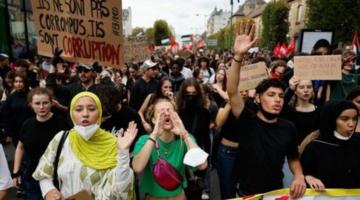
France is experiencing widespread protests that, it seems, the media is paying the most attention to but not analyzing clearly enough. Teachers in a Paris suburb of mostly African and other immigrants launched the initial protest over staffing and resource shortages in their school, and their students quickly joined. Then, students in other cities across the country carried out protests over the same conditions, and workers, teachers, university students, and parents joined them, expanding the focus to chronic shortages of affordable housing, as well as cuts to higher education. When the French people outside of those poor suburban areas joined their anger at the abolition of the wealth tax, cuts to corporate taxes, and attacks on worker benefits, the protests grew beyond student interests to include a large-scale condemnation of government policies that transfer the tax burden from the rich to the middle and lower classes and the crushing inequality produced. This dynamic may be the clearest example of how grassroots mass movements that start at the “bottom” of society can become a major force when people across class, ethnicity, race, and nationality identify with their struggle.
But perhaps most relevant to the U.S.'s history and current material conditions, Chile is also seeing massive student-led protests against the far-right government of President José Antonio Kast, which proposed $6 billion in cuts to the country’s 2027 budget, slashing funding for public health and education, and a proposed tax cut for large corporations from 27% to 23%. Chilean youth call the government's economic adjustment plan a "neoliberal myth" that promises better lives but will only lead to more precarity and a dismantling of social rights. They should know, because neoliberal policies emerged from the U.S. and were first tested in Chile before anywhere else in the world, even here. But because people in the U.S. are largely ignorant of history, the structural causes of current problems in public education that we also experience are hidden, and people in the U.S. are more likely to accept neoliberal privatization schemes, like vouchers and “school choice,” that others around the world are rising up against.
This is why we need to know who Milton Friedman and Lewis Powell are, and why these global protests all focus on neoliberal and austerity policies centered largely on education funding that they transformed.
The domestic push for vouchers was part of a larger capitalist rebellion against government regulation led by University of Chicago Economist and Nobel Laureate Milton Friedman. Post-WWII economic policy had relied on the Keynesian consensus, which prioritized state intervention, public infrastructure, full employment, and social safety nets to stabilize global post-war economies. Friedman challenged this model with monetarism, the idea that a country’s money supply drives economic growth, achieved by slashing government spending and regulation, cutting taxes for the rich and businesses, privatizing public services, and promoting free trade, principles that underpin neoliberalism. Friedman’s focus on transforming public education as part of this pursuit was foundational.
In his 1955 essay "The Role of Government in Education" and his 1962 book Capitalism and Freedom, Friedman argued that the government could finance education to ensure basic social benefits, but it should not run schools. His solution was the voucher system: public funds given directly to parents to spend at government-approved public or private schools, ostensibly run or at least approved by economic conservatives like his co-conspirator Powell. More on how he factors into this scheme later.
Friedman’s ideas were tested globally before the U.S. fully integrated them into domestic policy, however. After the U.S.-backed 1973 military coup against Salvador Allende in Chile, U.S. and UK-backed General Augusto Pinochet welcomed Friedman, who pitched his monetarist ideas, which the "Chicago Boys"—Chilean economists trained at the University of Chicago under Friedman's continued tutelage —then implemented as free-market restructuring. In 1981, Pinochet established the world’s first nationwide school voucher system, alongside widespread deregulation and privatization of public services. The global neoliberal order was born.
The “success” of the neoliberal revolution in Chile helped shape the Washington Consensus, which emerged in the 1980s as part of the neoliberal drive for economic development in the Global South, part of the notoriously bloody CIA program “Operation Condor,” and the enforcement of neoliberal policies as conditions on loans by the International Monetary Fund. Today, the IMF’s Structural Adjustment Programs (SAPs) and its Poverty Reduction Strategy Papers still exploit countries’ need for emergency loans by requiring them to adopt strict neoliberal policies that cut government spending on social programs, reduce budget deficits, privatize public services, deregulate their markets, and open them up to massive foreign “investment.” However, these conditions are not imposed on all countries. The IMF has largely required them of Global South countries seeking financial redress. Many youth in countries experiencing uprisings today oppose the impact of these programs.
After Friedman’s decades-old ideas were tested and proved in Chile, he and his wife, Rose Friedman, began popularizing the voucher idea for a mass audience in the U.S. in their 1980 book and PBS series “Free to Choose,” while British Prime Minister Margaret Thatcher and U.S. President Ronald Reagan were applying his neoliberal ideas to their respective countries’ economies, but Chilean-style nationwide school privatization was not part of their overhauls. Instead, Lewis Powell also pushed the same policies in the U.S., but through a different avenue: getting private industry involved in shaping public education.
The modern voucher and “school choice” movement in the U.S. has roots in both the South's response to Brown v. Board of Education and Milton Friedman's idea of using public funds for private education, which was seized upon by Southern leaders in 1956 when a Texas legislative subcommittee explicitly pitched the idea as a way to help white parents who refused to send their children to integrated schools after the Brown v. Board of Education ruling. White supremacists initially used Friedman’s market-based vocabulary to preserve segregation through private academies, obscuring their racist intentions to avoid legal scrutiny, but the Supreme Court declared such racially discriminatory voucher schemes unconstitutional in 1964. However, the infrastructure, ideas, and even the language have persisted, largely because just seven years later, in 1971, the U.S. Chamber of Commerce asked Lewis Powell, a corporate attorney who would later become a Supreme Court justice, to draft a memo on the state of the country. Powell’s memo argued that consumer, labor, and environmental groups were questioning, and even challenging, the validity of America’s beloved economic system, capitalism, and that this needed to stop.
He urged businesses to mobilize for an ideological war against those forces and argued that colleges, universities, and public schools were hotbeds of anti-business sentiment and that the Chamber needed to actively shape what was taught. He proposed that businesses influence curriculum and textbooks at all levels of primary school; he urged the Chamber to build a staff of scholars and speakers, establish bureaus to promote free-market ideology, and fill positions in college and university departments like Economics and Philosophy. Beyond higher education, the memo's most significant impact was creating a vast, well-funded network of think tanks and advocacy organizations dedicated to advancing its goals.
The Chamber sent the memo to leading CEOs, large businesses, and trade associations in every state, and it birthed a new corporate-political industry practically overnight, organized to produce research, shape public opinion, and influence legislation affecting the entire educational landscape. The Heritage Foundation, the Cato Institute, the Manhattan Institute, and the American Enterprise Institute (AEI) were among them, and they have all been central to promoting market-based education reforms and leading legislative efforts that have produced the same educational, and ultimately social, inequality in the U.S. that students around the world are protesting.
It took a few decades, but the first modern U.S. voucher program was launched in 1990 in Milwaukee, followed by Cleveland in 1995. Today, even though the U.S. still does not have a nationwide, universal voucher program approved in every state, as some have realized this scheme defunds public schools that disproportionately affect marginalized and racialized children, those that do exist still divert public money to private institutions that can discriminate, while charter networks often intensify segregation, particularly for racialized, disabled, and lower-income students, producing educational outcomes that do not justify the diversion of public funds. The whole-society indoctrination against publicly funded education that was carried out by pro-capitalist missionaries like Friedman and Powell still has us believing that “market competition” benefits us. And because this history has been left out of public education here by those same forces and their proteges, we do not know that our educational and social inequality and exploitation are exactly the same as what the students, the working class, and the poor are protesting in the streets in other countries today.
Gen-Z protests against neoliberalism and austerity were already global before the recent actions in Spain and France. Western media just didn’t pay attention to them when they were happening in parts of the globe that already do not matter to the Western leaders who imposed their neoliberal schemes on them in the first place. Previous protests led by the same generation in Nepal, Indonesia, Morocco, Madagascar, the Philippines, Bangladesh, Sri Lanka, and Kenya in recent years were all tied to the same economic injustice, austerity policies, and lack of opportunity. Youth in the darker regions of the Global South have long been demanding that we connect our dots to theirs.
Not knowing the history of how our struggles are connected to what the youth around the world are facing is why so many in the U.S. still believe that inequality is caused by individual failures. It is also why so many accept more neoliberal, and even fascist, policies as common-sense solutions to correct “bad people,” instead of focusing on destroying the exploitative system within which all working-class, poor, marginalized, and racialized people around the world are trapped – and fighting to escape.
Jacqueline Luqman is a radical activist based in Washington, D.C., as well as a co-founder of Luqman Nation, an independent Black media outlet available on YouTube (here and here) and Facebook.


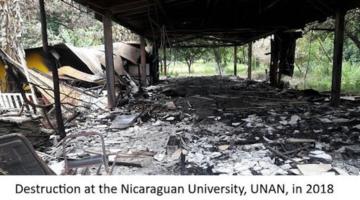 Jeffrey Isaac Jarquin was deported from the U.S. by ICE and upon arrival in Managua was sent to prison by Nicaraguan authorities. Corporate media has decried the detention of a “torture victim” and “…
 In this week’s segment, we discuss student protests by Black and brown youth in France against austerity measures and race-based inequality in the education system. But we begin with a discussion of…
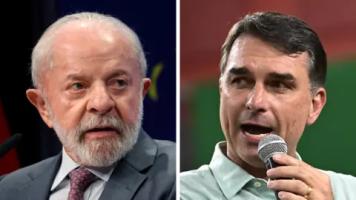 Brazil's incumbent president Lula da Silva finished second behind Flavio Bolsonaro in the first round of the presidential election. Because neither man received at least 51% of the vote, a run-off…
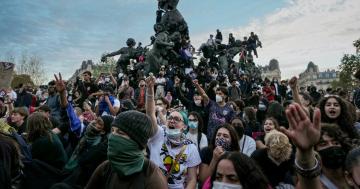 Students in France are engaging in mass protests. Hundreds of them have been arrested and injured by police, and many schools are closed. Annick Metefia joins us from Paris. She is a member of the…



