The USS Fort Lauderdale in a file photo. The amphibious assault ship is now docked in La Guaira, Venezuela, after the June 24 earthquakes. Under cover of disaster relief, Washington put a U.S. warship at the country’s primary port.
The same U.S. sanctions regime that gutted Venezuela's hospitals and left its buildings in ruins now lands Marines at its airport in the name of earthquake relief, which is not rescue but occupation.
Originally published in Struggle-La Luhca.
The U.S. Air Force now runs Venezuela’s main international airport. A U.S. amphibious warship is docked at its principal port. MQ-9 Reaper drones and combat helicopters fly reconnaissance over Caracas. Nearly 2,000 U.S. troops are deployed on land, air and sea in and around the country, operating out of two colonies: U.S.-held Puerto Rico and Dutch-held Curaçao.
Washington calls this earthquake relief.
Two earthquakes of magnitude 7.2 and 7.5, striking 39 seconds apart on June 24, devastated northern Venezuela — the strongest to hit the country in more than a century. The official count had risen by July 8 to 3,811 dead, 16,740 injured and 17,907 people left without housing, with thousands still unaccounted for and shelters facing mounting health risks.
By early July, international search teams were pulling out as hopes of finding the missing alive faded, the Associated Press reported. Venezuelans kept digging. Families and neighbors in Caracas and La Guaira worked the rubble with hands, shovels and ropes, pooled their wages to rent cranes, and ran rescue networks through WhatsApp groups. This was solidarity from below, moving faster than any foreign force.
Into this catastrophe the Pentagon has moved an occupation force.
The footprint of an occupation
U.S. Southern Command chief Gen. Francis Donovan announced at a July 1 briefing: “The U.S. military, the Department of War, has roughly 2,000 teammates in the area on land, air, and sea around Venezuela.” On June 30, Donovan had told Reuters that 900 U.S. troops were on Venezuelan soil. Donovan said he hoped the mission would build stronger “military-to-military relations” with Venezuela — a strange goal for a rescue operation.
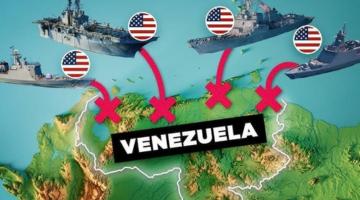
The deployment’s actual tasks tell the story. After repairing a runway, the U.S. Air Force’s Contingency Response Element took over “airfield management, air traffic coordination, communications, and security” at Simón Bolívar International Airport, according to SOUTHCOM’s own press releases. The amphibious warship USS Fort Lauderdale docked at La Guaira, the country’s principal port, serving as what the U.S. Embassy calls a logistical hub. The USS Fort Lauderdale is not a hospital ship. It is an amphibious assault ship built to carry Marines, landing craft, helicopters and military equipment into contested territory.
The USS Billings holds position near Venezuelan territorial waters. The USS Billings is not a relief ship either. It is a fast combat ship built for operations in coastal waters.
A Marine combat logistics company rolled ashore with trucks and off-road vehicles. Marine Maj. Gen. Kevin Jarrard directs the operation.
Control of the airport and the port means control of everything and everyone that enters or leaves Venezuela’s capital region. That is a military objective, and the Pentagon has secured it.
The thief arrives as savior
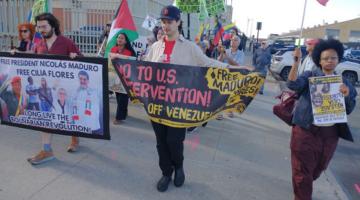
The New York Times reported in early July that the Trump administration has seized at least $8 billion of Venezuela’s oil wealth since Jan. 3, 2026, when U.S. forces attacked Venezuela and kidnapped President Nicolás Maduro and First Combatant Cilia Flores. Six months later, both remain prisoners of war at the Metropolitan Detention Center in Brooklyn, New York — a jail that federal judges and defense lawyers have described as “hell on earth” — where the husband and wife are held in separate units and kept apart from each other. Trump boasted afterward that the U.S. “took over Venezuela … and the oil is flowing.”
It flows through the U.S. Treasury Department, which controls Venezuela’s oil export revenues outright. Roxanna Vigil, a former senior sanctions policy adviser at Treasury’s Office of Foreign Assets Control, wrote for the Council on Foreign Relations in June that almost 100 million barrels of oil worth an estimated $8 billion have moved through a process with “no transparency and minimal oversight.” Washington has not disclosed how much oil it has sold, how much it has collected or where the money went. Even Jimmy Story, a former U.S. ambassador to Venezuela, asked Reuters: “Will these funds be released for the disaster response?”
The answer so far is no. The Bank of England still holds 31 metric tons of Venezuelan gold, worth more than $4.5 billion at today’s prices. U.S. sanctions still freeze Venezuelan state assets across U.S. jurisdiction; a narrow “special license” permits only limited relief-related transactions. The UN Development Program estimates direct earthquake damage at $6.7 billion in its first days; a fuller UN assessment on July 2 put direct damage alone at $37 billion — 32% of Venezuela’s gross domestic product. On July 7, more than 100 economists and scholars, including Jeffrey Sachs, James Galbraith, Jayati Ghosh and Isabella Weber, demanded the release of Venezuela’s frozen assets, full sanctions relief and debt cancellation.
The earthquake struck a country that Washington had spent a decade trying to bleed through sanctions. Those sanctions were aimed at the Bolivarian Revolution — at Venezuelan workers and the poor organizing to take back the country’s oil and mineral wealth and use it for housing, food, health care and the needs of the people.
The Washington Office on Latin America estimated that U.S. sanctions cost the Venezuelan state $17 billion to $31 billion in revenue between 2017 and 2020 alone; the Tricontinental Institute for Social Research puts lost oil revenue from 2017 to 2024 at $226 billion, more than twice Venezuela’s GDP. Those sanctions gutted the health system, drove nearly 8 million people into exile and left the housing stock in the disrepair that turned two earthquakes into a mass grave. The same power that hollowed out Venezuela’s capacity to survive a disaster now lands Marines at its port in the name of rescue.
The earthquake was natural. The mass death was not. The U.S. blockade turned disaster into catastrophe. The catastrophe now supplies the pretext for a new military occupation.
Regime-change specialists in rescue vests
The Pentagon is not the only force entering Venezuela under the sign of relief. Washington’s allies and regime-change auxiliaries are arriving under the same phony humanitarian cover.
On June 27, a team including members of the White Helmets flew into Venezuela from Damascus, dispatched by Syria’s HTS ruler Ahmad al-Sharaa. The White Helmets were created and funded by Britain and its allies during the war to overthrow Syria’s government. They operated in Western-backed armed territory and helped give a humanitarian cover to regime-change forces.
Whatever rescue work its members perform, the organization’s record is that of an instrument of regime change — and it has now been introduced into Venezuela under the same bogus humanitarian banner.
Days later an Israeli military delegation arrived: Brig. Gen. Elad Edri, chief of staff of the Israeli Home Front Command, with “expert teams” for reconstruction. Israel operates in West Asia as a U.S. forward base, and its appearance in Caracas is a deployment of U.S. power by other means — the army that bombed Gaza to rubble now sends officers and engineers to Venezuela as reconstruction experts.
The occupiers argue over how to run the colony
The U.S. ruling class is united on occupying Venezuela and divided over how to do it. The Wall Street Journal reported in March that former Chevron executive Ali Moshiri told the CIA not to install the old U.S.-backed opposition — the opposition bloc Washington had promoted for years before the Jan. 3 invasion and kidnapping of Maduro — because it “wasn’t capable of keeping the oil flowing, let alone running the country.”
That fight burst into the open after the earthquakes. Deputy Secretary of State Christopher Landau pushed for U.S.-backed opposition figure María Corina Machado to travel through Curaçao and Panama toward Venezuela — telling the Dutch ambassador the plan was U.S. policy backed by Secretary of State Marco Rubio. It wasn’t. Rubio’s own department disavowed the trip, and administration officials accused Landau of going rogue. The Dutch government reversed her landing permission while her plane was already in the air. Copa Airlines then refused to carry her from Panama. Washington’s factions were not arguing over Venezuelan sovereignty. They were arguing over whether Machado was useful to the occupation — or too discredited to impose.
Machado, who handed her Nobel Peace Prize medal to Trump after the Jan. 3 kidnapping of Maduro, wanted to return atop the rubble. The CIA and the oil companies want no part of her return. They think she cannot keep the oil flowing or hold the country down without provoking mass resistance.
The hemisphere is the target
The assault on Venezuela is the leading front in a wider offensive. The assault on the Cuban Revolution is its longest continuous front.
For more than six decades, Washington has waged economic war on Cuba through blockade, sanctions, financial pressure and threats of direct attack. The aim has always been to make daily life impossible and force the Cuban people to surrender what they won in 1959.
Today that siege is tightening again. The fuel blockade has pushed Cuba’s energy crisis to the breaking point, hitting transportation, electricity, food production, hospitals and every part of daily life. The pressure is meant to finish through strangulation what invasion, sabotage and isolation failed to defeat.
Elsewhere the offensive advances by other means. In Colombia, Abelardo de la Espriella, a Trump-endorsed U.S. citizen, won a fraudulent election bought and paid for by the Trump administration; he takes office Aug. 7. The vote was not an expression of Colombian sovereignty. It was another form of U.S. intervention.
In Brazil, Washington has taken two large criminal organizations rooted in the drug trade and the prison system and falsely labeled them terrorist groups. The label is phony, but the purpose is real: it gives U.S. agencies a pretext to threaten Brazilian banks, payment systems and, ultimately, Brazilian territory itself. In a written reply to Brazil’s Congress signed July 1, Foreign Minister Mauro Vieira warned that the terrorist designation “could be invoked as justification for extraterritorial actions targeting Brazilian institutions, particularly in the financial, migration, and criminal spheres,” adding: “There is, moreover, the risk of the use of U.S. military force against national territory,” citing Venezuela, Colombia and Cuba as precedents.
This is monopoly capital in crisis using the imperialist state — military, trade and finance together — to reorganize the hemisphere by force. The six-decade blockade of Cuba, Treasury control over Venezuela’s oil revenue, a U.S. warship docked at Venezuela’s primary port in La Guaira, the bought election in Colombia and the terrorist designations aimed at Brazil’s financial system are not separate fronts.
They are one imperialist offensive — an attempt to return the hemisphere to a colonial era when Washington dictated governments, seized resources and treated Latin America and the Caribbean as its property.
The target is the revolution
Within hours of the earthquakes, an information war was underway. Even as thousands of Venezuelan firefighters, civil protection personnel, soldiers, health workers and communal organizations deployed to the hardest-hit areas, the imperialist media moved in near-unison to declare the state absent — no response, no civil defense, no organized rescue. Every government measure, from coordinating rescue operations to organizing shelters, was recast as authoritarianism. The uniformity of the messaging points to its function: to fabricate a story in which Venezuelan sovereignty itself becomes the obstacle to relief. That is the story Washington tells when it needs to disguise aggression as humanitarian rescue.
What that campaign works to erase is the actual response. Communal councils, created by the Bolivarian Revolution as organs of popular power, set up kitchens amid the dust. Students turned classrooms and sports courts into collection centers and supply depots.
The government established a registration center at the Poliedro de Caracas to organize volunteers and aid convoys, and public health centers mobilized nationwide. None of this was spontaneous. It is the product of more than two decades of Bolivarian organization — communes, militias, health missions — the same popular power that survived the sanctions, the blockade and the Jan. 3 attack.
That is what the occupation is for. The warship at La Guaira and the troops at the airport are aimed at the revolutionary government and the organized masses behind it — the Bolivarian project Washington has spent a quarter century trying to break and has not broken. The Pentagon holds the airport and the port. The Venezuelan people hold the country.

 Mali, Burkina Faso, and Niger are leading the way toward the realization of Pan-Africanism and the struggle against imperialism in the 21st century.
 The 1976 bombing of Cubana Flight 455 was part of a six-decade U.S.-orchestrated campaign of destabilization against Cuba, which has now escalated into a genocidal siege aimed at starving the Cuban…
 Jeffrey Isaac Jarquin was deported from the U.S. by ICE and upon arrival in Managua was sent to prison by Nicaraguan authorities. Corporate media has decried the detention of a “torture victim” and “…
 In this week’s segment, we discuss student protests by Black and brown youth in France against austerity measures and race-based inequality in the education system. But we begin with a discussion of…


