Amazon labor organizer Chris Smalls aboard the Gaza Freedom Flotilla Ship “Handala,” July 2025
Chris Smalls and his best friend, Derrick Palmer, led the first successful drive to unionize an Amazon warehouse. He believes that labor must decouple from the Democratic Party, as he explains in his new book.
Chris Smalls, author of When the Revolution Comes: A Fight for the Future of the Working Class has hip hop flash and a half. He comes from working class Hackensack, New Jersey, enjoyed a short career as a rapper, and never stopped dressing like one. While leading the drive that led to the first unionized Amazon warehouse, Staten Island, JFK8, he and his best friend Derrick Palmer resolved to create a brand that made labor organizing and solidarity cool:
We had decided to dress as colorfully as possible. We had actually come up with a branding idea that we were calling Union Drip. We thought of it as if we were starting a rap group. You needed your own style, your own look, so that people could connect with you right away. Union Drip was our look. It was bright colors, reds, yellows, blues, greens. We wanted to stand out like Skittles wherever we went. We wanted to have a look that was as recognizable as Cam’ron had been when he was with the Diplomats. Union Drip also meant wearing the ALU logo or other slogans for organizing and justice on your person. You might have a “Stop Police Violence” shirt on or an “Organize Now” shirt. Whatever it took to remind people that you were here with a message.
And finally, Union Drip meant having the jewelry, accessories, and extras—gold front, shades, hats—to make organizing look cool to the average kid in the hood, to the average Black kid in Jersey, or New Orleans, or Compton, or Cincinnati, or Houston, or Oakland, or wherever. We knew that a huge percentage of blue-collar workers were people of color. But union leadership was almost always white guys in suits. How can you excite people about a movement when they don’t see themselves in it? You can’t.
This was the style, charisma, and imagination that the labor movement needed.
Since the successful drive to unionize Staten Island, JFK8, Smalls has traveled the country and the world speaking and encouraging labor organizing at more Amazon warehouses and joining other social justice campaigns. He joined flotillas sailing to both Cuba and Gaza to deliver emergency relief supplies. He was the sole Black activist on the July 2025 Freedom Flotilla Coalition mission to Gaza, where the Israeli Offense Force singled him out for a brutal beating.
Like the Italian dockworkers refusing to load ships bound for Israel and the Scottish trade unionists now protesting racist, anti-immigrant hate in Glasgow, and like Dr. Martin Luther King, he understands organized labor as part of a broader struggle for social justice.
In his book, however, Smalls says that, at Amazon, he was motivated by desire to achieve a relatively modest American dream:
I started to imagine what it would mean to my family for me to be successful here [at Amazon]. All of our money problems would be a thing of the past. I would save up for my own little house with my own little backyard, work normal, manageable hours, and spend my spare time with my kids and family, barbecuing on the weekends, taking them to basketball games. This could be the dream. From the moment I got there, I could see it all so clearly.
It didn’t work out as imagined, however, despite his considerable skills and his willingness to work very hard in the high pressure warehouse environment, where every second counts for meeting production quotas.
He moved to Connecticut to pursue an Amazon opportunity for advancement, driving long hours back to be with his family in New Jersey on weekends but eventually the strain broke his marriage, leaving him deeply despondent.
Then came COVID in 2020, when he was fired after organizing a walkout over COVID safety conditions at the height of the pandemic. He tells this story in “Walkout,” the book’s Chapter 11, beginning when he was struck with the enormity of what Amazon workers were facing while the company had no COVID protection plan in place:
If this was a billion-dollar company with hundreds of warehouses and more than a million employees and contractors, if this virus was a national, no, international thing, and if everyone was going to start staying at home, ordering everything they needed from the internet, then this was about to be huge. Amazon workers were about to enter the most intense labor period we had ever seen, especially at JFK8, which was the fulfillment hub for the most populated metropolitan area in the country. It would be like a permanent peak season, people pulling overtime, double shifts, rushing to get orders stowed, picked, and shipped, rushing past safety precautions, putting themselves in danger, all to keep money flowing for the company. What was the company going to do to protect us while we did all we could to enrich them?
Two years later, on April 1, 2022, the vote to unionize Staten Island JFK8 stunned the world’s largest corporation and all those who thought it couldn’t be done. It was the first and still only union organizing victory for a U.S. Amazon warehouse.
Smalls calls for labor to decouple from the Democratic Party
Near the end of his book, Smalls calls for labor to decouple from the Democratic Party. He writes:
I was recently invited to be the keynote speaker at a labor conference held by a large national union, and once I got there, they announced that they had pledged $150 million of workers’ money to the Democratic Party. I almost cried. How can a union believe that the party that was in power when the government awarded Amazon a $10 billion contract on the same day it met with Amazon labor organizers would ever use their money to support workers? I couldn’t stop thinking about all the small unionizing efforts like the ALU, like Bessemer, Alabama, like ALB1 in Albany that could have used that money to bolster their organizing. But in a way, I understand their thinking. We are given only two government options, and people have a hard time imagining anything outside that.
. . .
I envision a legitimate Labor Party on the ballot in every local, city, state, and federal election. I know I sound like someone who has lost touch with reality. I know I’m dreaming about things that sound impossible.
But you should know by now that when the revolution comes, it comes disguised as an impossible dream.
Penguin Random House published When the Revolution Comes: A Fight for the Future of the Working Class on June 2nd.
Ann Garrison is a Black Agenda Report Contributing Editor based in the San Francisco Bay Area. In 2014, she received the Victoire Ingabire Umuhoza Democracy and Peace Prize for her reporting on conflict in the African Great Lakes region. She can be reached at ann@anngarrison.com. You can help support her work on Patreon.




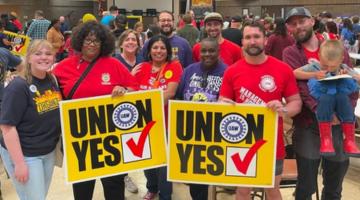

 Many in the U.S. "Left" are actually liberal elements that pull socialism toward the Democratic Party. Black organizers must build independent power.
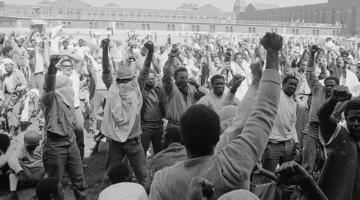 The Attica rebellion was not only about prison "reform." The prison is the most intense expression of a system of imperialist domination that operates at every scale.
 "In the same boat?" is the latest from BAR's Poet-in-Residence.
 An Open Letter from the American "Left" allegedly on behalf of unnamed persons said to be Iranian political prisoners has provided cover for U.S. imperial aggression against Iran by refusing to…
 Empire taught us what to believe about the Global South. It also taught us how to move through it, and being colonized here does not exempt us from carrying those beliefs with us.


