Jesse Jackson's legacy is complicated and sometimes contradictory, as he engaged in both radicalism and in political expediency.
“I am somebody. I may be poor, but I am somebody. I may be young, but I am somebody. I may be on welfare, but I am somebody.”
Sitting on the famous Sesame Street television stoop, made to look like a neighborhood in a New York city borough, a then 31 year old Jesse Jackson, afro’d, sitting tall, and sporting a massive gold chain, instructed the multi-ethnic group of children to repeat after him in his uplifting underclass positivity narrative. “I am, somebody” This heartfelt scene was shared on social media as the reports of Jackson’s passing came in, and the somber obituary reflections poured in citing Jackson as a “Civil Rights leader” and champion of progressive causes. From all ends of the political spectrum Jackson’s passing was a time to honor the fallen leader, and maybe the last living link to the Civil Rights movement.
The recent passing of Jesse Jackson has led many to reassess his life as a net positive. Whether socialist, left-liberal, or politically moderate, people across the spectrum have offered thoughtful and often glowing reflections on Jackson’s legacy. In a recent Jacobin article, the author David Duhalde said of Jackson, “The “Rainbow Coalition” represented some of the best progressive politics in the last quarter of the twentieth century. This framework was able to elect David Dinkins, then a DSA member, as New York City’s first black mayor.
None of this is to say this strategy was without flaws. Jackson’s Rainbow/PUSH Coalition did not become a mass and democratic organization. Dinkins’s mayoralty only lasted one-term. But the Coalition did show that a multiracial working-class movement was possible and could lead to real victories in high office.”
If Jackson was to assist in the ability to elect Dinkins into office, one of Dinkins first big legislative moves was to increase police size and budget. Being tough on crime, and seeing punishment as the immediate and proper solution was what many on the “progressive” end of the spectrum understood as the answer to record high levels of violent crime. Indeed, this type of posturing that we would call “right leaning” now was bipartisan speak, and the same rhetoric of the late Jesse Jackson.
“Down with dope, up with hope. Nobody will save us from us for us, but us.”
This moralizing rhyme, for many in the late 70s and early 80s echoed King, but the simplicity of this bumper sticker messaging, is the Black Nationalist equivalent of “Just Say No”. This “pull your pants up” respectability politics is what is often glossed over, or glazed over when people eulogize Jackson–heavy on style and a commitment to being on the “right side” of certain issues (his stance on Palestine for example) but he was never truly building anything concrete that could attempt to achieve any goals outside of positioning himself as a person who could deliver certain constituencies for electoral campaigns.
I have understood Jackson as the last vestige of an earlier moment of Black political life that contained the promise of economic transformation—but whose memory was reduced to inspirational speeches and incorporation into polite society.
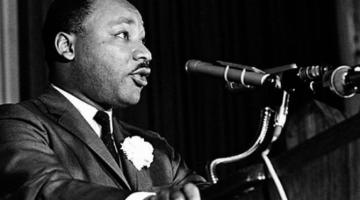
His proximity to Martin Luther King Jr., coupled with his immense charisma, allowed Jackson to embody one aspect of King; his oratorical brilliance. Jackson could capture crowds and present himself as a living continuation of King’s legacy. But we should ask: which King did Jackson emulate? It was not King’s radicalism. For many Black Americans, Jackson felt less like an instrument of transformative change and more like a carefully curated image of a Civil Rights leader, one who reproduced the aesthetics of struggle without any of its major material gains.
The King that has been canonized into the American lexicon of hope is the one that remains trapped in the final stanza of a speech—a kind of TikTok or Instagram Reels-ready soundbite. A perfect ending where King is preaching to a captivated audience of hundreds of thousands at the Washington Monument, speaking on simply a dream of racial harmony, and economic emancipation. To achieve that dream, it’s not about working toward concrete goals to alleviate barriers that prevent people from entry into union labor or keeping people bound to economically depressed neighborhoods, that requires legislation, not simply good will and a kind heart. If King is reduced to a well-spoken social justice advocate who fought racism and merely racism alone—then his struggle becomes one against abstract prejudice rather than against material deprivation and structural inequality. Yet by the end of his life, after major legislative victories that would improve the lives of millions of Black Americans, King remained focused squarely on economic redistribution and the plight of poor and working-class people of all races.
Jackson, by contrast, proved adept at channeling the version of King America preferred to remember. In The Jesse Jackson Phenomenon, Adolph Reed, Jr. argues that Jackson’s politics were less about structural transformation than about “symbolic representation” and elite brokerage. Reed describes Jackson’s appeal as rooted in the ability to personify Black political aspiration while leaving existing economic arrangements largely undisturbed. Jackson’s Rainbow Coalition, Reed contends, functioned more as a vehicle for mobilizing dispersed constituencies into the Democratic Party orbit than as an instrument for independent class politics. The emphasis was on access, visibility, and negotiation, not redistribution.
“Jackson said the news conference today was called to 'prepare for renegotiation of the relationships with corporations that get more than a fair margin of profit from the black community or, if they insist on present practices, to engage in economic sanctions.'
'Right now we want to focus on the beverage industry,' he said.
Jackson said the firms in question practice discriminatory practices in hiring, advertising and merchandising, yet blacks constitute a large part of their market.”
From, Some of the Nation’s Largest Beverage Suppliers are Being Targeted By a Boycott (1982)
The journey of the Civil Rights movement was not about positioning patronage brokers who would speak on behalf of all Black Americans and then distribute grants, foundation money, or symbolic concessions to pacify unrest. Yet that brokerage model is precisely what Reed and others saw emerging in Jackson’s ascent. In this sense, Jackson was less a continuation of the Civil Rights movement’s insurgent heart than a remnant of an older accommodationist tradition. He resembled, and was compared to, in important ways, Booker T. Washington: a leader who sought advancement through negotiation with white power structures, promising stability and uplift within existing hierarchies.
Jackson’s genius was electoral theater. His presidential campaigns in 1984 and 1988 stirred genuine enthusiasm and registered protest within the Democratic Party, but they ultimately reinforced party discipline. Reed observed that Jackson’s insurgency never threatened to break from the institutional confines of Democratic liberalism. Unlike later figures who flirted with independent class-based politics, Jackson remained committed to operating as an internal reformer, not an external challenger; delivering the Black electorate on a platter so their concerns were now moot, thus working to neuter any sort of Black political power within the Democratic Party.
His post–electoral career only deepened that pattern. When he was no longer running for office, Jackson became a moral validator for Democratic Party figures. Most notably, during the scandal that nearly ended the presidency of Bill Clinton, Jackson stood publicly by Clinton, serving as a spiritual advisor and defender. That would be years after Clinton, during his 1992 Presidential run, appeared at a Rainbow Coalition gathering to distance himself from Jackson and any sort of “Black radical” politics to insure centrist voters that he wouldn’t be swayed by Jackson, or the more radical end of the Black political spectrum that was making noise after the 1992 Los Angeles Riots. At the very moment when the Democratic Party was consolidating a neoliberal consensus, championing welfare reform, deregulation, and punitive crime policy, Jackson’s presence lent it the moral aura of the Civil Rights tradition. Jackson could perform radical and condemn militarism and poverty but no movement was ever formed like the one that allowed him this proximity to power–Jackson allowed absolution to the Democratic establishment, even endorsing Hillary Clinton in the 2016 presidential election against Donald Trump (although Jackson would later endorse Sanders in 2020 over Joe Biden).
Jackson, like Booker T. Washington, reassured white elites that Black advancement would not fundamentally disrupt the economic order. Jackson’s politics performed a similar function in a different era: translating grassroots energy into symbolic capital that could be reinvested into the Democratic establishment. He helped expand Black access to the middle class and corporate America—an achievement not insignificant, but one that left untouched the deeper structures of inequality. If trickle down doesn’t work for whites, it sure won't work for us.
In the end, the linkage between Jackson and King, the memory that allowed people, for a time, to see Jackson as a continuation of a radical tradition faded long ago. In the current era of everything being political from comedians to pop musicians, Jackson’s rhetorical clarity allows people to understand him as a precursor to Bernie Sanders, and it obfuscates how he paves a way for Obama and ultimately Trump. Speeches filled with soaring rhetoric and a campaign that is politically impotent. People fawning over a candidate who is devoid of experience and heavy on personality–they become a canvas of projection where their rhetorical “honesty” gives them a veneer of authenticity that can entrance the masses–demogaugic figures indeed. Jackson is gone now, and maybe now we can acknowledge that the end of the Civil Rights movement marked total usurpation into the Democratic Party, and Jackson was a major player at that hinge point.
Jackson didn’t continue the movement, he was a reminder that it was officially over, and was having its image, its soul looted to the highest bidder, be it Coca-Cola, Pepsi, let this passing be a reminder that days of Black people awaiting our “leader” like Vladimir and Estragon are over.
Jason Myles is a musician, filmmaker and the host of THIS IS REVOLUTION>podcast (TIR). You can find his video essays on MeansTV. You can find also find Jason’s work at Damage Magazine, and Current Affairs as well as the TIR Substack




 White supremacy works through institutions, and FEMA's formula for allocating disaster relief shows us how the state decides which neighborhoods are prioritized and which are left to suffer. Those in…
 The IMF and World Bank are not subjects the corporate media cover in any real sense. Instead, their role is treated as unquestionably immutable and beneficial.
 The Anti-Imperialist Scholars Collective (AISC) wrote this response to the open letter To Iran's political prisoners, 'trapped between two blades of a scissors' which appeared in The…
 The Anti-Imperialist Scholars Collective (AISC) offers an analysis of the Ramadan War and the multiple fronts of Iranian anti- imperialism. It uses anti-imperialist methodology, grounded in…
 From the blockade of Cuba to the kidnapping of Venezuela's president, U.S. imperialism is recolonizing the Americas, and the only answer is a Zone of Peace built through popular struggle and anti-…


