The so-called "peace agreement" between Rwanda and Congo prioritizes U.S. access to mineral riches. The violence carried out against thousands of civilians continues.
Donald Trump invited President Paul Kagame of Rwanda and President Felix Tshisekedi of the Democratic Republic of the Congo (DRC) to Washington, DC, on Thursday, December 4th to consummate a “peace” agreement that the foreign ministers of both countries signed on June 27, 2025.
Although the high-level meeting was promoted as the signing of a peace deal, it went far beyond the mere signing of a peace deal. Four agreements were signed among the three leaders:
1. A joint declaration to reaffirm the June 27th peace agreement
2. Formalization of the Regional Economic Integration Framework (A provision in the June 27th Peace Agreement).
3. Bilateral Health Cooperation Agreement between Rwanda and the United States
4. Strategic Partnership Agreement Between the United States and the Democratic Republic of the Congo
Of the four agreements signed, the most crucial and consequential is the bilateral strategic partnership agreement between the United States and the Democratic Republic of the Congo. Although phrased as a partnership, it is not an accurate representation of what was signed. In essence, it is an agreement that secures the United States' supply chain of critical minerals from the Democratic Republic of the Congo for military/defense and commercial purposes. In addition, the agreement curtails China’s ability to expand its presence in the DRC - a veritable strategic minerals containment strategy. China owns 15 of the 19 cobalt mines in the Congo and processes 90% of the world’s cobalt, which is indispensable to military industries, the green energy sector, the automobile, Artificial Intelligence, the tech sector and more. Although China is the target, any state or company that is not a part of the strategic partnership will be limited in its access to Congolese minerals. Access to Congolese minerals will now be determined by the United States in concert with the DRC government, as articulated in the strategic agreement.
During the US-Africa Leaders Summit in 2022, the Biden Administration signed a Memorandum of Understanding with the Democratic Republic of Congo and Zambia that triggered a visceral response from anti-imperialist formations and pan-Africanists who argued that the DRC was abdicating its sovereignty. However, the memorandum in 2022, which was on paper only with no real substance underlying it, pales in comparison to the recently signed December 4, 2025, strategic partnership. The United States government’s foreign investment arm, the International Finance Development Corporation, has already issued a letter of intent for $2 billion for investment in the strategic partnership agreement signed last Thursday. Billions more are being lined up by the US private sector to invest in minerals, energy and infrastructure in the Congo.
A dispassionate, objective reading of the agreement will immediately reveal the extreme extent to which President Felix Tshisekedi and the political elites in Kinshasa have gifted not only the spectacular mineral wealth of the Congo to the United States but also the co-management of those riches, which are supposed to be the patrimony of the Congolese people and serve the African continent as a whole.
The agreement will create a Strategic Assets Reserve (SAR) of critical minerals whereby the DRC will designate an initial list of critical mineral assets, gold assets and unlicensed exploration areas as part of the Strategic Asset Reserve (SAR). The SAR will be managed by a steering committee made up of five U.S. officials from various government departments and five Congolese. The SAR steering committee will be the entity that manages and makes decisions over the range of minerals that exist in the Congo. Some economists say that there is an estimated $24 trillion worth of natural resources in the DRC – a sum nearly equivalent to the Gross Domestic Product of the United States.
The United States will be the majority owner in all the projects that are a part of the agreement. Decisions surrounding the Strategic Assets Reserves will be made by consensus. However, within the next 12 months, the DRC will have to implement legislative and constitutional reforms to fit the terms of the agreement. One of the terms includes the provision of a ten-year tax holiday for US companies that are a part of this deal. The agreement also grants the United States the right of first offer for future mining projects in the DRC. In addition, the DRC must report on a quarterly basis to the U.S. Ambassador to the Congo about any changes or adjustments in the DRC’s minerals export policies.
The agreement between the DRC government and the Trump Administration reminds us of Kwame Nkrumah’s seminal work, Neocolonialism The Last Stage of Imperialism, where he warns us that this stage of imperialism is its most dangerous. Under the mis-leadership of neo-colonial leaders, the imperialist forces are able to secure critical minerals and other resources vital to their national security and corporate interests with little to no resistance due to the cover and cooperation they get from rent-seeking neo-colonial leaders who serve as a buffer class between the African masses.
The deal pays lip service to adding value locally, skills and technology transfer, training of local technocrats, formalization of the artisanal mining sector, and other social and economic benefits to the Congolese people. However, if in the current peace agreement, stability, peace and justice for the people are sidelined, why would one think or believe that a strategic mineral agreement would deliver any substantial benefits to the people?
In the midst of these deals being signed in Washington, Congolese civilians continue to suffer and perish. Since the signing of the peace deal on December 4th, the Rwanda-backed M23 has captured more territory and key cities. Seventy-four people have been killed and eighty-three wounded. An estimated 200,000 civilians have fled their towns and villages to add to the nearly seven million internally displaced Congolese inhabitants. The agreement does not require Rwandan soldiers to leave Congolese territory or the M23 to disarm before it goes into effect. Thousands of people have been killed, and the plundering of Congo’s resources continues unabated, making a mockery of what is called a peace agreement. The continuation and escalation of the conflict is predictable, seeing that matters of accountability, justice and an end to impunity are not priorities in the agreements signed in Washington. Profit, securing of US supply lines, access to critical minerals, and geo-strategic battles with China were the priorities of the Trump administration.
We are witnessing the capture of the heart of the African continent and her riches that are supposed to benefit the sons and daughters of the Congo and power the development of the African continent. Fanon’s prescient words that “the fate of all of us is at stake in the Congo” are even more relevant today. The challenge is for radical forces, leftists, anti-imperialist formations and pan Africanists to stand with the oppressed masses of the Congo to fight for a free, liberated and sovereign Congo.
Maurice Carney is one of the co-founders of Friends of the Congo and currently serves as the organization's Executive Director. He has pursued a Pan African solidarity mission for the past twenty-five years to build a global constituency in support of the Congolese people as they strive to fulfill Lumumba's vision of a free and liberated Congo.


 Many in the U.S. "Left" are actually liberal elements that pull socialism toward the Democratic Party. Black organizers must build independent power.
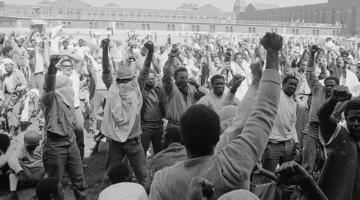 The Attica rebellion was not only about prison "reform." The prison is the most intense expression of a system of imperialist domination that operates at every scale.
 "In the same boat?" is the latest from BAR's Poet-in-Residence.
 An Open Letter from the American "Left" allegedly on behalf of unnamed persons said to be Iranian political prisoners has provided cover for U.S. imperial aggression against Iran by refusing to…
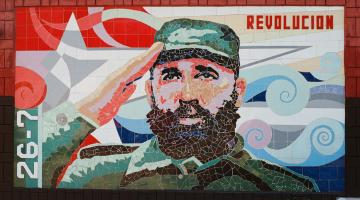 Empire taught us what to believe about the Global South. It also taught us how to move through it, and being colonized here does not exempt us from carrying those beliefs with us.


