As a Black army of mercenaries from Kenya, Barbados, Jamaica, and elsewhere arrives to continue the West’s colonial project in Haiti, we remember the history of the 1802 mutiny of African soldiers at Dominica.
The use of Black soldiers to police Black people has been a long standing feature of pan-European colonial and neocolonial practice. It is a strategy the great pan-Africanist George Padmore described in detail in the chapter “Black Soldiers of Imperialism,” from his classic monograph Life and Struggles of Negro Toilers (1932). Padmore recounts “the policy of militarising Negroes” by France, England, Belgium, and the United States. The white nations created “reserve black armies,” made up of tens of thousands of Black conscripts, that were deployed to fight in the European theaters of the white man’s imperial wars, to suppress Black revolts in Europe’s African colonies, and to expand and defend the European colonial project.
What Padmore does not describe in “Black Soldiers of Imperialism” is those instances of insurrection, insurgency, sedition, and mutiny among the reserve Black armies. In 1901, for instance, the West African Regiment, consisting of Mende and Temne conscripts from Sierra Leone, staged what the British press called “the Coomassie Mutiny.” The West African Regiment had been deployed in Kumasi in the Gold Coast colony to help suppress the Asante rebellion against the British, but they mutinied against their colonial officers in protest over their treatment. In 1944, there was a mutiny among France’s Senegalese regiments, known as Tirailleurs Sénégalais, at the Thiaroye military camp on the outskirts of Dakar. They too were protesting against terrible conditions and defaulted pay. Their Senegalese compatriots were brought in to suppress the rebellion; they massacred close to three hundred soldiers. In April, 1970, a mutiny by members of the Trinidad Defense Force was part of the island-wide Black Power rebellions. During the United States’ colonial war in Vietnam, Cambodia, and Laos, Black GI’s were consistently on the frontlines of militant resistance and rebellion against the US imperial project.
These insurrections and mutinies affirm colonial historian Bryan Edwards’ observation that “the employment of negroes as soldiers [is] not without danger.” Edwards, however, found immediate proof for his statement in what he described as “the melancholy event which occurred in Dominica” in April, 1802: one of the earliest insurrections within the reserve Black armies of the white colonial powers, the 8th West India Regiment.
The first of the West India Regiments was created by the British in 1795 out of a perceived need to create a standing force to defend the Caribbean colonies. As it was believed that African soldiers could better withstand the conditions of the tropics than their white counterparts, the regiments were made up of Africans, newly arrived in the Caribbean after the middle passage, who were purchased in local slave markets by the British Army. The West India Regiments were used for three purposes: to fight other white imperial powers vying for a foothold in the region, to suppress the revolts of enslaved Africans toiling on the plantations, and to hunt and exterminate the insurgent maroon communities that posed a constant threat to the institution of slavery. Echoing Bryan Edwards’ observations, the white Caribbean plantocracy held an incessant fear that an armed contingent of Africans might join the maroon communities they were paid to repress, or even join an insurrection of their African brethren on the plantations.
On the evening of 9 April 1802, those fears were realized with the mutiny of the 8th West India Regiment, stationed at Fort Shirley on the island of Dominica. The Dominican historian Lennox Honeychurch has noted that there were a number of causes behind the mutiny. A rumor began circulating among the regiment that it was to be disbanded and its soldiers sold into slavery. Those rumors seemed to be materializing when the colonial governor of Dominica, Andrew Cochrane Johnstone, forced members of the regiment to clear the brush and drain the swampy ground around his private estate in the neighborhood of Prince Rupert’s. Not only was the pay for their labor withheld for six months by the governor, but they were each issued a billhook, an implement similar to a machete, for the work. Billhooks were also used by enslaved Africans to cut sugar cane.
These circumstances, Bryan Edwards wrote, were akin to “a lighted match to a charged mine.” On the evening of April 9th, members of the Regiment killed their white officers, leading to a short but intense battle with other regiments and reinforcements. The response by the colonial authorities was merciless. By the end of the insurrection, more than one hundred members of the regiment were killed, many of them summarily shot on sight, their bodies plummeting into the sea from the high ridges edge of the mountainous Cabritt were they fled. Others were dumped and unceremoniously buried in mass graves. The mutineers who survived were incarcerated, exiled to Halifax and the East Indies, or ordered to Martinique where they were executed on the morning of April 27.
Below, we reprint an account of the mutiny at Dominica printed in the April 24, 1802 edition of the Barbadoes Mercury, a journal of the white, colonial, racist, planter elite. The biases of the account are obvious, but those biases cannot obscure the basic fact that whenever colonial powers deploy Black troops, those powers always live in fear of Black mutiny. As a reserve Black army consisting of conscripts and mercenaries from Kenya, Barbados, Jamaica, and elsewhere arrives to continue the West’s colonial project in Haiti, we remember this history of Black mutiny – and we pray to Jean Jacques Dessalines that Black mutiny will return.
Mutiny at Dominica
Roseau (Dominica), April 14 [1802].
On Saturday morning, the 10th instant, accounts arrived in town express to his Excellency Governor Johnson, that a mutiny had broken out in the 8th West India Regiment, of which his Excellency is Colonel, who, on the preceding evening, had revolt against their officers and put three of them to death; in consequence of which an alarm was fired, and the colony put under martial law, which was sanctioned by a Council of war, to continue for fourteen days.
They themselves assigned various motives for this outrage; what the real one may have been, yet remains to be investigated; but whatever it was, it can form no palliation for the scene of brutality which they committed.
The different corps of Militia were immediately assembled in town, and a part of the 68th regiment, with about fifty men of the St. George’s regiment, commanded by Captain Dodds, and the St. Luke’s Independent Company, were immediately embarked in some of the dragging vessels, in order to act with the St. John’s Independent Company, commanded by Captain Trotter. On Sunday his Excellency embarked with the remainder of the 68th, and arrived at Prince Rupert’s on the evening of the same day. Previous to this the mutineers had made a sortie, in which they had a skirmish with Captain Trotter’s company, but in the end were repulsed and driven back by that company, supported by the marines of the different ships in the Bay, who effectually continued to keep them within the post till the force which accompanied the Governor was disembarked.
His Excellency found, on his arrival, that terms had been proposed to Major Hamilton after which, several interviews between parties deputed from the mutineers and our commanders took place, the result of which was, that they should surrender and lay down their arms, which being agreed, and that 500 men should march to take possession, the Governor, at the head of a detachment from the Royals, commanded by Captain Puxley from the Saints, about 300 of the 68th, commanded by Majors Scott and Hamilton, and the Marines commanded by Captain [name unknown], together with some officers and privates of the artillery, entered the garrison, when they found the mutineers drawn up on their usual place of parade, with the colors in their front. They received our troops with presented arms, and obliged two of their officers, whom they had spared from the massacre of Friday night to take post in their front. The Governor drew up his troops in two lines opposite to them, rode to the line of the mutineers, and direct them to shoulder and ground their arms, on which he rode to the rear of the front line. They were then ordered to advance three paces in front; at which moment a Serjeant (Church) called out, “No, General—no.” The Governor then replied, if they did not instantly obey, he would order the troops to fire upon them. On which, the whole seized their arms, and a general fire commenced, by which many of the mutineers fell, and the remainder dispersed themselves in different directions.
Previous to their dispersion, Capt. Serrant, and Lieut. Beaubois, with St. Luke’s Independent Company, had received orders to occupy Fort Shirley, in which were some of the mutineers but being fired upon, and having no instrument with which to force the barrier gate, they were obliged to retreat.
After the scene on the parade, many of the surviving fugitives were seen scrambling up the outer Cabrit, others fled up the inner one, and those who could attain it, running along the line on the ridge, discharged, as they passed, the cannon which had been previously loaded, and pointed on their pursuers, and then threw themselves headlong over the precipice. Such, however, was the spirit of intrepid activity manifested by every white individual in the garrison, in storming the remaining posts of the mutineers, that, in the course of half an hour, the whole were completely reduced; and these daring banditti may now be said (except about 130, who are prisoners on board the ships of war) to be almost wholly exterminated.
It is with great satisfaction we find our own loss has been very trifling, according to the best accounts amounting to 20 killed and wounded.
Lieut. McKay and Lieut. Wastnays appears to have been peculiar objects of their rage. Lieut. Wastnay’s fate was truly lamentable. These barbarians having stripped him, fastened him to a tree, pricked him with their bayonets, and mutilated him in a most shock manner, even retarding that death, which would have been a boon, as terminating his sufferings; and the dead body of Lieutenant McKay, the first victim to their wrath, they equally insulted, by dragging it about the post in a manner too horrid to relate.
The strongest powers of panegyric would be faint, to give the due tribute to the merit of every corps which was engaged in the late perilous scenes. The zeal and intrepidity of the artillery, commanded by Captain Brough, the Royals, the 68th regiment, and Marines, reflect outhouse corpus the highest credit. The St. George’s regiment and St. John’s Independent Company manifested their usual spirit and alacrity, and though not engaged in the business of the interior of the fortress, sustained with becoming firmness the important position which is Excellency judged proper to assign them.
Captain Lewis, of the 37th regiment, who commanded the advanced guard, is justly entitled to applause.
Great praise is due to Captain Benjamin Matthews, of the ship Fanny, who volunteered his services, with several of his crew, and whose exertions on this occasion were highly useful. It is with concern we state, that one of his men was dangerously wounded by a grape shot.
“Mutiny at Dominica,” The Barbadoes Mercury, 24 April 1802




 In this week’s segment, we hear about the ongoing uprising in France against neo-liberal austerity, colonialism, and white supremacy. But first, we discuss a new report that reveals a 25% decline in…
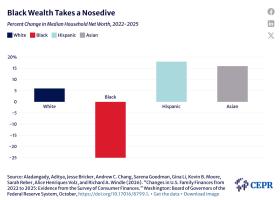 The Center for Economic and Policy Research (CEPR) recently reported on Federal Reserve data indicating that Black people in the U.S. have lost 25% of their wealth between 2022 and 2025. Whites,…
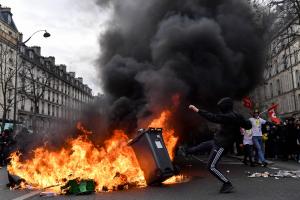 Bouna Mbaye is an activist, writer, and a member of the Pan-African League-Umoja, the Pan-African Brigade for Palestine, and the US Out of Africa Network. He joins us from Paris to discuss the…
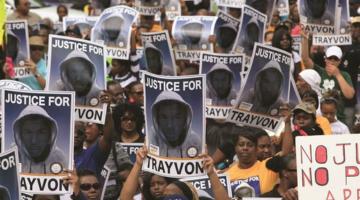 As Black Agenda Report is poised to celebrate its 20th anniversary, we reprint Glen Ford's commentary on the killing of Trayvon Martin and the impunity provided to his killer in a criminal justice…
 The Democratic Party is terrified of even small liberal reforms and will not abide left leaning democrats thwarting their plans for austerity and neoliberal orthodoxy.


