The recent killing of three Israeli hostages in Gaza has elevated questions about the policies of the zionist settler state and the occupation forces. The cold callousness with which they have navigated the hostage situation and the vicious brutality they inflicted on the Palestinians draw a parallel to the Attica Prison Uprising of 1971.
Originally published by Jon Jeter.
Israeli officials and their Western surrogates spent the weekend in crisis management mode following revelations that three hostages killed by friendly fire on Friday were shirtless and carrying a makeshift white flag when Israeli Defense Forces fatally shot them.
Thousands of Israelis poured into the streets of Tel Aviv on Saturday to protest the slayings of the three Israeli men who were among 240 hostages taken by Hamas militants in the October 7th attack. According to the Israeli newspaper, Haaretz, IDF soldiers in northern Gaza spotted a building with the inscriptions “SOS” and “help” scrawled in Hebrew on an exterior wall; one of the men even pleaded for help in Hebrew.
Suspecting it was a Hamas trap, however, IDF soldiers opened fire, killing two hostages as they stood on the roof of the building while holding aloft the white flag, and chasing the third into the building where he was gunned down as well.
While acknowledging that the soldiers had indeed violated the IDF’s rules of engagement, Israeli military spokesmen attributed the lethal mishap to the fog of war, and said that none of those responsible for the hostages’ death would be reprimanded. In that same vein, Israeli Prime Minister Benjamin “Bibi the Butcher” Netanyahu expressed regret for the killings, saying in a televised news conference: “It broke my heart; it broke the whole nation’s heart and our hearts go to the families at this tough hour.” Nonetheless, he made it clear that the IDF intended to stay the course in its effort to destroy Hamas militarily while simultaneously freeing the hostages.
“We will learn these lessons, we will apply them and we will not let go of the military and political efforts to release the hostages.”
But the IDF’s recklessness has inflamed Israelis who demand that their government immediately suspend its military campaign to negotiate the release of more than 100 hostages who remain in Hamas custody following a prisoner swap last month that was largely arranged by Qatari diplomats. In myriad interviews with reporters, demonstrators describe Netanyahu in terms that are mindful of Herman Melville’s myopic Captain Ahab, who is so obsessed with killing the great white whale known as Moby Dick that he sacrifices not only his own life but that of all the seamen in his crew, save one.
One Israeli woman told reporters Sunday:
They say they do everything, they say that the hostages (are) first in their considerations but it doesn’t seem like this, it doesn’t look like this.
Said another:
We need to be proactive about this, we should put a deal on the table that Hamas could not deny.
History, it has often been said, moves east to west, and yet, the New World has much to say to the old, especially when it comes to the savagery of settler colonialism. If what happened 52 years ago at Attica prison in upstate New York is any guide, Zionists should understand that the remaining hostages are in grave and imminent danger from an Israeli government that will not hesitate to kill its own citizens in a bid to maintain control of a darker-skinned, colonized population.
This was the case in September of 1971 when more than 1,000 mostly African American and Puerto Rican inmates kidnapped 39 white correctional officers and seized control of an Attica cell block to protest inhumane conditions, which were similar to what Gazans endure living under Israel’s illegal occupation. One prison guard was killed in the initial melee, but the correctional officers who survived the ordeal would say later that they were treated humanely by their captors who viewed their hostages as bargaining chips; the inmates promised to release them unharmed if state officials met all their demands.
One of those demands was an increase in the allotment of toilet paper. Prisoners at Attica were issued one roll of toilet paper each month and risked a beatdown if they asked for more. Arthur Harrison, a 21-year-old inmate at Attica in 1971, told the documentarian Stanley Nelson for the 50th commemoration of the uprising:
They would come in with four or five guys; they would rush a guy in a cell. You have no way of keeping four or five guys off you unless you were Superman or somebody like that. Then they would beat you down, drag you out the cell and take you to the box where you would get beaten again. . .It reminded me of the things I used to hear about on plantations in slavery. They treated us like we weren't human.
The demand for more toilet paper was emblematic of the inmates’ list of reforms sought by the Attica insurgents. Said Harrison:
The prisoners' demands were really just to be treated as human beings, they were: getting more toilet paper, getting more visiting hours, things like that, things that could easily be met. And to [prison commissioner Russell] Oswald's credit, he very quickly agreed to 28 of the 30 demands. The one demand that everything hinged on was amnesty, because the prisoners wanted amnesty, not for the crimes that they had committed outside of prison that got them there. They wanted amnesty for anything that was done in the rebellion, because there was a real fear that all of the prisoners would be tried en masse for everything.
One of the leaders of the prisoners’ uprising, 21-year-old Elliot James Barkley–known as L.D.–spoke eloquently of the inmates’ cause to journalists and camera crews reporting on the Attica takeover at the time.
We are men! We are not beasts and we do not intend to be beaten or driven as such. The entire prison populace, that means every one of us here, has set forth to change forever the ruthless brutalization and disregard for the lives of the prisoners here and throughout the United States. What has happened here is but the sound before the fury of those who are oppressed. We will not compromise on any terms except those terms that are agreeable to us. We've called upon all the conscientious citizens of America to assist us in putting an end to this situation that threatens the lives of not only us but of every one of you, as well.
New York’s Republican Governor, Nelson Rockefeller, declined the prisoners’ offer to even meet with them, let alone negotiate, and five days into the standoff, he ordered nearly 500 law-enforcement personnel–including state police troopers, deputy sheriffs, park police, and correctional officers– to storm the prison yard with rifles and shotguns loaded with buckshot pellets. Said the documentarian Nelson:
And they were up on the catwalks and first tear gas was shot down on [the prisoners]. So it was all smoky and [law enforcement] really couldn't see anything. They were just firing down randomly at the prisoners. Again, I want to reiterate that they couldn't see what they were doing, so they just fired over and over again. There's one New York state surveillance tape ... of the riot, and it's unbelievable how long they were firing. It's about nine minutes of straight shooting down into the yard.
When finally the smoke cleared, 39 prisoners lay mortally wounded, including Barkley, who Harrison said was hunted down, much like the Israeli airstrike targeting the Palestinian poet Refaat Alareer earlier this month. Additionally, 10 of the Attica hostages were killed in the indiscriminate shooting. Rockefeller initially said that the inmates had killed the hostages by slitting their throats but the coroner who examined the bodies said that all of the correctional officers had been shot, meaning that they could have only been killed by law-enforcement since the prisoners had no access to guns.
Rockefeller’s response to the Attica insurgents and his depraved indifference to the lives of their jailers is motivated by the same indecent impulses that shaped Israel’s killing of Hamas’ hostages last week, and Netanyahu’s preoccupation with sending a message of shock and awe to Palestinians. Some Palestinian analysts, such as Ali Abunimah, the executive editor of the Electronic Intifada, has publicly questioned whether the IDF continues to adhere to the Hannibal Directive, a controversial military policy that aimed to prevent the capture of Israeli soldiers at any cost, including killing the soldier before he or she could be abducted. Israeli generals maintain that the IDF abandoned the policy after the 2014 attack on Gaza.
What is not in dispute is that the European settler project can only survive by putting down uprisings of colonized people such as the one at Attica and by Hamas. The catch-22 is that this requires the settler state to overreach, and sometimes sacrifice their own in the effort to convince exploited populations that they are a defeated people, and their resistance is futile.
In a telephone conversation with Governor Rockefeller following the Attica massacre, President Richard Nixon revealed the benefits of whites as collateral damage, invoking the National Guard opening fire on unarmed anti-war protesters at Kent State University on May 4, 1970, killing four white students and injuring nine others. He said:
I think this is going to have a hell of a salutary effect on future prison riots.‘Just as Kent State had a hell of a salutary effect. … They can talk all they want about force, but that is the purpose of force.’ ”
A former foreign correspondent for the Washington Post, Jon Jeter is the author of Flat Broke in the Free Market: How Globalization Fleeced Working People and the co-author of A Day Late and a Dollar Short: Dark Days and Bright Nights in Obama's Postracial America. His work can be found on Patreon as well as Black Republic Media.





 In this week’s segment, we discuss U.S. control over Venezuela and its resources, and the Venezuelan people's response to their loss of sovereignty. But we begin with a report on the police killing…
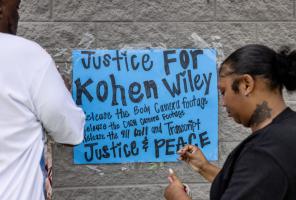 Our guest is attorney Jaribu Hill, executive director of the Mississippi Workers Center for Human Rights. She reports on the police killing of 1-year old Kohen Wiley in Senatobia, Mississippi and on…
 On January 3, 2026, the U.S. conducted a military attack against Venezuela and kidnapped president Nicolas Maduro and his wife, First Combatant Cilia Flores. Since that time interim president Delcy…
 The democrats’ backtracking on what they dismissively refer to as “wokeness” is the newest iteration of their political trickery as once again they give the appearance of supporting what they…
 “The Burnham dictatorship crept up upon Guyanese people like a thief in the night.”


