by BAR executive editor Glen Ford
As Nelson Mandela lay for nine months near death, the world got an education on his legacy – including the scope of the deal that he and his African National Congress comrades cut to abandon the Freedom Charter. Blacks got the vote, and little else, while whites held on to economic power. Imperialism got a new lease on life in Africa.
Nelson Mandela’s Long Death
by BAR executive editor Glen Ford
“A straight line could now be drawn connecting the ANC’s early Nineties pact with capital and the massacre of 34 striking Black miners at Marikana, in August, 2012.”
Had Nelson Mandela gone quickly to the grave when a lung infection recurred in March of this year, the world might not have experienced such a fantastic volume of political obituaries on his legacy. The nine-month deathwatch, culminating in an unprecedented send-off by nearly 100 heads of state, provided the space and time for a global examination of, not only the great man’s personal saga, but the tragic trajectory of the South African liberation struggle. Mandela’s long death became a wake, at which the body of his life’s work – and that of his comrades in the African National Congress (ANC) – was on display for collective view, commentary, and assessment.
When a dying Black man is lavished with praise by virtually all the imperial villains of the world, that is news, indeed. As corporate journalists wrote, and then rewrote, their obituaries for the still breathing Mandela, they revisited the critical period when a real revolutionary transformation was averted in South Africa through the miraculous ministrations of “Madiba.” For the first time, the “mainstream” media explored the terms of the deal that was struck to reconcile the demands of global capital and the white minority with the aspirations of the Black majority. Thus, a discussion that had previously been largely limited to the financial pages, on one hand, and left publications like this one, on the other, became far more general.
In the dimming twilight of Mandela’s life, the actual history of the “transition” to Black rule was illuminated for the larger public. A straight line could now be drawn connecting the ANC’s early Nineties pact with capital and the massacre of 34 striking Black miners at Marikana, in August, 2012. Foreign audiences could now understand how Cyril Ramaphosa, a former mine workers union leader, a deputy president of the ANC (and presidential contender), became a billionaire board member of the corporation that owns the Marikana mine. South Africa’s 2011 United Nations vote in favor of a no-fly zone over Libya, ultimately resulting in the murder of Muammar Gaddafi, a great supporter of the armed struggle against the white regime, makes perfect sense in the context of Mandela’s and the ANC’s capitulation to imperialism, two decades earlier.
”His living aura was a prophylactic against serious analysis of the ANC’s abandonment of the 1955 Freedom Charter.”
For non-South Africans, especially, Mandela was the personification of the ANC and the embodiment of the South African struggle. His living aura was a prophylactic against serious analysis of the ANC’s abandonment of the 1955 Freedom Charter, which called for redistribution of the country’s land and nationalization of the mines and banks. When death began to hover, this spring, Mandela’s aura was insufficient to limit the scope of the thousands of political obituaries that were being prepared for distribution.
Ronnie Kasrils, a former fighter in the ANC’s armed wing who became intelligence minister under Black rule and served as a high official in both the ANC and the South African Communist Party, broke the silence in June. “From 1991 to 1996 the battle for the ANC's soul got under way, and was eventually lost to corporate power,” he wrote in an article for the Guardian. “We were entrapped by the neoliberal economy – or, as some today cry out, we ‘sold our people down the river.’"
Kasrils, known as “Red Ronnie,” is white. Now that the “deal” is common knowledge, there are attempts to blame it on white communists – to absolve Mandela in much the same way as Black Obama apologists claim that his white advisors tricked or pressured their icon into pursuing anti-Black, reactionary policies. But the communists, who were multi-racial, and the ANC (also multi-racial) were thoroughly commingled in the South African leadership; they share responsibility for the betrayal of the revolution. “An ANC-Communist party leadership eager to assume political office (myself no less than others) readily accepted this devil's pact, only to be damned in the process,” said Kasrils. “It has bequeathed an economy so tied in to the neoliberal global formula and market fundamentalism that there is very little room to alleviate the plight of most of our people.”
”The communists and the ANC share responsibility for the betrayal of the revolution.”
On Democracy Now! last week, host Amy Goodman repeatedly tried to get Kasrils to acknowledge or admit that Nelson Mandela had been a member of the South African Communist Party’s Central Committee. Kasrils said he would have known if that had been the case, and accepts Mandela’s denial of membership. But Goodman’s pursuit of the matter avoids the central fact of Kasril’s testimony: that the leading figures in the commingled ANC, SACP and COSATU (Congress of South African Trade Unions) all endorsed or acquiesced to the “sell-out.”
If the Nineties capitulation had been engineered by a small clique in the leadership, then one could blame the debacle on a few individuals. But the whole forward motion of the South African revolution was turned around, so that when John Pilger interviewed Mandela shortly after he assumed the presidency, he is told the course is irreversible. “…for this country, privatization is the fundamental policy,” said Mandela.
To make sure that the capitalist road was irreversible, the deal included the near-instant creation of a Black business class hopelessly tied to international capital – like Cyril Ramaphosa and other high ranking ANC members – which would provide the African social base for capital’s continued political dominance of the country. When South Africa rises up, once again – and it will – the poor will have to cut and hack their way through this new class of Black compradors. They, too, are Mandela’s children.
BAR executive editor Glen Ford can be contacted at Glen.Ford@BlackAgendaReport.com.

 Margaret Kimberley was recently a guest on James Fauntleroy’s YouTube program, Jaybefaunt. They discussed the upcoming mayoral election in New York City that pits the Democratic Party nominee, Zohran…
 The federal government shutdown is a fight between Trump and democrats, but it is also emblematic of the tenuous nature of the welfare state in the U.S. The duopoly parties are both committed to…
 The genocide in Gaza, the threat to Venezuela, and the targeting of Iran are not isolated crises. They are coordinated fronts in a single war effort attempting to enforce imperial dominance.
 “Africans, as a last resort, may have to appeal to force in the effort to achieve Freedom, even if force destroys them and the world.”
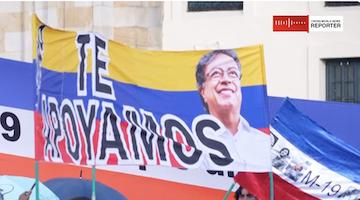 “I do not have a dollar in the United States. There is no account to freeze for me.” - Colombian President Gustavo Petro, solidarity rally in Bogota, 10/24/2025


