by Elizabeth Anderson
Racism has always been central to the politics of the Right. “Not only the content, but the style and emotional register of conservative politics have been constant” since the birth of the Republic. Today’s “conservatives” are more polite than their predecessors, but white supremacy remains the message.
American Conservative Politics and the Long Shadow of Slavery
by Elizabeth Anderson
This article previously appeared in Understanding Society.
“Their core objection is ‘free stuff’ thought to disproportionately benefit blacks, Latinos, immigrants, and other traditionally subordinated groups.”
An “outright Marxist!” That’s what Rafael Cruz, Senator Ted Cruz’s father, declared of President Obama on the campaign trail in April 2013. His accusation is common on the right. Google “Obama Marxist” and you will get about 4.95 million results. “Obama communist” yields 40 million. It’s a strange charge against a man who vigorously supported the bail-out of Wall Street banks as a Senator, and expanded it to other major firms as President. Yet the charge is nothing new. Conservatives have long accused anyone to their left of communism or fellow-traveling. Rick Perlstein traces this practice back to the 1950s.
In fact, it goes back a century before. George Fitzhugh, author of the famous proslavery tract Cannibals All! wrote a letter to William Lloyd Garrison in 1856 declaring that “every theoretical abolitionist at the North is a Socialist or Communist.” J. H. Thornwell, one of the most distinguished ministers of the antebellum South, delivered a sermon in 1850 on “The Rights and Duties of Masters,” in which he characterized the conflict over slavery as one in which slaveholders, Christians, and the “friends of order and regulated freedom” stood together against “abolitionists, atheists, socialists, communists, red republicans, [and] jacobins” who were united on the other side.
This fact about the origins of one aspect of conservative rhetoric opens a window to the larger structure of American conservative thought. Consider Romney’s notorious 47% speech:
“There are 47 percent of the people who will vote for the president . . . who are dependent upon government . . . who believe the government has a responsibility to care for them, who believe that they are entitled to health care, to food, to housing . . . . These are people who pay no income tax . . . . I'll never convince them they should take personal responsibility and care for their lives.”
This was spoken by a presidential candidate who supported the Wall Street bailouts, who did not complain about massive state subsidies to wealthy farmers or the oil and coal industries, and who paid 14.1% of his income in federal taxes—less than the 15.3% effective payroll tax for Social Security and Medicare that falls on wage workers, over and above the income tax. Counting state and local taxes, which are highly regressive, we have good reason to believe that the 47% he resents pay substantially higher total tax rates than the top 1%.
Romney, however, knew his audience. Tax breaks and subsidies for better-off whites are not what most conservatives oppose. Their core objection is “free stuff” thought to disproportionately benefit blacks, Latinos, immigrants, and other traditionally subordinated groups. As Lee Atwater explained, the Republican party’s “Southern Strategy” for winning white voters is all about opposing policies that disproportionately help blacks and promoting policies that disproportionately hurt them:
“You start out in 1954 by saying, ‘N-ger, n-ger, n-ger.’ By 1968 you can't say ‘n-ger’ — that hurts you. Backfires. So you say stuff like forced busing, states' rights and all that stuff. You're getting so abstract now [that] you're talking about cutting taxes, and all these things you're talking about are totally economic things and a byproduct of them is [that] blacks get hurt worse than whites.”
While conservatives, even those belonging to or sympathetic to the Tea Party, support Social Security and Medicare, they condemn programs such as means-tested welfare, which are perceived as disproportionately benefiting blacks and Latinos, whom they see as undeserving. A key driver of public opinion on domestic policy in the U.S. is racial resentment: in particular, the idea that blacks are too lazy to take responsibility for their lives but want to live off the hard-earned wealth of whites, either through crime or the public dole.
“A key driver of public opinion on domestic policy in the U.S. is racial resentment.”
My current research on abolitionism and the struggle for free labor finds that this idea has been a deep theme of American conservative opinion since before the Civil War. Although in the antebellum era, racists typically supposed that blacks were incapable of taking care of themselves, while today they are thought to be willfully refusing to do so, the complaints about black behavior are remarkably similar. In response to an emancipation petition submitted to the Virginia legislature, hundreds of citizens submitted proslavery petitions in 1795. Echoing other petitions, this one from the free whites of Lunenberg County worried that emancipation would bring
“Want, Poverty, Distress and ruin to the free Citizen; the Horrors of all the rapes, Robberies, Murders, and Outrages, which an innumerable Host of unprincipled, unpropertied, vindictive and remorseless Banditte are capable of perpetrating; Neglect, famine and Death to the abandoned black Infant, and superannuated Parent; inevitable Bankruptcy to the revenue; Desperation and revolt to the disappointed, oppressed Citizen; and sure and final ruin to this once happy, free, and flourishing Country . . . .”
Thomas Dew, in his 1832 article “Abolition of Negro Slavery,” predicted that abolition would lead blacks to idleness, drunkenness, destitution, and thence to crime. William Harper predicted in Cotton is King, an 1860 compendium of proslavery thought, that emancipation would reduce blacks to paupers and lead them “from petty to greater crimes, until all life and property would be rendered insecure,” and that if they got the vote, they “would be used by unprincipled politicians” to advance dangerous schemes.
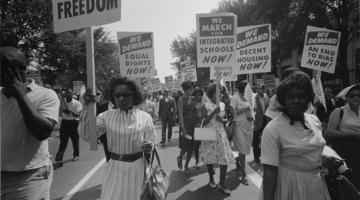
White conservatives saw their fears confirmed during Reconstruction. This cartoon reveals their view of the Freedman’s Bureau, described as “an agency to keep the Negro in idleness at the expense of the white man.”
Then it was the Freedman’s Bureau. Today it is food stamps, Medicaid, and Obamacare.
Not only the content, but the style and emotional register of conservative politics have been constant. The hysteria, apocalyptic sensibility, and intransigence of Tea Party conservatives on full display in the recent government shutdown crisis (complete with a confederate flag) mirrors that of the South in the run-up to the Civil War through the Reconstruction Era. American conservatism continues to operate under the long shadow of slavery and its legacy.
Elizabeth Anderson is John Dewey Distinguished Professor of Philosophy and Women's Studies at the University of Michigan. She is the author most recently of The Imperative of Integration.

 Despite Trump’s tariffs battering the fossil fuel industry, bipartisan policies, including Democrat-backed subsidies, are rescuing Big Oil, locking in climate destruction while working-class…
 Accelerating crises of imperialism in Haiti, Ecuador, and beyond highlight the urgent need for regional Pan-Africanist, anti-imperialist unity and strategy.
 "Saturday Mornings" is the latest from BAR's Poet-in-Residence.
 The future of the Christian church on the continent depends on the ability to develop an authentic African Christianity, moving away from its westernized forms.
 Black support for Palestine underscores the fight against empire, revealing how Israel’s violence in Gaza serves U.S. hegemony and white supremacy, with Palestinian freedom as a catalyst for global…


