Lynching: Black Resistance and Capitulation
by BAR contributing editor Tamara K. Nopper
A review of Loss of Empire: Legal Lynching, Vigilantism, and African American Intellectualism in the 21st Century (Africa World Press, 2006) by L.V. Gaither
Loss of Empire: Legal Lynching, Vigilantism, and African American Intellectualism in the 21st Century (Africa World Press, 2006) is an important and timely book for those of us who see ourselves as caring about the experiences of African Americans and the future of Black radicalism. Written by L. V. Gaither, a writer, activist, and editor and publisher of The Gaither Reporter, an independent journal of politics, literature, and culture, Loss of Empire is a collection of four detailed and well-researched essays that explore how Black radicalism is being undermined through political decisions and bargains, scholarship, and an investment in the state. While many will suspect that Gaither will take the right wing to task for its role in repressing Black radicalism, he instead focuses on those who purport to be part of or in support of a Black radical agenda. This means, basically, that he is talking about Black leadership, the Black intelligentsia, anarchists, white liberals, and non-Black people/immigrants of color.
"Gaither begins the difficult task of turning our political attention away from the spectacle of Black death and white collectivity captured in the photo."
Gaither's first essay is "Rethinking Fred Gildersleeve's Lynching Photography in the Age of Legalized Lynching." Gildersleeve's famous photo of the lynched body of African American Jesse Washington and the Waco, Texas spectators who surround him serves as a point of departure for the book as a whole. It is here that Gaither begins the difficult task of turning our political attention away from the spectacle of Black death and white collectivity captured in the photo. Instead, Gaither encourages us to see three people he identifies as Black who are part of the crowd surrounding Washington's body. As he writes, "With the exception of the men ushering in the spectacle, the crowd's collective gaze is fixated on the victim's body. Included among them are three very noticeable black people - two men and one woman - standing near the periphery of the crowd." Gaither's discovery, as he reports in the essay, has gone unnoticed by many he shares the photograph with, including various groups to which he has lectured. A common response is surprise at the presence of Black bystanders. But this is precisely the point, as Loss of Empire argues. Indeed, Gaither remarks, "I am not surprised to see them; I was expecting them..."
 "Them," as he puts it, are African Americans who stood by and did not politically resist the lynchings of their peers. The rest of the essay explores Black responses to lynching. In the process, Gaither explores the political imagination of leaders in terms of how they politically conceptualize lynching, including viewing the act as separate from state-sanctioned terror against African Americans. Addressing this tendency to distinguish between lynchings and the death penalty, Gaither explores the relationship between the two forms of violence. He contends that lynching, whether by mob rule or the state, is sanctioned by entire communities. Thus, there is not a clear demarcation between non-legal lynching and executions. State-sanctioned executions, therefore, are simply "legal lynchings" that occur "within the context of present-day antiblack discipline and punishment." Gaither argues that Black leadership vacillates on the issue of the death penalty for a variety of reasons, including wanting to spare Blacks en masse from being suspected and condemned as criminal, hoping to diffuse, for suspect reasons, armed rebellions of "those willing to fight back against white injustices," and the "lure of being accepted within the dominant group" - in other words, striking bargains with white power brokers.
"Lynching, whether by mob rule or the state, is sanctioned by entire communities."
Gaither's arguments are not simply philosophical musings but derived from his experiences of politically organizing against the death penalty in Texas, including his involvement in the campaign to stop Shaka Sankofa's (Gary Graham) execution. His work on Sankofa's campaign and situations that occurred during this time compelled Gaither to question mainstream African American leaders' "historical relationship to legal lynching." His final sentence of the first essay sets the tone for the rest of the book: "As earlier noted, I was expecting to meet these African Americans in Gildersleeve's photo." In other words, the African Americans seen in the crowd surrounding Washington's body serve as a metaphor for contemporary African American leadership's responses to (legal) lynching.
This point is explored further in the second chapter, "All James T. Byrd, Jr. Wanted was a Ride: Lynching and Police Powers in Texas." Reflecting on the 1998 lynching of Byrd in Jasper, Texas, Gaither questions the media depictions of the murder as a spectacle - an extreme racist act in an otherwise racially healing society. As Gaither puts it, "based on this type of rhetoric, this atrocity appears to be an aberration" instead of an expression of what he describes as "antiblack vigilantism." While he acknowledges the media's role in creating this narrative of Byrd's lynching, Gaither is most concerned with how African American leadership helped promote it. He concludes, "Such comments regarding the murder of James Byrd...also underscored the inability, and perhaps even unwillingness, of African American leaders to come up with effective strategies for mobilizing resistance to antiblack and state violence." The rest of the chapter explores how "black representatives" "call upon the very same state apparatuses that historically have been the most ardent repressors of the political struggles of blacks to police their own communities."
Rest assured that while Loss of Empire poses a challenge to African American leadership, it is not simply another progressive effort to blame Black people for the seeming decline of radicalism in the U.S. - a move that is becoming all too common among the multiracial left. Indeed, Gaither has plenty to say about antiblack racism and the left, particularly in the third essay, "African American Leadership Responses to the Increasing Significance of Whiteness." Here he gives some pointed criticisms of the shared discourses and/or political stances between white liberals and leftists and that of prominent members of the Black intelligentsia, including Drs. William Julius Wilson, Manning Marable, and Cornel West. Chapter three also addresses how anarchists, multiracialism, and non-Black people of color contribute to the "increasing significance of whiteness" that undermines Black radicalism.
 In regard to non-Black people of color and specifically, immigrants of color, Gaither has some choice words for us:
"Immigrant activists...seem to identify with an imagined hip-hop community, and enough have participated in various anarchist formations to now begin the process of reformulating their own ‘people of color' collectives that promise to maintain the same racial hierarchies as their parent organizations. The main concern is the need for increased political space, which they mistakenly believe African Americans have monopolized. Young black activists, however, are in urgent need of clarity regarding who their global allies are, for they might find themselves in bed with strange bedfellows at a critical moment in history...No longer can we simply look at racism as a power relationship between whites and blacks. Serious thought must be given to the manner in which new immigrants have subscribed to the logic of antiblackness in ways that are perhaps more complicated than the traditional forms of white supremacy."
"Gaither is most concerned with the inability, and perhaps even unwillingness, of African American leaders to come up with effective strategies for mobilizing resistance to antiblack and state violence."
Overall, some may think that Gaither's book is harsh, especially to African Americans and those who see themselves as their allies. While I do not agree with everything in the book, it nevertheless raises important questions about the past, present, and future of Black radicalism in a nation that is presumably, as suggested in the title, beginning to lose its place in the world system. Additionally, Gaither writes in a clear and unapologetic manner, even to the point where the depth of what he is saying might be missed if not read carefully. And despite its critical stance toward Black leadership and non-Blacks on the left, the book is also infused with a belief in the possibilities of Black radicalism and the urgent need to confront vexing questions in the process of mobilizing/supporting it. Thus, Gaither's book should be read as an important starting point instead of the end. Presented near the book's conclusion, the following passage best explicates this sentiment:
"African American intellectuals have a tremendous role to play in America's future. America is the place where the vast majority of African Americans will call home both now and in the foreseeable future. Given this reality, they must seriously consider engaging a new set of assumptions regarding history, economics, and culture. And honestly engaging the centrality of whiteness and antiblackness in left politics will be a good, indeed necessary, starting point."
Tamara K. Nopper is an educator, writer, and activist living in Philadelphia. She is a PhD candidate in the Department of Sociology at Temple University and is involved in anti-war/militarization work. She can be reached at tnopper@yahoo.com.

 The ongoing crisis is a result of converging forces determined to pursue their own interests by controlling the affairs within the Congo and subjecting the masses to inhumane conditions.
 Ngũgĩ wa Thiong'o reminds us that the primary contradiction in Africa is imperialism and its meek comprador bourgeoisie enforcers.
 Over a year in advance, the Black Misleadership Class has kicked their efforts to corral Black people into the Democratic party, despite the Dems’ apathy toward Black politics or the concerns of…
 The US empire is continuing its psychological warfare campaign by conducting a mass mobilization of resources and waging a propaganda offensive to protect its interests in the Middle East.
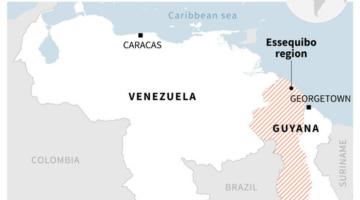 Despite the reality of US intervention causing inhumane conditions in the region, Venezuela’s push for the annexation of Guyana’s Essequibo region prioritizes its own political objectives,…


