by Marsha Coleman-Adebayo
The author witnesses sudden death in South Africa, where Blacks had been condemned to social death since the arrival of the Dutch, centuries ago.
No Fear, Chapter 4. The Gore-Mbeki Commission: The Sound That Freedom Makes
by Marsha Coleman-Adebayo
Dr. Coleman Adebayo’s tells her own story as a whistleblower in the Environmental Protection Agency, and the growth and triumph of a movement to protect all the truth-tellers in the federal civil service and beyond. She has graciously allowed us to serialize her book, No Fear: A whistleblower’s Triumph Over Corruption and Retaliation at the EPA. The following is from Chapter Four.
“I tried to give flesh and fiber to the odious word, apartheid.”
South Africa is renowned for many wonderful things— coastal beaches, mountains, gold, diamonds, mineral fields, amicable golfers—and one monstrosity: apartheid. The colonial governments of South Africa, from that of President F. W. de Klerk all the way back through the British domination, to the eighteenth century, when the Dutch first discovered South Africa’s riches—and then attacked the indigenous people to get them—have been masterful at showcasing every one of South Africa’s characteristics except apartheid. The Dutch were armed with the modern technology of European warfare. The Africans were armed only with traditional hunting gear. But the most lethal of the Europeans’ weapons was their belief in the white man’s burden to civilize African people, and the corresponding brutality they therefore felt justified in inflicting upon the local people, without regard for their humanity or any worry about consequences.
The Africans never stood a chance, neither in battle nor in appealing for justice to an outside world that didn’t speak their language or see the need to. Even as colonialism was being dismantled piece by piece in the rest of the world, it managed to thrive in South Africa well past the midpoint of the twentieth century by the conceits of a culture that called itself “civilized” and its masterful use of propaganda. The fascist regime had its allies. President Ronald Reagan supported the apartheid government, he explained to CBS News, because it was “a country that has stood by us in every war we’ve ever fought, a country that, strategically, is essential to the free world in its production of minerals.”
Toward the end of another long flight, this time diagonally across the Atlantic, I looked out the window as we approached the lit coastal areas near Cape Town. I tried to give flesh and fiber to the odious word, apartheid, that had been so much a part of my being, my thoughts, and my prayers, knowing that what I was about to encounter would not be abstract, but tactile. Apartheid would no longer be something I read about, marched against, and risked arrest for. It would be the people, the vast majority of the population of South Africa, who had remained hidden to the rest of the world—by the design of an occupying government and with the collusion of most of the world’s other governments [1].
“Even as colonialism was being dismantled piece by piece in the rest of the world, it managed to thrive in South Africa well past the midpoint of the twentieth century.”
The members of the US delegation to Gore-Mbeki were now in Pretoria, settled into our individual rooms at the hotel. We were all going through our various home remedies for jet lag. For some this meant sleeping. For others it meant working until they dropped. But I headed to street level to get a sense of the lay of the land. It must have been the Leo in me, because like a cat, I needed to wander my new home range. I also needed something to eat.
The hotel doors slid open like glass eyelids on the face of a city that could have been Marrakech, Buenos Aires, or any other metropolitan resort city with signature high-rises, designer clothing stores, and traffic. The thought occurred to me that since I had flown in a different direction than my journey to China, this trip might provide the corrective needed to right my circuitry, which was still misaligned from that marathon, even six months later. I was anxious to stretch my legs and hungry for food, for American food in particular. I’d have plenty of time to experience the local cuisine, but my needs just then were primal. I sought therapeutic instant gratification. I decided to take a stroll through downtown Pretoria in search of my American birthright. It couldn’t be far, but, I’d still get a chance to clear my head and case my new surroundings.
My experience in other metro centers elsewhere in Africa had been that the veneer of the modern city was only the makeup that covered the abscess of the more common living conditions. One never needed to travel too far to see how the greater population lived. But Pretoria was designated a “whites only” area during apartheid, and blacks had been required to carry passes that severely limited their access to the city. Nestled among Pretoria’s Western amenities was the familiar red sign of a Pizza Hut. Perfect. Fast, American, and greasy.
I was beginning to feel better already when a commotion broke out. A black man ran out of one of the little shops, racing in a direction that would bring him directly in front of me. Another black man burst out of the shop in pursuit. The first man slowed, twisting his torso around, raised a gun, and shot the second man. Then he sprinted out of sight. The second man fell to the ground like a duffel bag. Thump. No grasping his chest. No, You got me! Just thump. He was lying face down.
See Marsha on C-Span Book/TV at:www.marshacoleman-adebayo.org.
Dr. Marsha Coleman-Adebayo is the author of No FEAR: A Whistleblowers Triumph over Corruption and Retaliation at the EPA is available through amazon.com and the National Whistleblower Center. Dr. Coleman-Adebayo worked at the EPA for 18 years and blew the whistle on a US multinational corporation that endangered vanadium mine workers. Marsha's successful lawsuit lead to the introduction and passage of the first civil rights and whistleblower law of the 21st century: the Notification of Federal Employees Anti-discrimination and Retaliation Act of 2002 (No FEAR.)

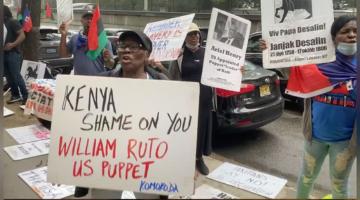 Dahoud Andre joins us to discuss the latest indictments in the 2021 assassination of president Jovenel Moise, the 2004 coup against Aristide, and the latest US plan for the occupation of Haiti.…
 Aaron Bushnell was desperate for the world to know what was happening to the people of Gaza. So much so that he died by his own hand, publicly, and in a painful way. But Palestinians are dying…
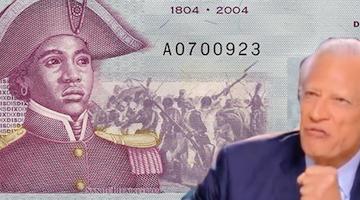 Remembering France’s odious participation in the 2004 coup d’etat in Haiti.
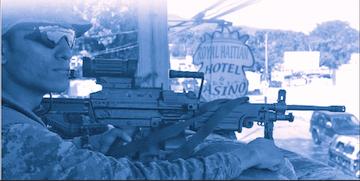 Jemima Pierre’s presentation at a forum to commemorate the US-France-Canada-sponsored 2004 coup d’état in Haiti. The forum was hosted by the Center for Caribbean Studies at the University of Toronto…
 Ann Garrison spoke to Eritrean British attorney Feven Yemane regarding attacks on Eritrean diaspora festivals and gatherings and the investigations underway.


