 by Dedrick Mohammed
Today’s economic inequality is the direct result of Europe’s 500-year-long subjugation of the rest of the planet’s inhabitants. Even when corrective measures are undertaken, such as in the New Deal response to the Great Depression, widening economic disparity is often reinforced by the same “blue-eyed” elite that created the crisis. The identical forces that have plunged the world into financial meltdown are responsible for the fact that, in the U.S., “Blacks and Latinos have less than 15 cents for every dollar of wealth held by the median white family.”
Economic Inequality: The Foundation of the Racial Divide
by Dedrick Mohammed
“President Silva highlighted that the global economic downturn is the result of the irresponsibility and greed of white elites who manipulated markets that provided great short term wealth.”
Greed, economic exploitation, and dehumanizing stereotypes of inferiority have been the root of racism in the Western world. Brutal, racist exploitation in the United States and throughout the Americas has been the means through which Western European economies have been built; belief in the inferiority of people of color justified the concentration of wealth in European hands. As Howard Zinn writes in his classic A People's History of the United States "These were the violent beginnings of an intricate system of technology, business, politics, and culture that would dominate the world for the next five centuries."
Lula Silva, President of Brazil, brought to light the current racist global economic order during a visit from the Prime Minister of England Gordon Brown to Brazil, the country that was the primary destination of enslaved Africans during the Trans-Atlantic slave trade. President Silva highlighted that the global economic downturn is the result of the irresponsibility and greed of white elites who manipulated markets that provided great short term wealth. Additionally, he noted, this greed has caused disproportionate suffering to the poor of the world, primarily people of color. President Silva's remarks have been mocked in much of the US press, ignoring his demand that global racial economic inequality be addressed as nations come together to rebuild the global economy.
”Blacks and Latinos have less than 15 cents for every dollar of wealth held by the median white family.”
The same week that President Silva highlighted the global racial wealth divide, scholars, activists, and experts from across the United States came to Washington DC to discuss the racial wealth divide in this country. During this Color of Wealth summit, it was highlighted that Blacks and Latinos have less than 15 cents for every dollar of wealth held by the median white family, thus exposing economic inequality as the foundation of today's racial divide. During the two-day summit there was excitement about the opportunities to bridge the racial wealth divide with an Obama administration that has recognized a greater role for government to play in increasing opportunity for all Americans. Yet in the opening roundtable of the summit, John Powell of the Kirwan Institute for the Study of Race and Ethnicity highlighted the historical failure of universal economic programs to advancing racial equality. Powell noted that when policies fail to take into account institutional racism and the unique characteristics of disenfranchised minorities, often times greater racial inequality is created. For example, many of the great liberal programs of the New Deal failed in creating greater racial equality.
From the time of the civil rights movement till today those who highlight racial inequality are often times portrayed as troublemakers creating racial divisions rather than problem solvers exposing racial division. One of those who were regularly criticized for being a troublemaker and creating racial division was Dr. Martin Luther King who was killed 41 years ago this April 4th. Dr. King, in examining the need to master ones' fears, wrote:
“Courage and cowardice are antithetical. Courage is an inner resolution to go forward in spite of obstacles and frightening situations; cowardice is a submissive surrender to circumstance.”
Too many white Americans have surrendered to the circumstance of racial inequality, blaming racial inequality on the inferiority of disenfranchised groups rather than the systemic disenfranchisement faced by these groups. In the past, the rationale for racial inequality was a belief in the inherent mental deficiencies of people of color. Today, the rationale is belief in deficiencies of morality or the work ethic of people of color.
“Many of the great liberal programs of the New Deal failed in creating greater racial equality.”
Yet there are some who are willing to go beyond the standard racial justifications of contemporary racism. Thousands of white Americans are showing this kind of courage by participating in a week of “White Privilege Awareness” events occurring March 30th to April 5th. In Washington DC, Resource Generation will have a viewing of "Traces of the Trade," a documentary that follows white descendents of slave traders and their struggle with the privilege attained in their family through profiting off of the Transatlantic slave trade. The Global Awareness Project will host a panel discussion as to how white privilege is an issue and challenge in the multi-racial Latino community. Finally there will be a national gathering in Memphis, where Dr. King was assassinated, to discuss and strategize how to courageously stand up to address white privilege and racial inequality.
Dedrick Mohammed is Senior Organizer for the Institute for Policy Studies, in Washington, DC. He can be contacted at Dedrick@ips-dc.org

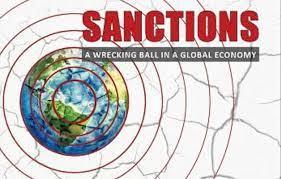 Sara Flounders joins us to discuss her work as editor of the newly published anthology, 'Sanctions: A Wrecking Ball in a Global Economy.' The book is an analysis of U.S. unilateral coercive measures…
 The open white supremacy and fascism exhibited in Ukraine are conveniently swept under the rug. Nazis are bad, unless they serve the interests of the U.S. state.
 A round-up of The Black Agenda Review’s posts from 2022 – and a reprint of Haiti’s January 1, 1804 declaration of independence.
 The hope that the U.S. will intervene anywhere in the world for humanitarian reasons is misguided in the extreme. Claims of concern are always a ruse hiding ulterior motives. Imperialist…
 Every U.S. action intended to increase its power actually results in it being diminished. Multipolarity is here to stay.



