Just as the edifices of finance capital began to slip into
the abyss, a report shows that the Black American economy went into reverse
eight years ago. The study by the
Economic Policy Institute is titled "Reversal of Fortune,"
and tracks the roller coaster ride from the late Nineties, when Blacks
registered real progress in employment, housing and reduction of poverty, to
the steady slide backwards that began around the year 2001.
Viewed in hindsight, the late Nineties were among the most
promising economic years on record for African Americans. Black family income
grew at the quickest pace since the 1950s and 60s, when jobs were abundant and
unions far more powerful. Although Black unemployment remained far higher than
white joblessness even in the robust economy of the 90s, employment rates did
improve, and the African American poverty rate declined significantly, as did
crime in Black communities.
All that came to a halt in 2001. African American families
lost $404 per year in income, a one percent drop, between 2000 and 2007. The
worst off were single, male-headed households, which saw incomes decline over
nine percent during George Bush's first seven years in the White House. Poverty
among African Americans, which had declined 8.5 percent in the years between
1989 and 2000, rose 2.8 percent from 2000 to 2007. Black home ownership, which
was just shy of 50 percent in 2004, was down to around 47 percent by 2007 - before
the subprime lending crisis made itself generally felt.
"The worst off were
single, male-headed households, which saw incomes decline over nine percent
during George Bush's first seven years in the White House."
Even as government and business announced that the economy
was recovering from the downturn of the early to mid 2000s, Blacks were
experiencing a "jobless recovery" - which, for a people with very little wealth
to lean on, is no recovery at all.
The authors of the Economic Policy Institute (EPI) study
conclude that "Black America needs a strategy for Black full
employment." Their reasoning is that, since Blacks are consistently left behind
in the employment arena, the best way to ensure a generally healthy employment
environment is to work towards bringing Black unemployment below five percent.
The EPI's approach, although eminently sensible, would
require government measures specifically targeted at joblessness in Black
areas, rather than measuring the nation's economic health on statistics that
"mask" pervasive racial disparities in society. Unfortunately, the presidential
candidate that overwhelming numbers of African Americans support, Barack Obama,
opposes race-specific remedies for America's economic problems, insisting that
class-based measures will serve everybody. Of course, the numbers show that
America doesn't work that way.
The EPI study reveals that Black Americans face special
obstacles, even in boom-times like the late 90s. Now the nation - and possibly
the world - peers into the gathering darkness. With Blacks already facing loss
of precious housing wealth hovering around $100 billion dollars, the
prospect of mass unemployment is terrifying, indeed.
The 90s were not Heaven by any stretch of the imagination,
but the future is shaping up to be Hell.
For Black Agenda Radio, I'm Glen Ford.
BAR executive editor Glen Ford can be contacted at Glen.Ford@BlackAgendaReport.com.

 Clau O'Brien Moscoso continues her dispatches from Peru in the wake of a natural disaster and the ongoing coup against President Castillo. A Spanish translation follows.
 The legacy of colonialism and interference from the U.S. and other states keeps Djibouti's president in office after 25 years. Djibouti needs democracy and sovereignty for its people.
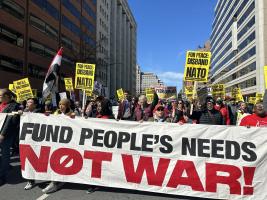 On March 18 thousands of people rallied in Washington DC to mark the 20th anniversary of the invasion of Iraq and to call for an end to the war in Ukraine.
 Being a white ally is a very serious matter. They can be "martyred on a shrine of white supremacy in an effort to discourage other whites from following their lead."
 The FBI raid on the Uhuru Movement has resulted in economic sanctions like those imposed on countries that dare to be sovereign despite being under U.S. attack.


