by BAR managing editor Bruce A. Dixon
George Jackson was a pre-eminent organizer of prisoners who founded a Black Panther Party chapter behind the walls of San Quentin prison. In the 42 years since his death a black leadership class has emerged which is deeply complicit in the sixfold expansion of US prisons in that same period. Now, more minds and hands than ever are engaged in the project to which Jackson gave his life, the political organization of the prisoner class.
The Living Legacy of Comrade George Jackson, September 23, 1941 – August 27, 1971
by BAR managing editor Bruce A. Dixon
September 23 should have been the 72nd birthday of George Jackson. George Lester Jackson was born of black working class parents in Chicago, and grew up mostly in California. In 1961 at the age of 18, he was accused of sticking up a gas station for about $70. Represented by a public defender, he pled guilty and began serving a sentence of one year to life.
While in prison George Jackson learned to study productively and to write eloquently He took upon himself the project of politically organizing those confined in America's prisons and jails, eventually founding a chapter of the Black Panther Party behind the walls of San Quentin. Jackson's tireless work, his personal example and two best selling compilations of his letters, Soledad Brother and Blood In My Eye, ensured that his influence was felt across racial lines throughout California's penal system and far beyond.
In January 1970 Jackson was accused of the murder of a prison guard. On August 7 of that same year his younger brother Jonathan Jackson staged a doomed rescue attempt at the Marin County courthouse in which four persons died and several were wounded, and in connection with which Angela Davis was prosecuted for murder and conspiracy. George Jackson's life ended on August 21, 1971 in a hail of gunfire under circumstances which strongly suggest a setup and assassination staged by California prison officials. More than twenty thousand people showed up for his Oakland California funeral.
Though Comrade George has been gone now a dozen years longer than he lived, his influence is more deeply and widely felt than ever, as the project of prisoners in the United States politically organizing other prisoners, their families and their communities to confront and dismantle the prison state remains very much alive and growing.
George Jackson lived and died before the rise of the current black political elite gave us dozens of black congressmen and women, and thousands of black mayors, state legislators, judges and sheriffs. Jackson lived and died before the massive expansion of the carceral state multiplied the US prison population five and sixfold through the seventies, eighties, nineties and into the new century. But these two facts of 21st century political life, the prevalence of black faces in high and low places combined with the use of prisons to sanction, stigmatize and cow a black working class our leaders have no intention of educating, empowering or providing useful work or stability for, make George Jackson's life and death, his example and his selfless dedication to the cause of organizing the prisoner class more relevant than ever.
Comrade George may be forty years dead, but his tireless spirit does not rest. In the last few years alone we have seen transracial prison organizing, in Ohio and Georgia, in New York and Virginia just to name a few, and most recently in the hunger strikes in the California prison system, in which thousands of prisoners took part at least for a time.
Our black misleadership class cannot even form its lips to say “mass incarceration” or “prison state” because it is deeply complicit in both. Democrats and Republicans have been and will be of little or no use in any movement that aims to roll back the prison state. The main body of leaders in that fight will arise from the same place George Jackson arose, from among the prisoners themselves, from former prisoners and their families. And as long as that struggle goes on, George Jackson lives.
Presente, comrade George Jackson.
For Black Agenda Radio, I'm Bruce Dixon. Find us on the web at www.blackagendareport.com.
Bruce A. Dixon is managing editor at Black Agenda Report. He lives and works near Marietta GA, and can be reached at bruce.dixon(at)blackagendareport.com, or via this site's contact page.

 Frank Chapman is Executive Director of the National Alliance Against Racist and Political Repression. He joins us from Chicago, which Donald Trump has targeted with an onslaught of federal law…
 Ben Passmore is the author of the graphic novel: “Black Arms to Hold You Up: A History of Black Resistance,” published by Pantheon Books. Ben Passmore is an award-winning political cartoonist who has…
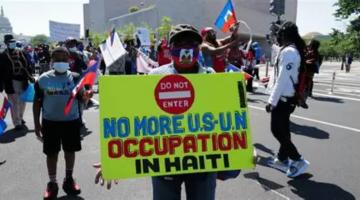 The latest interference from the United Nations ensures that Haiti’s “gang” problem will continue and that its cause, an illegitimate governing structure brought about by the UN, U.S. and their…
 “We, the people, charge genocide.”
 In practice, the UN Charter ensures that the world’s most powerful nations are free to wage war at will without UN intervention or even censure, as the US has time and again.


