by Sokari Ekine
Last month, upwards of 20,000 Brazilians of African descent, predominantly women, came together to protest the deep seated racism, including the targeting and murder of Black youth by the police, and gender based violence in Brazil. This single act of protest shatters the myth of a racially harmonious nation.
Marcha das Mulheres Negras: The Myth of a Racial Democracy in Brazil
by Sokari Ekine
This article previously appeared in Pambazuka News.
“Police in Brazil have killed nearly as many people in the past five years as U.S. police have killed during the past 30 years.”
The denial of the existence of racism in Brazil is so strong that Black feminist scholar, Sônia Beatriz dos Santos, recalls being considered “crazy” or not “taken seriously” because of her insistence that racism exists in Brazil. Specifically dos Santos points to the “deep and intense” inequalities faced by Black women. “Poverty, mass sterilization, unsafe abortions and illiteracy are some of the signs of the prevalence of racism, sexism and social class subordination that still inform Brazilian society,” she wrote.
Dos Santos’ thesis explores how racism and sexism are imbued in Black women’s bodies through a series of gendered and racialized stereotypes. These range from the hyper-sexual, highly desirable carnival mulatto, to the dark skinned undesirable maid and the undisciplined, welfare dependent, bad or unfit mother. Directly in relation to these categories is the dangerous criminal black male youth, child of the unfit mother, undesirable maid, wanton mulatto.
In an article on the Black Lives Matter movement in Brazil, writers Kaelyn Forde and Jihan Hafiz of Refinary 29 report that on average six people, mainly black and poor, are killed every day and this does not include those murdered by death squads, many of whom are police officers. However, a recent Amnesty International report puts the number of daily murders much higher at 82 and again the majority are Black youth. The FBI and Brazilian Public Safety Forum statistics show that “Police in Brazil have killed nearly as many people in the past five years as U.S. police have killed during the past 30 years.”
“On average six people, mainly black and poor, are killed every day and this does not include those murdered by death squads.”
Alongside the extra judicial killings is the policy of forced evictions of black families, predominantly women and children, from favelas in major cities such as Rio de Janeiro and Sao Paulo. It is no exaggeration to state there are systematic killing sprees formed around anti-blackness and anti-poor in Brazil. This is the same Brazil whose military has led the 11-year UN occupation of Haiti under MINUSTAH – an occupation that has committed numerous acts of violence against the Haitian people including the introduction of cholera which killed at least 9 thousand and left thousands more orphans, widows and families destitute.
As Jemima Pierre writes, for Brazil the country with the largest Black population Haiti has become it’s “imperial ground zero”:
“Brazil has used its contribution to the occupation of the Black Republic to demonstrate its credentials as a regional power and to show the Americans and Europeans that it is ready for a permanent seat on the UN Security Council. For Brazil, Haiti is also a training ground for domestic security and enforcements; its Haitian forces return to the country and deploy the tactics of military terror on its own poor Black and Brown favela dwellers.”
The construction of race in Brazil has its own contradictions and complexes that ask the question, who defines Blackness in Brazil? Based on crude definitions of phenotype – hair texture, body structure, color and a range of other arbitrary categories of humaness or unhumanness – the act of coming to Blackness is itself an act of resistance and survival. An act which refuses the deracialized notion that “we are all the same” where even racists claim blackness as a way of dismissing their own racism and the existence of racism while at the same time excluding Black people, in a process of social death.
“There are systematic killing sprees formed around anti-blackness and anti-poor in Brazil.”
It is in this context that on the 18 November, 2015 upwards of 20,000 Brazilians of African descent, predominantly women, came together to protest the deep seated racism, including the targeting and murder of Black youth by the police, and gender based violence in Brazil. This single act of protest shatters the myth of a racially harmonious nation. Instead, the presence of thousands Black women forced Brazilians and the world to acknowledge the inequalities reproduced in the afterlife of nation built on slavery and where black life remains visible only as labor and property.
I arrived in Brasilia as part of a solidarity group of African activists from the continent and Diaspora to witness and to learn from Afro-Brazilian women about their struggle against racism and state violence against Black people. In addition to the march we attended a number of seminars and listened to women discuss their experiences. We spent one memorable evening having dinner prepared by a women’s collective, and attended by 25 women from various organizations including by Criola, one of the oldest women-led NGOs focused on gender, race, sexuality and reproductive rights in Brazil. As each woman introduced themselves and spoke of their work it became increasingly clear that the Afro-Brazilian community faced multi-layered formations of racism. Nonetheless, the beauty of solidarity and sisterhood were inspiring as we broke bread together and shared our stories.
“Brazil’s Haitian forces return to the country and deploy the tactics of military terror on its own poor Black and Brown favela dwellers.”
On the day of the march, we were overwhelmed and moved by presence of thousands of women of African descent claiming their Blackness with joy, pride, dance, song and purpose. This process of naming racism as endemic and unacceptable was a massive act of resistance. We also noted the presence of indigenous women marching in solidarity with their African sisters.
There was a brief incident at the end of the march with a group of right wing racist militarists who had camped on the grounds of the National Congress. They had erected a blow up figure of a general who had recently been kicked out of the army for advocating a return to dictatorship and posted various anti-communist and anti-workers slogans around their camp. Some of the protestors deflated the inflatable figure and the militarists responded by firing live ammunition into the air and attacking protestors. The police were called and what could have been a dangerous situation was quickly ended.
Black women activists, domestic workers, spiritualists, priestesses, academics, mothers of murdered Black children, lawyers, doctors, musicians, queers, young, old came together for five days to claim ownership of their bodies and insist on being seen. This was a powerful moment in the herstory of our struggle as Black women of African descent.
Sokari Ekine is a Nigerian journalist and social justice activist who blogs at Black Looks.

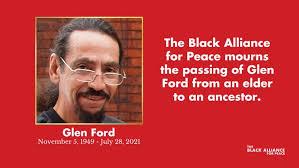 I was very proud to write the preface to Glen Ford's book, The Black Agenda, which was published posthumously by OR Books. As we approach the first anniversary of Glen's passing, I endeavored to…
 Glen Ford was among the speakers at a May 16, 2014 teach-in on Ukraine sponsored by the International Action Center. The event was held at The Riverside Church in New York City in the wake of the…
 The U.S. reprises Iraq, inventing a WMD threat from Syria. The FBI concocts home-grown terror through stings, while the NSA claims it has secretly saved many lives. “Why this steady stream of…
 An essay by the late Glen Ford recounts the perverse origin story of the twisted life and lies of Clarence Thomas.
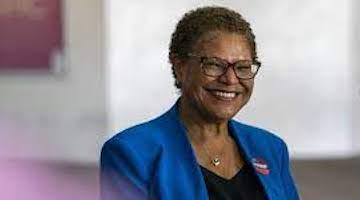 As the late Glen Ford said, the Black misleadership class has no shame. Congresswoman Karen Bass's campaign for mayor of Los Angeles is full of empty promises. She proposes nothing that would…


