One-fifth of the U.S. Navy now sits in the Caribbean, positioned to initiate regime change in Venezuela and beyond. This is a campaign to cleanse the hemisphere. First Venezuela, then any government that rejects the Monroe Doctrine.
Originally published in Resumen English.
It’s increasingly obvious that the US military threats against Venezuela have a wider agenda. Their game plan is regime change, but not only in Venezuela. This is the objective – on a longer timescale in some cases – across several of the countries in the Caribbean Basin, aiming to cleanse the region of governments deemed undesirable to Washington.
As international relations professor at the University of Chicago, John Mearsheimer reminds us, the US “does not tolerate left-leaning governments…and as soon as they see a government that is considered to be left-of-center they move to replace that government.”
In the Financial Times, Ryan Berg, head of the Americas program at the Washington think-tank CSIS, which is heavily funded by Pentagon contractors, said that Trump’s vision is for the US to be the “undisputable, pre-eminent power in the western hemisphere.” The New York Times dubbed Trump’s ambitions the “Donroe Doctrine.”
After Venezuela, in the current US line of fire, is Honduras. This Central American country faces an election on November 30 which will determine whether the leftist Libre Party stays in power or whether the country reverts to neoliberalism.
The crisis in the Caribbean engineered by the Trump administration is being actively instrumentalized to distract Hondurans from domestic issues when deciding how to vote. Honduras’s mainstream media repeatedly draw attention to the likelihood that Washington will threaten Honduras militarily if it votes the “wrong way” on November 30.
Interviewed on television, opposition candidate Salvador Nasralla was asked what would happen if the Libre Party won. He replied: “Those ships that are soon going to take over Venezuela are going to come and target Honduras.” Amplifying the supposed threat, opposition candidates have posted street signs labelling themselves “anti-communist,” as if communism were actually on offer in the election.
In a bizarre article, the Wall Street Journal alleges that Venezuela aims to “gobble up Honduras.” Turning on its head recent alarming evidence of a plot by Libre’s opponents to steal the election, the article claims that Venezuela is schooling Libre in defrauding the Honduran people.
This argument is also being repeated enthusiastically in the US Congress by María Elvira Salazar and others. On November 12, Deputy Secretary of State Christopher Landau said the US government “will respond rapidly and firmly to any attack on the integrity of the electoral process in Honduras.” In fact, the US is working with the opposition to undermine the popular mandate.
There is acute irony here. Washington’s justification for its military build-up is supposedly to tackle “narcoterrorism,” yet a Libre defeat would risk returning Honduras to the “narcostate” it had become in the decade under US patronage before the previous election in 2021.
Also lined up for regime change is, inevitably, Cuba. The UK’s Daily Telegraph, not normally known for its Latin America coverage, argues that Cuba is the “real target” of Trump’s campaign in Venezuela.
Having failed to dislodge the Cuban revolution after more than six decades of blockade, driving its citizens into acute hardship and pushing a tenth of them to migrate, Secretary of State Marco Rubio evidently sees the “real prize” of the US military build-up as dealing the fatal blow to its revolution.
Installing a US-friendly government in Caracas would aid the counter-revolution by cutting off gasoline and other supplies it currently sends to Cuba. Or supplies might be stopped by the US navy itself, further tightening the screws on Havana. In addition, if the Bolivarian Revolution in Venezuela collapsed, it would embolden the US-sponsored dissidents in Cuba, who feed on the discontent rained upon their country by US sanctions.
Yet even the gung-ho Telegraph doubts whether Rubio’s goal will be achieved, given Cuba’s remarkable resilience.
Another country in Washington’s crosshairs is Nicaragua. Here too, Rubio is leading the charge. But he has plenty of confederates on both sides of the congressional isles.
Although not directly threatened militarily (at least, so far) by the US, it has imposed new sanctions on Nicaraguan businesses, threatens to impose 100% tariffs on the country’s exports to the US, and may try to exclude it from the regional trade agreement, CAFTA.
At the same time, Nicaragua’s opposition figures enthusiastically identify with their peers in Venezuela, hoping that regime-change in Caracas would encourage Washington to further attack Nicaragua’s Sandinista government.
Two other left-leaning administrations in the Caribbean Basin, Colombia and Mexico, have been subject to Trump’s threats of military strikes. Colombian President Gustavo Petro has been sanctioned by Washington as “a hostile foreign leader.” He has responded by condemning the US attacks on boats in the Caribbean as “murder.”
Trump has recently repeated earlier threats to attack Mexican drug cartels, saying he would be “proud” to do so. Asked whether he would only take military action in Mexico if he had the country’s permission, he refused to answer the question. Mexican President Claudia Sheinbaum had earlier dismissed Trump’s threat of military action against drug cartels inside her country, telling reporters: “It’s not going to happen.”
However, despite Sheinbaum’s ongoing popularity, on November 15 she faced so-called Gen Z demonstrations which erupted in over 50 cities. According to The Grayzone, these were not what they seemed: they were financed and coordinated by an international right-wing network and amplified by bot networks. Their timing in relation to the Caribbean military build-up may have been intentional.
In the context of these protests, Trump said: “I am not happy with Mexico. Would I launch strikes in Mexico to stop drugs? It’s OK with me.” Elements in the MAGA movement are urging him to go further, launching a US military incursion to ensure “a transitional government.”
Washington successfully interfered in recent elections in Argentina. US endorsement of the right-wing victory in Ecuador in April was critical after a disputed election. Next month is the second round of Chile’s elections. Trump hopes for a rightward shift – with a little help from the hegemon – in that election as well as those in Colombia next year and in 2030 in Mexico.
Former Bush and Trump official Marshall Billingslea says the ultimate target of a US regime change assault is the entire Latin American left, “from Cuba to Brazil to Mexico to Nicaragua.” Military intervention leading to the end of the Maduro government would halt what he alleges (without evidence) is the flow of money from Caracas that has led to the “socialist plague that has spread across Latin America.”
US-imposed regime-change in Venezuela, Cuba, and Nicaragua – where the “socialist plague” has taken deep root – is a bipartisan project. For other progressive and left-leaning Latin American states – Mexico, Honduras, Colombia, and even Chile – the pax americana prescription stops short of outright deep regime change; infiltration, intimidation and co-optation are employed to keep them subordinate.
For Democrats and Republicans alike, the US imperial projection on the region is a given. Trump and his comrade-in-arms Rubio are leading the charge. But the so-called US opposition party is offering weak constraints.
To these ends, the US empire, with Trump at its titular head, is weighing the opportunity costs of deploying the full force of the military might assembled in the Caribbean, one-fifth of its navy’s global firepower. But Trump’s neocon advisers appear to want to seize the moment and embark on hemispheric political change, bringing a Trumpian “Donroe Doctrine” to fulfilment.
Will caution prevail, or will the US continue to bring lawlessness and chaos – as it has to Haiti, Libya, Syria, Afghanistan and elsewhere – not just to Venezuela but possibly to other countries in the region?


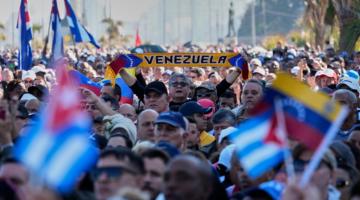
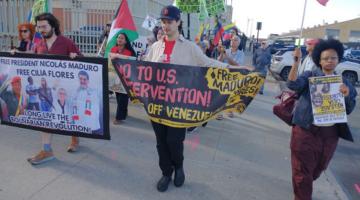 While Trump pardoned an actual drug lord president, he keeps a kidnapped Venezuelan president, Nicolas Maduro, and his wife, First Combatant Celia Flores, in a mold-infested Brooklyn jail on false…
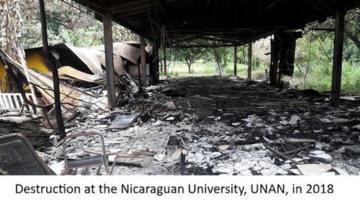 Jeffrey Isaac Jarquin was deported from the U.S. by ICE and upon arrival in Managua was sent to prison by Nicaraguan authorities. Corporate media has decried the detention of a “torture victim” and “…
 In this week’s segment, we discuss student protests by Black and brown youth in France against austerity measures and race-based inequality in the education system. But we begin with a discussion of…
 Brazil's incumbent president Lula da Silva finished second behind Flavio Bolsonaro in the first round of the presidential election. Because neither man received at least 51% of the vote, a run-off…
 Students in France are engaging in mass protests. Hundreds of them have been arrested and injured by police, and many schools are closed. Annick Metefia joins us from Paris. She is a member of the…


