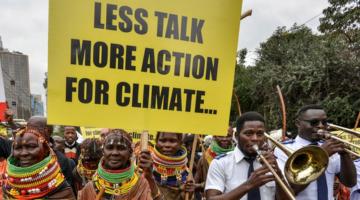
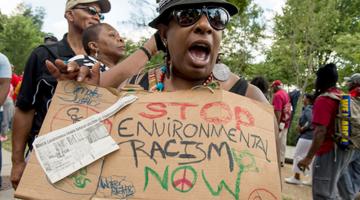
The climate movement will never be effective as long as it refuses to confront white supremacy within its own organizations and as a belief system which is unconcerned about Black and brown death.
This July was the second warmest on record and tens of thousands of Europeans have died this summer from complications associated with exposure to extreme heat. Climate change still ranks as low as 15th on what U.S. voters consider a key issue. Some years ago , Seattle-based journalist Charles Mudede wrote a piece entitled, “The Fact is Nothing is Going to be Done About Climate Change Until it Kills Lots of white People.” Mudede’s overall premise associates the lack of climate action with the fact that white lives are not as directly impacted by the climate crisis. At one point he declares, “What is between climate change and meaningful human action is simply white American lives. As long as they are not directly threatened, we can continue business as usual.” He then points out the difference between the response to those affected by climate-exacerbated storms in Texas/Florida last year, to the lack of a response for Puerto Ricans adding, “Those lives on that island are Black and Brown. They do not matter. Politically, the average white person only wakes up when it’s time to die.” Mudede touches on an issue that few people want to discuss — the relationship between white “supremacy” and climate change.
Climate change and white “supremacy: have a thing going on, and we’re not talking about a one night stand or two-week fling. They one-upped Jerry McGuire, as they had each other before, “Hello.” The moment their eyes met across the room, they were instant soul mates. #Brangelina, #Beniffer and #TomKat are done, but #WhiClimaSupremaChange won’t be breaking up anytime soon. This, in the words of Sade, is no ordinary love; it’s downright symbiotic. Known in biology as mutualism — here we see two interacting entities that benefit each other while jointly increasing their chances of survival or reproduction. These lovebirds wasted no time reproducing and decided to name their progeny oppression.
There’s consensus on how climate change operates. There’s less consensus on how white “supremacy” operates and what it even is. In her latest book, White Fragility, renowned scholar, Dr. Robin DiAngelo, refers to white “supremacy” as, “a descriptive and useful term to capture the all-encompassing centrality and assumed superiority of people defined and perceived as white and the practices based on this assumption.” For most people, the phrase “white supremacy” evokes an image of overt racists, like David Duke, tiki torch holders, and established hate groups. DiAngelo corrects this myopia while challenging us to distinguish between white supremacy and white supremacists, stating that the former, “does not refer to individual white people and their individual intentions or actions,” but to, “an overarching political, economic, and social system of domination.”
We rarely see institutions that form our collective society acknowledge and confront white “supremacy.” Our understanding of how it manifests and where it operates must improve if we are to understand its symbiosis with climate change, as this has direct implications for the climate crisis and how we address it. For instance, a recent study found that while, “climate deniers” tend to be older, white and Republican, they also tend to hold racist viewpoints. Writing for the Sierra Club’s magazine, Heather Smith declared, “…mixing of racism and politics when it comes to climate change is especially dangerous because, historically, whenever racism and government get together, some truly terrible policy is the result.” She is of course spot on, as we know the role that state-sponsored racism plays in the intentional siting of toxic facilities near, and unequal enforcement of environmental protection for frontline communities.
But we also have to address how the mixing of racism and climate activism impacts the institutions and organizations who portray themselves as justice seekers challenging systems of oppression. Because based on DiAngelo’s characterization of white supremacy, the climate community and its non-profit apparatus are littered with it. And until we clear this trash from our climate community spaces, we will never achieve climate justice in the space of our larger society or the planet.
Ask anyone who or what a “progressive” is, you’ll get more answers than asking someone who the greatest guitarist of all time is (the answer btw is Jimi Hendrix, and if you don’t believe me just listen to his “Live at the Fillmore” album with Band of Gypsies). Nonetheless, if you were to ask most white people active in the climate community if they are “progressive,” the majority would likely answer, “yes” — some more emphatically than others. That’s a good thing, right? Well, maybe not in the context of racism, white “supremacy” and climate change.
Dr. DiAngelo believes that, actually, “white progressives cause the most daily damage to people of color,” explaining that this is because, “to the degree that we think we have arrived, we will put our energy into making sure that others see us as having arrived. None of our energy will go into what we need to be doing for the rest of our lives: engaging in ongoing self-awareness, continuing education, relationship building, and actual antiracist practice.” — put that in your “progressive” pipe and smoke it.
Any melanin-blessed person who has worked for, or with, an historically white-led environmental non-profit has been waiting for a white person to say this as long as they have been waiting for climate liberation — and they are waiting for many more white people to say and embrace this as well. The people on the frontlines of the climate crisis, and the groups/organizations representing them, understand better than anyone that confronting racism and white supremacy is a prerequisite for achieving climate liberation. They also understand that this confrontation is especially necessary for environmental non-profits that facilitate more racism and white “supremacy” than too many are ready or genuinely willing to admit and accept. This unwillingness is due to white fragility.
“We consider a challenge to our racial worldviews as a challenge to our very identities as good, moral people,” DiAngelo says of white fragility, explaining, “Thus, we perceive any attempt to connect us to the system of racism as an unsettling and unfair moral offense.” She goes on to name the reactions that follow these challenges and connections to the system of white supremacy, which include, “anger, fear, and guilt and behaviors such as argumentation, silence, and withdrawal from the stress-inducing situation.”
Withdrawal from the challenges associated with climate change and white “supremacy” is simply untenable at this point in history. The stakes are too high for the climate community and the planet alike. And you have to ask yourself how some of the most ardent climate champions have found the ability to cope with the stress that comes with taking on powerful entities like the fossil fuel industry and political establishments, but not the stress that comes with dismantling racism/white “supremacy” in their own spaces? Whomever determines the answer to this riddle may be responsible for saving the world.
We’ve seen hundreds, if not thousands, of white folks putting it all on the line and their bodies in harm’s way to confront the climate crisis. Lockdowns to fossil fuel infrastructure and even right in front of the White House that led to arrest were documented on social media, as pictures were posted by white folks of themselves handcuffed by police like a badge of honor for the world to see (incidentally, this is a profound example of white privilege, because I don’t know too many Black folk who would be comfortable posting pics of themselves getting arrested on social media for various reasons — just sayin’). Yet for some reason, this same fervor does not exist when it comes to confronting their own institutions/organizations to demand that they come to grips with their own racism/white “supremacy.”
It almost makes me wonder if the words courage and valor are as interchangeable as we think. Personally, I think it’s rather craven to willfully risk arrest to address climate change on the one hand, while lacking the willingness to take on your organization/community to keep a job/reputation on the other. Cowardice of that kind comes with consequences that are preventing the climate community from saving itself and the world in the process. Yes, it takes courage to take on powerful entities like the fossil fuel cartels,, but it takes valor to look at yourself, your community and your organizations, and then confront them with even more vigor than you would your adversaries when you know they are not doing the right thing and must do much better.
The lack of diversity in environmental nonprofits is well documented, as is the discrepancy of funding for frontline/environmental justice groups vs. historically white-led groups. Numerous conversations have ensued, workshops and summits have been attended and anti-oppression trainings have been completed. Still, environmental nonprofits find themselves in the same place as in 1990 when the Southwest Organizing Project (SWOP) sent a letter to the so-called “Big Ten” environmental groups, which, among other things, proclaimed, “The lack of people of color in decision-making positions in your organizations such as executive staff and board positions is also reflective of your histories of racist and exclusionary practices. Racism is a root cause of your inaction around addressing environmental problems in our communities.”
I get that it may be shocking for some to come to grips with the reality that racism and white supremacy are alive and well in the climate “movement,” especially as it pertains to staffing and allocation of funding. But I think it’s even more shocking that the Boston Red Sox hired a Latino manager before any “major” environmental organization has hired a Black or Latino Executive Director. There’s way more to say about this, but let’s just say that when it comes to diversity, you’re really on the wrong side of history when the Red Sox, one of the last teams to have any Black players, achieves a milestone before you do.
SWOP’s letter held true then and it holds true now. Twenty-three years after it was written, melanin-blessed people are still seldom hired for leadership positions by environmental non-profits, even when they are more qualified than their white counterparts. A 2013 Washington Post article that discussed this issue and more included thoughts from Norris McDonald, president of the African American Environmentalist Association, who did not mince words, “This goes back a long way. It’s why I founded the [association] in 1985…white groups weren’t hiring Black professionals, and when they did, it was a hostile atmosphere. There were a handful of Black professionals in the environmental groups then, and there are a handful now.”
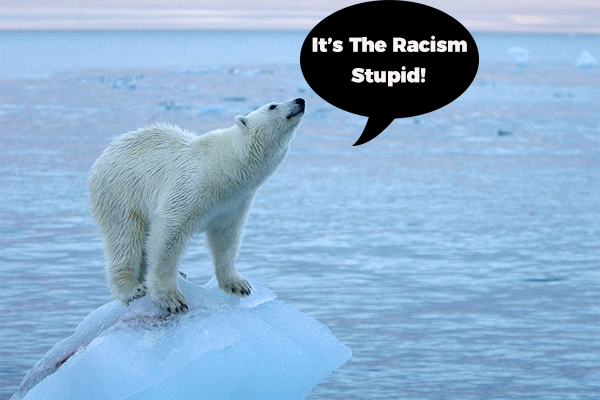
This is not progress. This is how white “supremacy” plays its hand and implicates “progressives” who seem to spend as much time defending themselves as non-racists as they do defending the planet. That said, as SWOP decried in 1990, unchecked racism/white supremacy, while (hopefully) unintentional, is the only explanation for the lack of diversity and melanin-blessed leadership in “mainstream” environmental groups– if it swims like a polar bear and looks like a polar bear, it’s a polar bear.
The homogeneity of the “Big Greens” may seem benign as I’m sure many hold the idea, “it doesn’t matter if mostly white people are in positions of leadership and decision-making if they are good people.” That’s really sweet and all, but if the people most impacted by the climate crisis are not in positions of leadership to address it, if they are not at the table, we have a very troubling story. Because the people at the table who are telling the story informs how the climate community operates, determines which issues are “worthy” of attention (and, yes, money). They also determine who gets to be at the table and who doesn’t. As Dr. DiAngelo reminds us, “The decisions made at those tables affect the lives of those not at the tables. Exclusion by those at the table doesn’t depend on willful intent; we don’t have to intend to exclude for the results of our actions to be exclusion.”
When marginalized people don’t have seats at the table to tell their stories, someone else will tell it for them. And when this is done, even with the best of intentions, it frequently leads to cultural appropriation and what I refer to as the, “Iniquitous Transmission of Urgency.” Kwame Ture (aka Stokely Carmichael) once said, “Those who have the right to define are the masters of the situation.” To this end, by allowing white people to be the primary storytellers of climate change, the primary ambassadors and the primary “experts,” we have, ipso facto, made them the masters of the climate “movement.” This has created an Alabaster Narrative that does not tell the full story, and too often has nothing to do with the people on the frontlines of the climate crisis. In turn, this creates a form of self-inflicted inertia that interrupts and even prevents galvanizing and mobilizing more people — something that is key for the climate “movement” to succeed and “win.” A whitewashed narrative simply does not allow for this and leads to many more causal effects that we largely take for granted.
Close your eyes and think of the names and organizations that come to mind when you think about climate change. Now ask yourself who and what is most impacted and who seems to have the best solutions and who are the leaders taking climate action. I’ve used this exercise with participants in numerous lectures and discussions I’ve led across the country, and the responses are consistent. The vast majority of the people who took part associate climate change/climate leadership with a white narrative engendered by white people and historically white-led organizations. Seldom have participants associated white supremacy with climate change, and never with the environmental “movement.”
Then I ask people to think about every article or email they’ve read on climate change and ask them to name one or two melanin-blessed writers on the subject. Not many people can name one as the primary email writer for an organization, nor the primary climate journalist for any publication, ranging from as far “right” as The Washington Examiner, to closer to the “center” like The New York Times, to as far “left” as In These Times or The Intercept. To understand how this form of unconscious racism impacts climate action and perpetuates the iniquitous transmission of urgency.
Ironically, if not paradoxically, by not naming white “supremacy” as a major function of climate change, and by not addressing its manifestations within “progressive” spaces and their own organizations, the professional environmental non-profit apparatus takes part in their own climate denialism. Discussing climate science may be less uncomfortable than talking about the role racism and white supremacy play in disproportionately impacting Black and Brown folk. And it’s certainly less discomforting than discussing the role racism/white supremacy plays in the climate “movement” itself. But embracing this discomfort has become necessary to dismantle the myriad systems of oppression that contribute to the oppressive system of climate change.
Yes, racism is a hot topic, but the best way to cool off is to address it head on. As one of my new favorite writers, Sam McKenzie, put it, “if white people can’t take the heat, then they should uproot the reasons for the fires — which is the old growth of white supremacy.” It was James Baldwin who said, “The truth which frees Black people will also free white people, but this is a truth which white people find very hard to swallow.” White folks and their organizations best take some throat lozenges STAT, because we will never address the climate crisis adroitly until we properly address the crisis of white “supremacy” in the institutions that claim to be addressing it. It would be like trying to play jazz before learning how to play the blues — you may pull it off, but it damn sure ain’t gonna swing.
Anthony Karefa Rogers-Wright is an international climate and environmental liberation advocate, a racial justice practitioner, and a writer and policy expert residing in the United States with his family and their mischievous cat, “Evil” Ernie. He is a proud and active member of the Black Alliance for Peace and the Movement for Black Lives. His radio program, “Full Spectrum with Anthony Rogers-Wright,” airs on the Mighty WPFW network every Tuesday at 6:00 PM EST.


 Abayomi Azikiwe, editor of the Pan-African Newswire, discusses Israeli recognition of the Somaliland region, the US reduction of sanctions on Eritrea, a new anti-government alliance in Ethiopia, and…
 The trope of the United States being in a state of decline is a common one, but it should not be accepted without scrutiny. The U.S. faces crises but remains dangerous, powerful, and single-minded in…
 The "Antifa summit" and the NSPM-7 represent another institutional step toward consolidating fascism in the United States by criminalizing opposition to fascism itself.
 “...the science for revolutionary change…is forged by human persuasion and building social consciousness based on the class analysis which sees the struggle against racism as central.”
 Symone Sanders interview with Hasan Piker exposed her as a bad-faith interlocutor who uses identity as a cudgel while remaining silent on the poverty, pollution, and police violence that plague the…


