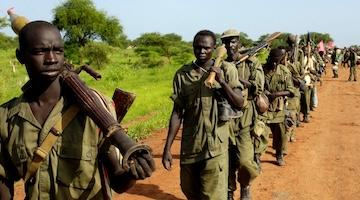
Images of the Eritrean War of Independence, 1961-1991.
As the militarization of the Red Sea escalates, the US tries to enlist Eritrea in exchange for sanctions relief.
The Wall Street Journal (WSJ) recently published a piece about US-Eritrea relations headlined “U.S. Seeks to Reset Ties With Reclusive but Strategically Vital African State.” Eritrea is the one African nation to have refused engagement with both AFRICOM and the IMF, and it has long been one of the most heavily US-sanctioned countries in the world, excluded even from the SWIFT system for conducting international financial transactions, like Russia and North Korea.
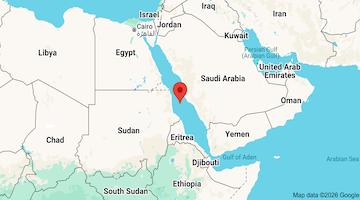
According to the WSJ report, the US is looking to finally lift some of the sanctions in hopes that Eritrea could become a “bulwark against Iranian influence.” It has 1,400 miles of coastline on the Red Sea, a crucial chokepoint for world trade, including roughly 13% of its oil. It also sits across from Yemen’s Ansar Allah, aka the Houthis, who disrupted Red Sea trade in 2025 and now threaten to do so again, even as Iran blocks trade in the Strait of Hormuz.
The WSJ writers quote former U.S. intelligence and State Department official Cameron Hudson, who asked what the US would get in return for lifting sanctions.
Multiple outlets published similar reports citing the Wall Street Journal. They included Semafor, which also quoted Hudson, who, in a single sentence, laid bare the entire logic of empire. “Every administration,” he said, “believes it can ‘tame’ Eritrean President Isaias Afwerki.” Not engage. Not respect. Not partner. Tame.
That word is not careless. It is ideological. It reflects a worldview in which African sovereignty is conditional, African leadership is a problem to be managed, and African geography is an asset to be seized and secured.
Democrats have at times been worse than Republicans with regard to Eritrea, but Trump heads the same empire that sanctioned it, attempted to isolate it, and so limited opportunity for its youth that many risked deadly migration routes. The same empire that justified this violence with phony narratives about democracy and human rights, as though these were ever its real concerns.
This is the same empire trying to crush Iran for refusing to submit, the same empire committing genocide in Palestine, waging aggression against Yemen, enforcing economic siege on Cuba and Venezuela, and keeping Haiti in a state of permanent breakdown through sanctions and intervention. The list is endless. This is not an empire that accepts sovereign partners. It disciplines those who resist it and uses those who submit. There’s no reason to imagine it will treat Eritrea any differently.
The Imperial Script: Isolate, Re-Engage, Destroy
As the United States, under Donald Trump, explores normalization with Eritrea, drawn by its Red Sea coastline, I hope the response will not be optimism about sanctions relief but alarm backed by memory because this is not new. It reveals an oft-repeated pattern. Leaders are isolated, then courted, then neutralized. States are pressured, then opened to Western interest, then destabilized.
The US lifted sanctions on Sudan, removed it from its laughable State Sponsors of Terrorism list, and arranged large World Bank loans after it signed the Abraham Accords, in January 2021, normalizing relations with Israel, but look at Sudan now. The United Arab Emirates, a close ally of the US and Israel, is using a ruthless, proxy militia to fight its sovereign forces, raid its resources, and turn it into the world’s worst humanitarian crisis.
The United States is not offering friendship; it is attempting to advance its position in a moment of imperial decline, dangling sanctions relief as an enticement to secure control of Eritrea’s strategic coastline. It does not deal with independent African states as equals. It cycles them through a pattern: isolate, pressure, re-engage, co-opt, and when necessary, destroy.
The fate of Muammar Gaddafi is the clearest warning. After years of Western sanctions and hostility, Gaddafi opened Libya to Western capital penetration and surrendered his nuclear weapons potential. He became vulnerable even as the West lifted sanctions and welcomed him back in their good graces, and French President Nicolas Sarkozy ominously shook his hand.
Gaddafi did not fall because he refused engagement. He fell because he accepted it. Libya’s sovereignty and its national oil company were still more than the West would tolerate. Like Venezuela, its oil wealth gave it the power to support the development of other African nations.
Gaddafi strategized to create an African currency with Ivory Coast’s nationalist President Laurent Gbagbo, who himself wound up in the clutches of the ICC in 2011, the same year that NATO unleashed its aerial bombing campaign on Libya. Gaddafi was hunted down and killed, and Libya was left in ruins. Once one of Africa’s most stable and prosperous states, it was reduced to fragmentation, competing governments, and militia rule.
Trump is not initiating engagement with Eritrea because he and the Republican Party are more supportive of the nation’s independence. They are not going to lift sanctions without exacting a price. Hopefully Eritreans remember the endgame that has followed rapprochement with the West.
Crushing the Axis of Resistance
The US hopes to enlist Eritrea in its war to crush the Axis of Resistance, an informal, Iran-led military coalition of state and non-state actors determined to stop the regional dominance of Israel, a nation created not only to satisfy Zionist fervor but also to enforce the empire’s control of West Asia. What sense could this make to one of the few African nations who have refused to allow US troops on their soil?
This is happening at a moment of the empire’s own desperation about its decline. It is losing its long uncontested dominance, and like all declining empires, becoming more aggressive in its attempts to secure what it can still control.
Some Eritreans seem open and even receptive to the idea of normalization with Washington. This is wholly understandable given the price that the country has paid for its fierce independence. Years of sanctions, isolation, and misrepresentation have created fatigue. The desire for space, for relief, for engagement is no doubt real.
Many will argue that Eritrea has suffered too much, for too long, and that what is needed now is reprieve. However, what that suffering has produced is not weakness, but a rare and proud political position on the world stage. Eritrea is a country that has already paid the costs of resisting at the very moment when the imperial system that imposed those costs is visibly fracturing and losing legitimacy.
Can the “normalization” of US-Eritrea relations proceed without becoming an entry point for US military architecture in the Red Sea? Isn’t the US hoping that Eritrea will quietly align with it against regional resistance movements, integrating into a system designed to control or destroy? Should that line be crossed, it would not be easily reversed.
Across the Global South, and in the politically conscious North, people are searching for countries that hold the line, that do not bend, that can anchor a different future. Eritrea is one of those countries. It has done so for over 35 years.
Ann Garrison is a Black Agenda Report Contributing Editor based in the San Francisco Bay Area. In 2014, she received the Victoire Ingabire Umuhoza Democracy and Peace Prize for her reporting on conflict in the African Great Lakes region. She can be reached at ann@anngarrison.com. You can help support her work on Patreon.

 Our guest is Dr. Gerald Horne, who discusses his newly republished International Publishers book, “Black and Red: Du Bois and the Afro-American response to the Cold War, 1944-63, the 40th anniversary…
 Donald Trump and Interim Venezuelan President Delcy Rodriguez have announced a 'historic' oil deal between the United States and Venezuela. Although the terms remain murky, the deal appears extremely…
 Hakeem Jeffries climbs the political ladder because he engages in dirty deeds with the world’s worst people. Being called a monkey gives him an easy out. The presence of a Black face in a high place…
 “To seize control of the political economy of the Midwest is to seize control over the political economy of imperialist America.”
 The victory of Somalia’s Northeast State over secessionist Somaliland gives Somalis hope of renewed unity and sovereignty, but Israel attacked that hope by recognizing Somaliland.


