by Danny Haiphong
When capitalism is sinking, the working class is drowning, and flails about for a life raft – like Power Ball. “Workers, especially the increasing numbers thrown out of the labor force, must possess a strong hope of individual gain within the confines of the capitalist system.” Power Ball and other gambling vices give them that hope – which relieves pressure on the system’s big winners: rich capitalists.
Power Ball and the American Psychosis of Capitalism
by Danny Haiphong
“Hopes to ‘win big’ through a scratch ticket are antagonistic to collective struggle and community development.”
Americans rushed to convenience stores and shops across the country on the week of January 11th to purchase lottery tickets for the new Power Ball jackpot, whose winners will get 1.5 billion dollars. One’s chances of winning the jackpot are microscopic. Yet lottery games such as the Power Ball have become a popular activity for America's poor and working class. Like a parasite that grows when latched onto a host, lottery sales increase in size whenever a new jackpot is revealed. The parasitic relationship between the lottery and the nation's poor is a quintessential example of the psychosis of capitalism.
The lottery cultivates the psychosis inherent in capitalist society through its deep penetration of US states around the country. States all over the US utilize the lottery to generate public revenue. The lottery takes from the wages of the poor and funnels it back into state governments committed to privatization and enrichment of Wall Street. Not only does the lottery impose a regressive tax on working class lottery players, but it also fails to generate the revenue necessary to fund critical services such as public education. Thus, the Power Ball represents nothing more than a scheme of finance capital to rob the working class.
“The lottery takes from the wages of the poor and funnels it back into state governments committed to privatization and enrichment of Wall Street.”
But the lottery acts as something more than just blatant, naked exploitation of the working class. As with any machination of world capitalism, the lottery possesses a deeply powerful ideological component. Lottery games impose the allure of instant wealth that aligns nicely with the historic "American Dream" promoted by the rich for centuries. The seduction of the "American Dream" supports the deep alienation of the capitalist system. Hopes to "win big" through a scratch ticket are antagonistic to collective struggle and community development. Rather, the hope of becoming rich plants the seeds of competition between workers and poor people.
Competition between workers and the poor allows the ruling class in the boardrooms of Wall Street and the corporate sector to sleep comfortably at night. The ruling class understands better than anyone on earth the necessity of not only automating the economic base of capitalism, but also the life of the worker. Workers, especially the increasing numbers thrown out of the labor force, must possess a strong hope of individual gain within the confines of the capitalist system. Without the alienation necessary to attach the exploited to the capitalist apparatus, the legitimacy of the system would be lost. When legitimacy is lost, the only act left for the victims of capitalism is rebellion.
Of course, the lottery cannot be separated from the larger forces of capitalist development that have allowed it to thrive. Capitalism is in a worldwide, prolonged, and arguably permanent crisis. The system is severely overextended and the profit rate on the decline. Overproduction is not just periodic, but constant. This has pushed the capitalist ruling class to wage an all out, global war for productivity, profits, and geopolitical dominance.
“Workers and poor people are little threat to the rule of the rich when their energy and frustration is channeled into the addiction of vices like lottery tickets.”
Workers have been the primary target of capitalist ruin in the US. Since the 1970s, wages have plummeted for the majority of workers. Most workers do not have 1,000 USD to their name. Eighty percent of the population is "near poor." Basic needs such as healthcare, education, and housing guarantee a lifetime of debt or are inaccessible altogether.
These conditions would be untenable without the militarization of the police and the expansion of the prison state. Together with the consolidation of the corporate media and the attack on all collective forms of organization in the US (i.e. unions), state repression has created an atmosphere of fear, alienation, and political immaturity nationwide. The lottery is a convenient tool for the ruling class to further automate the US workforce. Workers and poor people are little threat to the rule of the rich when their energy and frustration is channeled into the addiction of vices like lottery tickets.
Some activists on social media felt compelled to explain that the Power Ball jackpot could eliminate poverty if the spoils were divided evenly and then distributed to each person in the US. While the math is correct, the idea behind the calculation presents a critical problem. US capitalism is based on the enrichment of the owners of capital. Every aspect of the system is designed for this purpose. The 1.5 billion dollar Power Ball jackpot is a blip on the radar screen for bankers and monopoly capitalists raking in a monthly installment of tens of billions of dollars from the Federal Reserve alone. In the end, whether someone wins the jackpot or not matters little for the growing numbers of impoverished people inside of the US. What matters is that this small, but important tool of finance capital must be destroyed along with the system that made it.
Danny Haiphong is a writer and political analyst in the Boston area. He can be reached at wakeupriseup1990@gmail.com. His work can also be found at http://gianalytics.org/en/authors/danny-haiphong and has been published in CounterPunch, Center for Global Research, and TruthOut.

 Chile, Colombia, Bolivia, Honduras, Peru, and Costa Rica have all elected right-wing presidents in the past year, and most are open Trump allies. Brazil's runoff between Lula and Flávio Bolsonaro is…
 October 7, 2023, was not an isolated attack, but the culmination of generations of Palestinian imprisonment and resistance in Gaza, comparable to Nat Turner's rebellion. History will record the Al…
 The 2026 French uprising is a continuation of the anti-colonial struggle, rooted in the 1961 Paris massacre of Algerians and the ongoing neocolonial relationship between France and its former…
 Disregard for Palestinian rights is a feature of Israeli politics rather than a bug. The upcoming Knesset election will change nothing for Palestinians, because every candidate across the political…
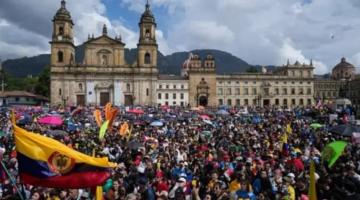 Thousands of people took to the streets across Colombia on Wednesday in the first national strike against President Abelardo de la Espriella’s administration, as police used tear gas, rubber bullets…



